
Niche E-Commerce Retailer: Zero to 84,000 Clicks With 42 Guest Posts
An Australian e-commerce store went from zero search visibility to 84,000 verified clicks and 2.12M impressions — with a Domain Rating under 10.
The Starting Position
An Australian e-commerce retailer selling a popular niche toy brand had launched their Shopify store but had zero organic search presence. No rankings, no traffic, no referring domains. The site was invisible to Google.
The market was competitive. They were an authorized retailer competing against the brand manufacturer’s own website (DR67), a major department store chain (DR74), and several established niche retailers — all with hundreds of referring domains already.
When we ran the initial link audit on July 1, 2025, the data told a blunt story:
The primary keyword — “[niche toy brand] australia” (35,000 monthly searches) — was languishing at position #23. Four of the eight target keywords were not ranking in the top 100 at all. Two had cannibalization errors. The site had product pages but Google had no reason to rank them over established competitors.
The Diagnosis
Our link audit analyzed eight target keywords across the homepage and key collection pages, benchmarking the client against three direct competitors per keyword.
The gap analysis revealed a clear pattern:
Based on the competitive scoring, the audit recommended 27 guest posts distributed across DR tiers:
The audit also identified the specific inner pages that needed direct backlinks: product category collections for bags, seasonal products, companion animals, and character lines.
The site had solid on-page fundamentals — the Shopify architecture was clean, collection pages were properly structured, and product categorization was logical. What was missing was entirely off-page: zero external endorsement from any source. Google had no evidence this retailer existed beyond its own domain.
The Campaign Architecture
We took the audit prescription and expanded it. Instead of the recommended 27 links over 4 months, we built 42 guest posts over 6 months (July–December 2025) — exceeding the recommendation by 56%.
The engagement operated at our Foundation tier throughout — the right entry point for a site launching from zero authority:
Every link, every anchor, every target URL was mapped directly from the gap analysis findings.
Anchor Strategy: From Audit to Execution
The link audit identified what anchors the competitors were using. We crafted our anchor distribution to match the natural patterns while filling the competitive gaps:
The 52% branded ratio kept the profile natural — exactly what you would expect from editorial mentions of a retailer. The 33% product anchors directed relevance to specific collection pages that the audit had identified as needing page-level signals.
Target URL Strategy: Matching the Audit
The audit identified which inner pages had the widest competitive gaps. The link distribution followed that intelligence precisely:
Host Site Quality
Every guest post was placed on a real editorial site with genuine traffic. No PBNs. No link farms. The sites were selected for topical relevance to the store’s market — parenting, children’s products, lifestyle, gifting, and consumer reviews.
Representative placements (described by category):
Average host site DR across all 42 placements: ~48.
The Evidence Trail
Month 1–2 (Jul–Aug 2025): First Signals
The first 14 guest posts went live. Within weeks, Ahrefs began registering the new referring domains:
GSC told a more detailed story. By August, daily clicks had risen from the 50–80 range to consistently breaking 100. The site began ranking for long-tail product queries as Google made the topical connection between the guest post content and the store’s product pages.
The primary keyword — “[niche toy brand] australia” — moved from position #23 to the mid-teens. Still page 2. But moving.
Month 3–4 (Sep–Oct 2025): The Breakout
14 more guest posts were delivered. This is where the curve bent sharply upward:
September averaged 127 clicks/day. By late October, the site was hitting 200+ clicks daily and regularly appearing on page 1 for competitive terms. The average position across all queries dropped from 15+ to below 9 — the site moved from deep page 2 to solidly page 1.
The keyword footprint expanded dramatically: from targeting a handful of terms to ranking for hundreds of niche-toy-related queries simultaneously. This is the compounding effect of topical authority — once Google recognizes a site as relevant for a topic cluster, new pages within that cluster rank faster.
Month 5–6 (Nov–Dec 2025): Peak Season Performance
The final 14 guest posts completed the campaign — timed to coincide with the holiday shopping season. This is a seasonal niche, and the timing was deliberate.
November 2025 saw the site cross 8,000 impressions per day. Daily clicks averaged 380, with peaks above 600.
December 25, 2025: 755 clicks in a single day. The highest single-day performance. The site was now appearing on page 1 for the primary keyword (35,000+ monthly searches), city-specific queries, product category searches, and dozens of commercial-intent terms.
The question was: was this just seasonal demand, or had we built something lasting?
Post-Campaign (Jan–Mar 2026): The Proof
After the campaign ended in December 2025, the traffic stabilized rather than collapsed:
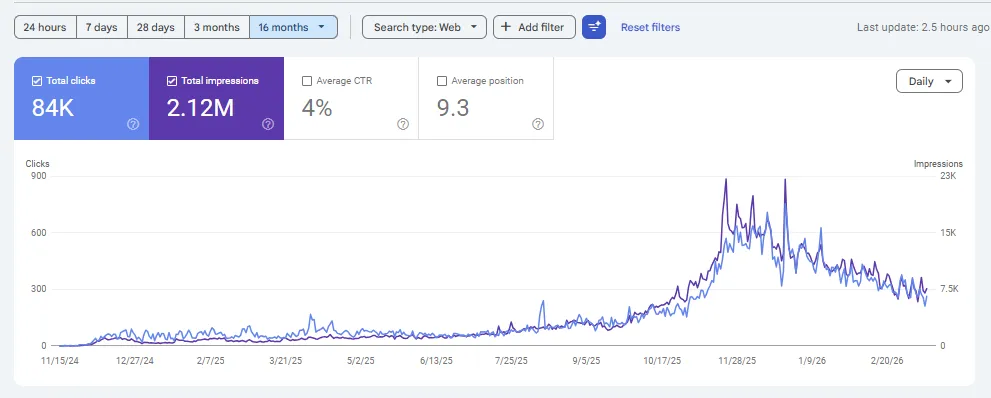
Keywords in the top 3 actually peaked in January 2026 at 68 — one month after the campaign ended. This latency is normal: Google continues to process and weight links for weeks after indexing.
Year-Over-Year: The Real Comparison
Because this is a seasonal product, the most meaningful comparison is the same period, year-over-year. Here is what GSC shows for the last 3 months compared to the same 3 months one year prior:
Over 1,700 queries now generate traffic — compared to a handful one year ago. The year-over-year comparison eliminates the seasonality argument entirely: same shopping period, same product demand, radically different results.
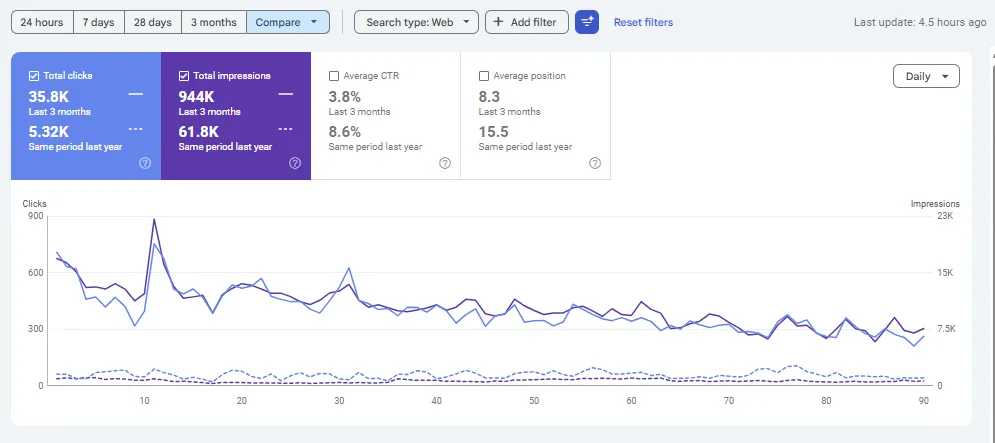
The variable that changed? 42 guest posts.
The Outcome
84,000 verified clicks from Google Search. Not estimated traffic. Not modeled data. Real clicks from Google Search Console, each one a potential customer landing on a product page — during peak shopping season.
The site now ranks for 1,700+ queries in its niche across Australia, covering product categories, city-specific searches, and commercial-intent terms. The branded search signal grew organically — the brand name now generates thousands of searches per month, a direct indicator that the guest posts created genuine brand awareness, not just link equity.
The site currently maintains 300+ daily clicks with zero ongoing link building. This is not a rental result. The authority was built; the rankings persist.
Estimated Revenue Impact
These are real product pages receiving real clicks from buyers with commercial intent. The store’s top traffic pages are product collections and individual product pages — not blog posts or informational content — so the visibility is concentrated on buyers searching for specific products.
A dollar figure depends on the store’s own conversion rate and average order value; those figures are pending client confirmation and are not published here. What the data does make clear is that the traffic is dominated by commercial-intent product queries, and that this picture does not yet account for:
- Returning customers who discovered the brand through search
- In-store purchases driven by the “store locator” queries (2,700+ clicks)
- Gift purchases with multiple items per order
- Brand awareness lift from 2.12 million impressions
Campaign ROI
For context: the link audit estimated the PPC cost to acquire equivalent traffic at $4,335 USD per month ($26,010 over 6 months). The campaign achieved the same organic visibility for 58% less — and the traffic continues after the spend stops. PPC stops the moment the budget runs out.
AI Visibility: An Unplanned Bonus
The campaign was designed for Google Search. But the authority signals have crossed over into AI platforms:
The site now appears as a cited source in 91 AI-generated responses across five platforms — a channel that did not exist as a meaningful traffic source when the campaign started. This is unpaid visibility generated entirely by the topical authority the guest posts created.
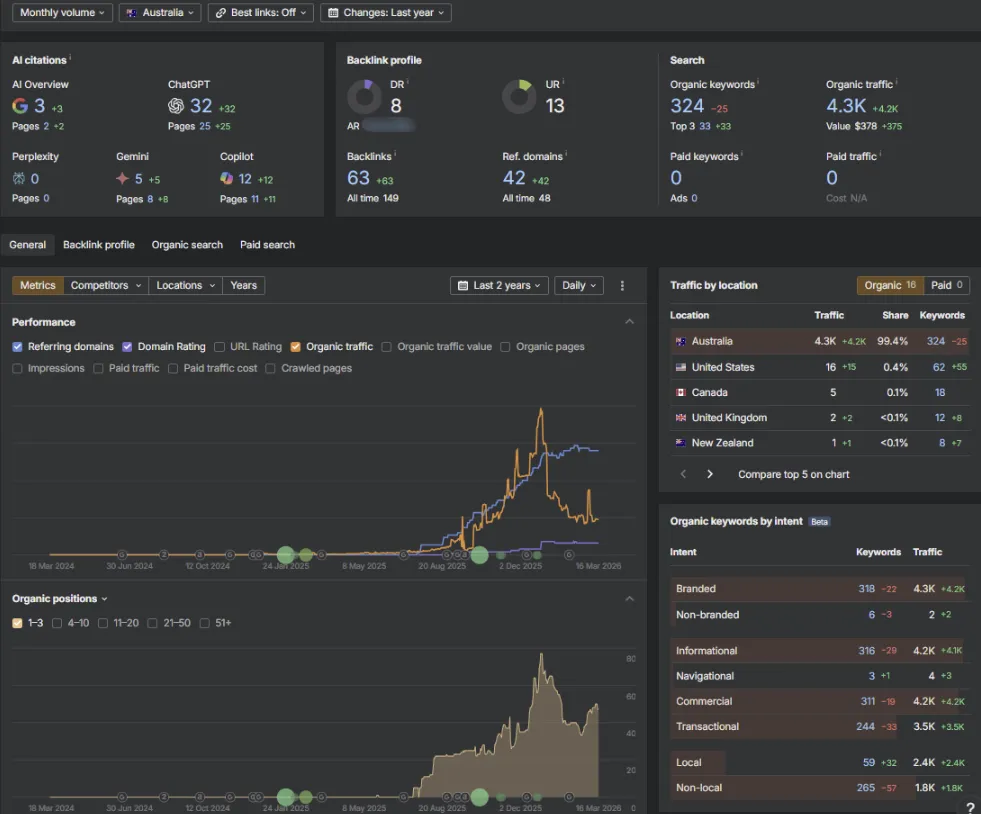
What the Data Shows
Precision Over Volume
Our link audit recommended 27 guest posts. We built 42. But the real story is not the quantity — it is the precision.
Every anchor text was mapped from the audit’s competitive scoring. Every target URL was selected based on which inner pages had the widest link gaps. The seasonal links went live in November and December, timed to capture holiday demand with freshly indexed authority signals.
The campaign did not shotgun links at the homepage and hope for the best. It followed a data-driven prescription, page by page, anchor by anchor.
Topical Relevance Over Raw DR
The most counterintuitive data point: Domain Rating 8.
The site accumulated 84,000 clicks while its DR barely broke single digits. Every competitor in the top 10 had a higher Domain Rating. The brand manufacturer sits at DR67. A major department store chain sits at DR74.
What mattered was not raw domain authority — it was topical relevance. Every guest post was placed on a site that naturally discusses children’s products, parenting, gifting, or consumer reviews. The content context matched the store’s inventory. Google did not need a DR50 signal to rank this site — it needed evidence that the retailer was a legitimate, contextually endorsed participant in its niche.
42 links from relevant, high-quality sources created enough topical consensus to compete with sites that had hundreds more backlinks but weaker contextual alignment for the Australian market.
Seasonality as Amplifier, Not Driver
The peak (755 clicks/day) coincided with the holiday shopping period. But the year-over-year comparison proves the rankings — not the season — drove the growth. Same shopping period one year prior: 2 clicks for the primary keyword. This year: 3,754.
The campaign provided the rankings. The season provided the search volume. Without the campaign, the season would have delivered nothing.