
Key Takeaways
- Google stores 25+ quality attributes per link — including the source page’s PageRank, spam score, independence rank, and content quality tier. Every link type in this guide is evaluated against those attributes.
- We score each backlink type across three dimensions — Trust, Authority, and Relevance — because those are the dimensions that determine whether a link contributes to source recognition or gets ignored.
- In our evaluation model, a fully relevant backlink can be roughly 4× more powerful than an irrelevant one from the same domain. Relevance is not a bonus — we treat it as a multiplier that compounds across the algorithmic, human-rater, and AI citation layers. (The 4× figure is Get Me Links’ own scoring heuristic, not a Google-published factor.)
- The highest-value types are editorial links, digital PR placements, and journalist citations. The lowest are PBN links, comment spam, and auto-generated links. The gap between them is not incremental — it is structural.
- Every type in this guide links to a dedicated deep-dive page where we break down the acquisition methodology, risk profile, and the specific patent signals that govern how Google processes that link.
Table of Contents
- The 4 Link Attributes Every SEO Must Know
- High-Value Backlink Types (Build These)
- Supporting Backlink Types (Use Strategically)
- Backlink Types to Avoid
- How Links Actually Build Source Authority
- The Strategic Question: Which Types Should You Invest In?
- FAQ
The 4 Link Attributes Every SEO Must Know
Before we get into specific backlink types, you need to understand the four HTML link attributes that modify how Google processes any link. These are not types — they are modifiers that any backlink can carry.
Dofollow backlinks
A dofollow backlink is the default. When a page links to you without any rel attribute, that link passes full equity.
Google stores the transmitted equity as pagerankWeight. The community reads this field as a per-anchor authority weight, but its precise derivation is inference, not documented — it most plausibly reflects the source page’s own graph authority rather than a confirmed raw formula. (Graph proximity to trusted seed sites is a separate signal, documented in the leak as PagerankNS — not pagerankWeight.) The classic PageRank model illustrates the underlying principle: equity is diluted across a page’s outbound links, so a link from a page with 10 outbound links passes roughly 100× more equity than the same page with 1,000. This is why link placement context matters as much as the source domain’s authority.
Read our complete breakdown of dofollow backlinks and how they affect your rankings.
Nofollow backlinks
The rel="nofollow" attribute tells Google not to pass equity through that link. Google introduced nofollow in 2005 to combat comment spam.
Since 2019, Google treats nofollow as a hint rather than a directive. Their systems may still crawl, index, and pass partial credit through nofollow links — especially when the source is authoritative. A nofollow link from The New York Times carries more signal than most dofollow links from unknown blogs. For human quality raters, the source’s reputation matters regardless of the HTML attribute. And for AI citation systems, the editorial context around the link matters more than whether it passes PageRank.
Sponsored backlinks
The rel="sponsored" attribute identifies paid or compensated links. Google introduced this in 2019 alongside the nofollow hint update. Read our dedicated guide on sponsored backlinks and compliance requirements.
Marking paid links as sponsored is not optional. Google’s SpamBrain system evaluates linking sites for commercial link-selling patterns. Sites flagged by SpamBrain’s link-spam classification (surfaced in the leak as spambrainLavcScore) can see their outbound links devalued, not just the unmarked ones.
UGC backlinks
The rel="ugc" attribute marks links from user-generated content — comments, forum posts, community contributions. It signals that the site owner did not editorially place the link.
UGC links carry minimal direct ranking value. Their primary benefit is discovery (Google’s crawler follows them) and topical co-occurrence — Google’s entity systems track where your brand appears alongside relevant topic discussions, and that pattern contributes to entity recognition over time.
High-Value Backlink Types (Build These)
These are the backlink types that consistently produce the strongest source authority signals. They share three characteristics: the source has real editorial independence, the placement carries genuine endorsement, and the surrounding context reinforces your topical relevance. When Google’s algorithms evaluate them, when human quality raters assess the linking domain’s reputation, and when AI systems scan for cited authorities — these links register positively across all three layers.
Editorial backlinks
An editorial backlink is placed by a writer or editor because your content earned the citation. No outreach. No payment. No reciprocal arrangement. Someone found your work valuable and referenced it.
Editorial links score the highest on every quality dimension Google measures. The sourceType classification places these links in the TYPE_HIGH_QUALITY tier — reserved for pages with real traffic and genuine user engagement. The mechanism that actually governs “links from pages people click” is Google’s Click-Validated Quality patent (US9558233B1), which ties link value to destination-side click and engagement behavior rather than to the linking page merely having traffic. The surrounding editorial context also generates strong context2 hash values because the linking text naturally contains topically relevant anchor text and surrounding terms.
But the multi-dimensional value goes further. Google’s human quality raters use editorial citations as primary evidence when assessing a site’s reputation — the Needs Met guidelines specifically evaluate whether authoritative sources reference the entity being rated. And AI systems trained on web corpora learn to associate cited sources with topical authority, which directly influences which brands get recommended in AI-generated responses.
The challenge: editorial links cannot be directly built. They are earned by creating content worth citing — original research, proprietary data, novel frameworks, or tools that solve real problems. Our editorial backlinks deep dive breaks down what Google measures at the per-link level, and our high-quality backlinks guide maps all 25+ quality attributes stored per link source.
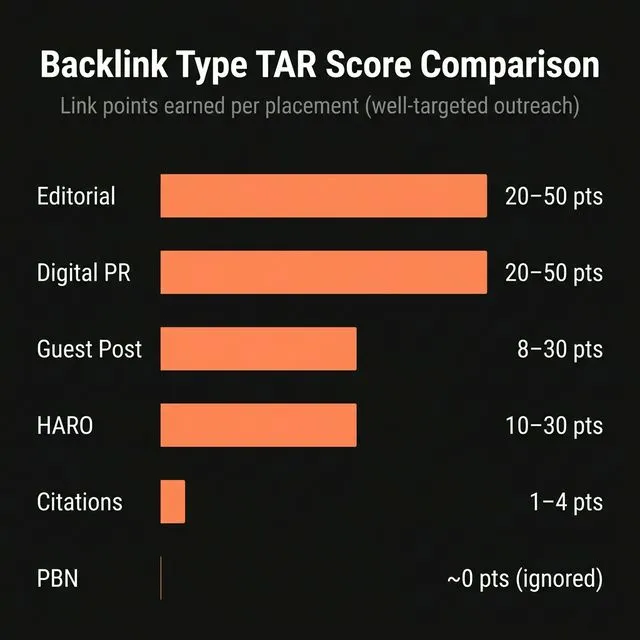
TAR Score: T5 · A5 · R varies — editorial links almost always come from trusted, authoritative sources. Relevance depends on the publisher’s niche.
Guest post backlinks
A guest post backlink comes from an article you write and publish on someone else’s website. You contribute expertise, they get content, and you receive a contextual link back to your site.
Google’s patent on reference contexts (US8577893B1, filed by Anna Patterson and Paul Haahr) confirms that the text surrounding a link matters as much as the anchor text itself. The fullLeftContext and fullRightContext attributes store the complete text around every link. A guest post where your link sits inside a genuine paragraph of relevant analysis passes significantly more value than a link dropped into an author bio.
The quality of the host site determines whether this link builds or undermines your authority. Google’s 3-tier sourceType system draws a hard line: a guest post on a site with real traffic (TYPE_HIGH_QUALITY) passes full PageRank signals, a mid-tier site (TYPE_MEDIUM_QUALITY) passes reduced signal, while a guest post on a zero-traffic site (TYPE_LOW_QUALITY) gets effectively ignored — regardless of the domain’s DR. Human quality raters evaluate these host sites independently, and a placement on a thin, content-mill blog creates a negative reputation signal that DR cannot capture.
This is the most common link type we deploy in client campaigns. The difference between a guest post that moves positions and one that gets ignored comes down to publisher selection — traffic, topical alignment, editorial independence, and content quality on the host site. Our buy backlinks page details how we vet publishers across these dimensions.
TAR Score: T4 · A4 · R4 — quality depends heavily on host site selection. Relevant hosts with real traffic produce strong links.
Link insertions / niche edits
A link insertion (also called a niche edit) is a backlink placed into an existing, already-indexed page. Instead of creating new content, your link is added to content that is already ranking and receiving traffic.
This approach leverages a specific advantage in Google’s systems. Patent US7346839B2 — authored by Matt Cutts and Jeffrey Dean — documents how Google uses historical data, including link age and velocity, as a trust signal: the existing editorial context and older, legitimate links on a page provide a protective buffer for a new insertion. (A separate Penguin-era field, penguinEarlyAnchorProtected, is often cited here, but its meaning is narrower and unconfirmed — it appears to grandfather pages that already had a clean anchor profile before spam appeared, not to confer a general “old page” status.)
The distinction between a valuable niche edit and a manipulative one is editorial integrity. A well-executed insertion adds genuine value — your resource fills a gap readers would benefit from. A poorly executed insertion contributes nothing, and Google’s anchorMismatchDemotion system catches irrelevant placements. Human quality raters evaluating these pages can see when an insertion is contextually jarring.
TAR Score: T4 · A4 · R4 — strong when the host page has traffic, the context is relevant, and the insertion adds genuine value.
Digital PR backlinks
Digital PR backlinks come from media coverage — news sites, industry publications, and established editorial platforms that cover your brand, data, or story.
These links trigger multiple quality bonuses simultaneously. Google stores an encodedNewsAnchorData attribute for links originating from news-quality sources, providing a direct quality indicator. The linking pages sit close to Google’s trusted seed set (Patent US9953049B1), which means the link distance is short and the equity transfer is strong — equity decays exponentially with each hop, so a 1-hop link from a seed-adjacent publication delivers materially more value than a link one or more hops further out. (The exact decay multiplier is not disclosed; the exponential-decay direction is what the patent establishes.)
Digital PR also generates brand consensus signals beyond the link itself. Unlinked brand mentions still register as entity signals — Google’s Entity Metrics patent (US10235423B2) scores name mentions as one component of an entity’s authority, and the Implied Links patent (US8682892B1) formalizes treating unlinked mentions like citations. When a news outlet writes about your brand without linking, that mention still registers as an entity association signal. And for AI systems, media coverage is one of the strongest indicators of source legitimacy — models are more likely to cite and recommend brands that appear consistently across authoritative publications.
Read our complete guide to PR backlinks and media link acquisition strategies.
TAR Score: T5 · A5 · R3 — trust and authority are consistently high. Relevance varies based on the publication’s topic alignment.
HARO / journalist backlinks
HARO (Help a Reporter Out) and similar journalist platforms connect subject-matter experts with reporters who need sources. When a journalist cites your expertise, the resulting backlink carries editorial endorsement from a publication with real readership.
These links score well because they satisfy quality signals across all three evaluation layers. Algorithmically, the source has real traffic (sourceType = HIGH_QUALITY) and the anchor text is contextually integrated with relevant surrounding terms (strong context2). For human quality raters, a journalist citation is primary evidence of expertise and reputation. And AI systems weight journalist-sourced expert quotes heavily when determining which entities have genuine authority in a topic area.
The scaling challenge is response rate. The practitioners who succeed treat it as a disciplined process — responding quickly, leading with credentials, and providing data rather than opinions. Wikipedia citations offer a related pathway — being cited on Wikipedia as a source triggers a citation cascade that generates editorial links downstream. See our guide on Wikipedia backlinks.
TAR Score: T5 · A4 · R3 — high trust (real publications), solid authority, relevance depends on topic match.
Resource page backlinks
A resource page backlink comes from a curated list of useful links on a specific topic. Libraries, universities, industry associations, and niche blogs maintain resource pages where they link to the best content on a subject.
Resource page links have a specific advantage: the source page typically has low outdegree relative to its authority. A university resource page with 20 curated links passes roughly 50× more per-link equity than a directory page with 1,000 links — a direct consequence of classic PageRank dilution (equity ÷ outdegree). This dilution concept is well established; the exact way it maps onto the leaked pagerankWeight field is inference, not documented.
The limiting factor is availability. High-quality resource pages are finite, and the best ones receive constant outreach. Targeting .gov and .edu resource pages delivers disproportionate value because these domains sit exceptionally close to Google’s seed sites. See also our guide to curated backlinks and list-based link acquisition.
Read our complete guide to .gov backlinks and government resource link acquisition.
TAR Score: T4 · A5 · R4 — resource pages from authoritative institutions score very well. Relevance is usually strong because the page is topically curated.
Embedded asset links
Embedded asset backlinks come from original resources that other sites reference or embed — calculators, interactive tools, infographics, data visualizations, benchmarks, or proprietary research. The linking site cites your asset and credits you with a backlink — and because those citations land in main content rather than boilerplate, they’re the kind of in-content placement that actually counts. Once the asset exists, the links accumulate passively, with no ongoing outreach.
The overlooked half: a linkable asset does two jobs, not one. A primary-research census of 200 calculator keywords (Ahrefs data, 2026) found the average real-business calculator carried 51.5 referring domains — against roughly zero for a normal content page (the median was 6; the distribution is heavily skewed). But for most businesses the links are the second prize. The first is traffic: the tool often becomes the single most-visited page on the entire site, with the links compounding on top. A dedicated tool site is a link magnet; a normal business’s calculator is a traffic engine that happens to earn links too.
Where a smaller site can actually win: the long tail. In that same census, small-business share of the top-3 results climbed from ~1% on head terms to ~23% in the long tail. The big terms — mortgage, BMI, currency — belong to governments, universities, and decade-old exact-match domains carrying thousands of links (nih.gov’s BMI page alone has ~8,800 referring domains). You don’t beat those. You win where no one has bothered to build the tool your niche keeps searching for.
Why it works runs deeper than the links — and it maps directly onto the signals earlier in this guide. A genuinely useful tool holds and answers its visitors (long clicks, no pogo-sticking back to the results page) — the engagement NavBoost rewards. It reads as high-effort, original work, which is what contentEffort and Google’s quality-scoring models are built to reward. And the biggest lever is internal: a page this well-linked becomes a strong internal seed, so through your own internal links its authority cascades — seed → source → resource — into the pages you point it at, per the Click-Validated Quality model. The asset doesn’t just rank itself; it lifts everything you connect it to.
Chase link equity, not link counts. The largest link totals are often the least valuable: one golf-handicap calculator in the census carried 1,775 referring domains, but roughly two-thirds were spam — directories, scrapers, bookmark farms — the exact links SpamBrain and click-validation already discount. The number that matters is the handful of real editorial linkers (a wedding-alcohol calculator earned DR-70 links from genuine wedding publishers because it solved a genuinely hard problem). Build for those; the junk that accumulates on top is harmless noise Google already ignores.
For AI citation, embedded assets carry particular weight. When LLMs train on pages that reference your data or tool, they learn to associate your brand with the underlying topic. Original data assets — calculators, benchmarks, proprietary research — generate exactly the entity-topic associations that make AI systems surface your brand in relevant queries. And the barrier to building one has collapsed: what used to require a developer and a budget now takes an evening with AI-assisted coding.
TAR Score: T4 · A4 · R4 — depends entirely on the quality and relevance of the asset and the sites that embed it.
Supporting Backlink Types (Use Strategically)
These backlink types provide legitimate value when used as part of a diversified link profile. They rarely move rankings on their own, but they contribute to the diversity signals Google measures through IndyRank — the independence metric stored alongside PageRank at the same uint16 precision. They also serve a different strategic function: establishing your entity’s presence across the web, which feeds into how quality raters assess brand reputation and how AI systems determine whether an entity is notable enough to recommend.
Business citations / directory links
Business citation backlinks come from structured directory listings — Google Business Profile, Yelp, industry-specific directories, and local business aggregators. They provide name, address, phone number, and a link to your website.
Citations primarily serve entity validation. Google’s Knowledge Graph uses consistent NAP (Name, Address, Phone) data across directories to verify that your entity is real. For link equity, the value is modest — directories have high outdegree, which dilutes per-link PageRank significantly. But for entity recognition — used by both quality raters and AI systems to confirm a business exists and operates legitimately — citations are foundational.
Focus on authoritative, curated directories rather than mass submissions. A listing on a Chamber of Commerce site or an industry association directory passes meaningfully more value than a listing on a generic free directory.
TAR Score: T3 · A3 · R2 — trusted sources but high outdegree dilution. Relevance is usually low unless the directory is niche-specific.
Testimonial backlinks
A testimonial backlink comes from providing a genuine testimonial for a product or service you use. The company publishes your testimonial on their site with a link back to yours.
These links are low-effort and legitimately editorial — you are providing genuine feedback, and the company has editorial discretion over whether to publish it. The SEO value is moderate. Testimonial pages tend to have moderate outdegree and decent authority, but the surrounding context (fullLeftContext, fullRightContext) is focused on the product being reviewed rather than your topic.
TAR Score: T3 · A3 · R1 — trust and authority depend on the company’s domain. Relevance is typically low because the context is about their product.
Podcast and webinar backlinks
Podcast and webinar backlinks come from appearing as a guest on audio or video content. The host publishes show notes with a link to your site. Some podcast hosts also embed links in episode descriptions on Apple Podcasts, Spotify, or YouTube.
These links carry a unique advantage: the surrounding content typically includes your name and credentials, which reinforces entity recognition. Consistent podcast appearances build a visible expertise footprint across multiple trusted domains — the kind of cross-domain author/expertise association Google’s entity systems track. (An “author vector” patent, US11275895B1, is sometimes cited for this mechanism; we have not been able to verify that patent number against a primary source — treat it as unconfirmed, pending manual validation.) For AI systems, this is particularly relevant — models learn entity-expertise associations from exactly these kinds of cross-domain mentions. YouTube backlinks operate on similar principles but with Google’s native video platform advantages.
TAR Score: T3 · A3 · R3 — quality varies widely. Industry-specific podcasts with real audiences outperform generic interview shows.
Badge and sponsorship backlinks
Badge backlinks come from sponsoring events, open-source projects, or organizations that display a sponsor badge linking to your site. Scholarship backlinks follow a similar pattern — you fund an award and receive a link from the institution’s scholarship page.
The link equity depends entirely on the source. A sponsorship badge on a conference website with 30 sponsors passes modest value. A badge on a high-authority .edu page with 5 sponsors passes significant value because the low outdegree concentrates the equity transfer.
TAR Score: T3 · A4 · R2 — authority can be high (especially from .edu or conference sites). Trust and relevance vary.
Social media backlinks
Social media backlinks originate from profiles and posts on platforms like LinkedIn, X (formerly Twitter), Facebook, and Reddit. Nearly all social links carry rel="nofollow" or rel="ugc" attributes.
Social links pass minimal direct ranking equity. Their primary value is discovery (Google’s crawlers follow them) and referral traffic. It’s tempting to credit this to NavBoost, but NavBoost scores clicks on Google search results — a visitor arriving from a LinkedIn post did not come from a SERP, so “return-to-SERP” behavior does not apply to that traffic. Off-platform engagement is at best an indirect, unproven signal, more plausibly reflected in brand-usage proxies (Chrome-usage and direct-navigation) than in NavBoost. The documented click mechanism — how pages that earn genuine clicks build trust — is described in Google’s Click-Validated Quality patent (US9558233B1). For AI systems, social sharing patterns are an indicator of content quality and brand relevance.
Read our complete guide to social media backlinks and their indirect ranking effects.
TAR Score: T2 · A2 · R2 — minimal direct link value. Real value comes from traffic and engagement signals.
Forum backlinks
Forum backlinks come from contributing to online communities — Reddit, Quora, niche forums, and discussion boards. These links are typically UGC-attributed and carry minimal direct equity.
The strategic value of forum links lies in topical reinforcement rather than authority transfer. A well-placed, genuinely helpful forum response on a topic related to your content builds brand consensus — the state where enough of the internet connects your brand to a specific topic. Google’s systems track co-occurrence patterns as entity relationship signals. And AI systems trained on forum discussions learn which brands get recommended by practitioners — a Reddit thread where experienced SEOs recommend your tool carries real weight in how LLMs learn brand-topic associations.
Read our complete deep dive on forum backlinks, UGC signal value, and community-driven link strategies.
TAR Score: T2 · A2 · R3 — low authority transfer, but high relevance when forums are topically aligned.
Backlink Types to Avoid
These backlink types carry risk that outweighs their potential value. Google’s multi-layered detection systems — Penguin (rule-based), SpamBrain (neural network), and temporal velocity analysis — identify these patterns with increasing accuracy. It’s worth being precise about the response: SpamBrain generally neutralizes manipulative links (it withdraws the borrowed authority, silently, with no manual action or Search Console notice, affecting both buyers and sellers), whereas outright penalties and manual actions are reserved for the most egregious cases. Quality raters actively flag these sources during reputation research. And AI systems, trained on editorial-quality corpora, simply do not learn from the content where these links appear.
PBN backlinks
A Private Blog Network (PBN) is a collection of websites built or acquired specifically to create artificial backlinks. The sites exist only to pass link equity — they have no real audience, no genuine content, and no editorial standards.
Google detects PBNs through multiple overlapping systems. IndyRank measures source independence and diversity — PBN links from related, non-independent sources produce low IndyRank scores even when PageRank appears high. Patent US7953763B2 describes how Google computes the derivative of the PageRank function to detect link farms — nodes whose PageRank is disproportionately influenced by a small number of sources get flagged.
The most reliable detection mechanism is sourceType classification. PBN pages whose links nobody selects — the norm for zero-engagement networks — tend toward TYPE_LOW_QUALITY, effectively a blackhole where links are stored but ignored. What sinks them is weak source quality and no genuine engagement, not raw traffic alone. Human quality raters who encounter these sites during reputation research will rate the linked entity’s credibility lower. And AI systems never learn from PBN content because it is not part of the editorial web.
TAR Score: T0 · A1 · R1 — fails the trust gate entirely. Even high-DR PBN domains pass negligible value because the individual pages have no traffic.
Auto-generated / scraped links
Auto-generated backlinks come from software that creates links at scale — scraped content sites, auto-generated directories, and content spinning operations. These links share common patterns: duplicate or near-duplicate content, randomized anchor text, and zero user engagement.
Google’s Helpful Content System specifically targets thin, auto-generated pages. The spambrainLavcScore attribute evaluates pages for “Low-quality Auto-generated Vast Content” — a direct signal for identifying content mills that exist solely for link infrastructure.
Read our guide on unnatural backlinks and algorithmic detection patterns.
TAR Score: T0 · A0 · R0 — provides no positive signal and creates measurable negative signal.
Comment spam links
Comment spam backlinks appear in blog comments, forum signatures, and guestbook entries — placed not for community contribution but for link placement. They were effective in the early 2000s. They have not been effective for over a decade.
Google’s anchorMismatchDemotion system applies penalties ranging from 0 to 1,023 when anchor text does not match the page’s topic. A comment about “best SEO tools” on a cooking blog triggers maximum demotion. This penalty is not just applied to the spammed link — it creates negative signal for the target page’s anchor profile.
TAR Score: T0 · A0 · R0 — no positive signal, measurable negative signal, trivially detectable.
Link farm / excessive reciprocal links
Link farms are networks of sites that primarily exist to exchange links. Excessive reciprocal linking — where two sites agree to link to each other across dozens of pages — triggers Google’s affiliated source detection.
Patent US7783639B1 describes affiliation-aware PageRank. Multiple links from affiliated documents get consolidated. Google identifies affiliation through shared hosting, similar content themes, cross-linking patterns, and registration ownership. Ten links from ten sites you control does not equal 10× the equity.
Read our guide on toxic backlinks and link profile risk management.
TAR Score: T1 · A1 · R1 — some reciprocal links are natural (partners, suppliers). The risk emerges at scale.
Hidden / injected links
Hidden backlinks are placed through CSS manipulation (display:none, white text on white background), JavaScript injection, or hacking. They are invisible to users but readable by crawlers.
Google’s rendering infrastructure (the Web Rendering Service based on headless Chromium) renders pages fully. Hidden links visible only in source code but not in the rendered DOM get flagged. Injected links from hacked sites create severe trust problems — not just for the individual link but for the target site’s entire link profile. Sitewide backlinks from legitimate partnerships are sometimes confused with manipulative patterns — our guide explains the distinction.
Read our guide on hidden backlinks and penalty recovery.
TAR Score: T0 · A0 · R0 — maximum risk. Can trigger manual actions that affect the entire domain.
How Links Actually Build Source Authority
Every backlink type above gets a score, but the scoring is a simplification. What actually determines whether a link contributes to your brand’s source authority is how that link registers across three independent evaluation layers — and whether the signals from those layers reinforce each other.
The algorithmic layer — Trust, Authority, Relevance
Google’s internal systems evaluate links using 25+ attributes per link, 40+ attributes per anchor, and multiple cross-referencing systems that check temporal patterns, source independence, and semantic alignment.
Trust is a binary gate. A backlink only enters quality evaluation if the source passes a basic threshold: real editorial content and genuine engagement — its links actually get selected. Google’s sourceType attribute classifies pages into quality tiers. Editorially strong, well-engaged pages sit toward TYPE_HIGH_QUALITY; pages whose links nobody engages with sit toward TYPE_LOW_QUALITY — a tier where links are stored but effectively ignored.
The homePageInfo attribute provides a 4-level trust classification: NOT_HOMEPAGE, NOT_TRUSTED, PARTIALLY_TRUSTED, and FULLY_TRUSTED. Patent US9953049B1 (Seed Distance PageRank) describes the underlying relationship: link equity decays exponentially with graph distance (the number of link hops) from Google’s manually curated seed sites. The patent measures distance in link hops, not traffic — proximity to the seed set is a property of the link graph, not a reward for commercial traffic.
Read our detailed breakdown of trustworthy backlinks and source verification criteria.
Authority measures the source’s domain strength. Google measures this through PageRank (stored as uint16, 0–65,535 levels of precision), nsr (Normalized Site Rank, 0–1,000), and indyrank (source independence, also uint16 0–65,535). DR correlates with these metrics because both measure inbound link quality and volume from diverse sources.
But DR misses critical factors. It does not capture outdegree dilution — a DR70 page with 10 outlinks passes 100× more PageRank than the same page with 1,000 outlinks. It also misses IndyRank — a DR70 built from PBN links registers very differently than a DR70 built from diverse, independent sources. Read our guide on natural backlinks to understand how earned links build the strongest authority profiles.
Our high-quality backlinks deep dive maps all 25+ quality attributes Google stores per link source.
Relevance operates as a multiplier. Google’s phrase-based indexing patent (US7536408B2) builds co-occurrence matrices between phrase pairs. When a linking page contains phrases that predict your page’s topic, the link gets validated as semantically legitimate. When the phrases do not match, the link gets flagged.
| Context | Multiplier | Effect |
|---|---|---|
| Both website and page are irrelevant to your niche | 0.5× | Base value halved |
| Either website or page is relevant, not both | 1.0× | Baseline |
| Both website and page are topically aligned | 2.0× | Base value doubled |
In our model, a fully relevant backlink is ~4× more powerful than a fully irrelevant one — the compounding effect of stacking multiple relevance signals (this multiplier is Get Me Links’ scoring framework, not a documented Google factor). The underlying signals are real and documented: the anchorMismatchDemotion attribute applies penalties of 0–1,023 when anchor text does not match, the context2 hash captures the semantic fingerprint of surrounding text, and the Reference Contexts patent (US8577893B1) confirms that rare words near the link carry independent ranking weight.
Read our guides on niche-relevant backlinks and contextual backlinks for detailed strategies.
The human evaluation layer — Quality raters and E-E-A-T
Google’s quality raters assess websites against the Experience, Expertise, Authoritativeness, and Trustworthiness (E-E-A-T) guidelines. The types of sites that link to you directly influence the reputation score raters assign.
A brand that is cited by industry publications, referenced in educational resources, and quoted by journalists receives a higher reputation assessment than a brand whose backlink profile consists of directory listings and sponsored posts — even if both profiles have similar DR distributions.
This is the layer where link type selection has its most visible impact. Raters are instructed to search for independent reputation evidence. Editorial citations, PR coverage, and expert quotes in legitimate publications are exactly the evidence they look for. PBN links, comment spam, and thin guest posts on content mills are exactly the evidence that lowers the assessment.
The AI citation layer — How LLMs choose which brands to recommend
Large language models — ChatGPT, Gemini, Perplexity — are trained on large-scale web corpora. The editorial patterns in that training data directly influence which brands these systems recommend.
When your brand is consistently cited by authoritative publications, referenced in expert analyses, and appears in editorial contexts across the web, AI systems learn to associate your brand with the relevant topic. When a user asks an LLM “who are the best [providers] for [service],” the model draws on those learned associations.
This is not theoretical. Brands with strong editorial backlink profiles — the kind built from genuine citations, PR coverage, and expert contributions — appear in AI recommendations more frequently than brands with stronger DR but weaker editorial signals. The link types that build algorithmic authority are the same ones that build AI citability.
The scoring framework
Link Value ≈ Trust (pass/fail) × Authority (DR bracket /5) × Relevance (0.5–2.0)Example 1: Editorial link from a DR70 niche-relevant SEO blog with 5,000 monthly visitors.
- Trust: ✅ Pass (5,000 > 1,000 threshold)
- Authority: 4/5 (DR70 bracket)
- Relevance: 2.0 (both site and page cover SEO topics)
- Score = 4 × 2.0 = 8.0 / 10 — strong link across all three layers
Example 2: Forum comment from a DR90 general news site with 500,000 monthly visitors.
- Trust: ✅ Pass (500,000 visitors)
- Authority: 5/5 (DR90 bracket)
- Relevance: 0.5 (neither the site nor the page covers your niche)
- Score = 5 × 0.5 = 2.5 / 10 — weak despite high authority. Quality raters find no topical endorsement. AI systems learn no relevant entity association.
The Strategic Question: Which Types Should You Invest In?
The answer is not “build all of them.” Link building without competitive intelligence produces a diversified profile that does not move positions. The answer starts with understanding what your competitors’ link profiles look like, where the authority gaps are, and which link types will close those gaps most efficiently.
| Backlink Type | Strategic Role | TAR Potential | Best For |
|---|---|---|---|
| Editorial | Highest-leverage source signal. Cannot be bought — must be earned. | 10/10 | Established sites with content worth citing |
| Guest Posts | Scalable authority transfer with editorial context. The workhorse. | 8/10 | Sites at any growth stage |
| Link Insertions | Authority from established, indexed pages. Compound value. | 8/10 | Sites with content gaps to fill on existing pages |
| Digital PR | Seed-proximity + brand consensus. Highest compound return. | 9/10 | Brands with data or stories worth covering |
| HARO / Journalist | Expert citation from real publications. Strong E-E-A-T signal. | 8/10 | Subject-matter experts with credentials |
| Resource Pages | Low-outdegree, high-authority. Concentrated equity transfer. | 8/10 | Sites with genuinely useful resources |
| Embedded Assets | Passive acquisition. Compounds over time. | 8/10 | Long-term investment in linkable resources |
| Citations | Entity foundation. Not a ranking lever — a validation layer. | 4/10 | New sites establishing entity presence |
| Podcasts / Webinars | Entity recognition + expertise footprint. | 5/10 | Personal brands and thought leaders |
| Forum / Social | Topical co-occurrence + engagement signals. | 3/10 | Brand awareness, community building |
For new sites (DR 0–20)
Start with entity validation: business citations, social profiles, and a few genuine testimonials. These do not move rankings, but they establish your entity in Google’s Knowledge Graph and build baseline IndyRank diversity. Then layer in guest posts on relevant sites with real traffic. At this stage, five well-placed links from topically relevant, trafficked publications outperform fifty from random domains.
For growing sites (DR 20–50)
This is where strategic link building produces the highest ROI — and where competitive intelligence determines success or failure. Guest posts on relevant, trafficked sites, link insertions, and HARO should be your primary channels. Start creating embedded assets (data studies, tools, original research) that earn editorial links passively. Digital PR becomes viable once you have data worth pitching. The goal at this stage is closing specific authority gaps identified through competitor backlink analysis — not accumulating volume.
For established sites (DR 50+)
The marginal value of another guest post diminishes at this level. Focus shifts to editorial links earned through exceptional content, digital PR campaigns that generate coverage on seed-adjacent publications, and embedded assets that compound. The strategic objective evolves from closing gaps to building the kind of editorial consensus that algorithms, quality raters, and AI systems all interpret as source authority — the state where the web independently recognizes your brand as the origin of truth in your category.
This is the progression we design for every client engagement. A backlink profile built with this architecture does not just improve rankings. It engineer’s your brand’s recognition as a source — the entity that humans go to, algorithms score as authoritative, and LLMs cite by default.
FAQ
What are the most valuable types of backlinks?
Editorial backlinks from trusted, relevant publications consistently deliver the strongest signals across all three evaluation layers. Algorithmically, they come from TYPE_HIGH_QUALITY sources close to Google’s seed sites. For quality raters, they serve as primary reputation evidence. For AI systems, they build the editorial consensus that drives brand recommendations. Digital PR placements and HARO citations share these characteristics.
Do nofollow backlinks help SEO?
Since 2019, Google treats nofollow as a hint rather than a directive. Their systems may crawl, index, and pass partial signals through nofollow links from authoritative sources. Beyond the direct algorithmic effect, a nofollow link from a major publication provides referral traffic, brand recognition, and entity association signals — which influence ranking systems through indirect channels (brand-usage and engagement signals) rather than through NavBoost, which scores clicks on search results.
How many backlinks do I need to rank?
The number matters less than the quality distribution and how it compares to your competitors’. Google’s Vital/Good/Bad link quality classification (Patent US9002832B1) evaluates the proportion of high-quality links in your profile, not the total count. Ten editorial links from niche-relevant, trafficked sites outperform 1,000 directory submissions. The right answer comes from analyzing what the sites currently ranking for your target keywords have — and engineering a profile that closes the specific gaps.
▶ Alejandro Meyerhans on how many backlinks you really need to rank.
Are PBN backlinks still effective?
PBN links are increasingly ineffective and carry growing risk. Google’s IndyRank measures source independence — PBN links from non-independent sources produce low scores regardless of PageRank. The sourceType 3-tier system classifies zero-traffic PBN pages as TYPE_LOW_QUALITY. SpamBrain’s neural network identifies link-selling patterns with increasing accuracy. And PBN content never influences AI systems because it exists outside the editorial web.
What is the difference between backlinks and referring domains?
A backlink is a single link from one page to another. A referring domain is a unique website that links to you — it may contain one or many individual backlinks. Google’s RedundantAnchorInfo system actively drops redundant links from the same domain. One quality link per domain carries more strategic value than many links from the same source.
How do we evaluate which backlink types a site needs?
Every engagement starts with a competitive gap analysis. We extract the top-ranking competitors’ backlink profiles, map the authority distribution by link type, identify where the gaps are, and design a campaign that closes those gaps with the highest-leverage link types. The methodology is grounded in the same patent-backed signals described on this page. Request your gap analysis →
Last updated: April 2026. Each backlink type above links to a dedicated deep-dive covering the acquisition methodology, risk profile, and patent-backed evaluation criteria.