
- A natural backlink is a link that another website places to your content without being asked — earned purely because your content provided value worth referencing.
- Google’s leaked API does not contain an attribute that distinguishes “natural” from “built” links. The same quality factors —
pagerankWeight,sourceType,context2,siteFocusScore— are applied to all links regardless of how they were acquired. - What the algorithm detects is quality patterns, not acquisition methods. A well-built link from outreach that satisfies all 6 quality factors produces identical signals to a naturally earned link that satisfies the same factors.
- Natural backlink profiles have distinctive anchor text distributions — dominated by brand mentions and generic anchors, with exact-match keywords comprising less than 10% of the profile. Manipulated profiles invert this ratio.
- The real value of natural backlinks is sustainability: they accumulate over time as content continues to provide value, creating a compounding growth curve that no amount of outreach can replicate at scale.
Every SEO guide tells you to “earn natural backlinks.” The advice implies that natural links are somehow superior to links acquired through outreach, guest posting, or any form of active link building.
The leaked API documentation tells a different story. Google’s link scoring system doesn’t measure how a link was acquired. It measures the quality signals the link produces. A natural link from a low-quality, irrelevant page carries less ranking power than a proactively built link from a high-quality, niche-relevant article — because the quality factors, not the acquisition method, determine the signal.
That said, natural backlinks have structural advantages that make them the foundation of any healthy link profile. In this article, we explain why — and why the natural vs. built distinction is less important than the industry assumes.
What Is a Natural Backlink?
A natural backlink is a link that another website places to your content without any direct outreach, request, exchange, or transaction. The linking publisher discovered your content independently and decided it was worth referencing.
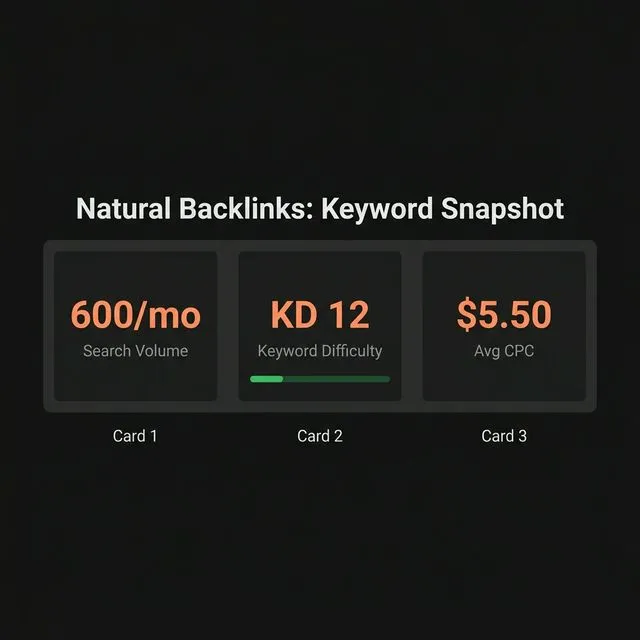
Examples of natural backlinks:
- A blogger citing your research study in their article after finding it through Google
- A journalist referencing your tool or data point in a news piece
- A forum user sharing your resource in a thread because it answered someone’s question
- An educator linking to your guide as a recommended reference for students
The defining characteristic is zero intervention from you. You published the content, and the link was a consequence of the content’s value — not your outreach effort.
Google Cannot Distinguish Natural from Built
This is the insight that changes the natural-vs-built conversation: Google’s link scoring system has no “natural link” detector.
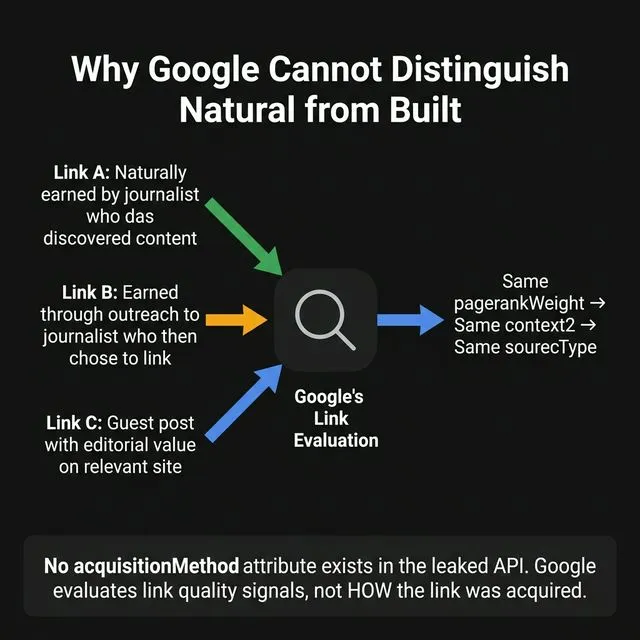
The leaked API documentation reveals the signals Google uses to evaluate every link:
| API attribute | What it measures | Natural vs. built? |
|---|---|---|
pagerankWeight | Authority of linking page | Identical for both |
siteFocusScore | Domain topical focus | Identical for both |
context2 | Surrounding text alignment | Identical for both |
sourceType | Editorial classification | Identical if placement quality matches |
lastLongestClicks | User engagement | Identical if page quality matches |
anchorMismatch | Anchor-topic alignment | Identical if anchor is appropriate |
There is no acquisitionMethod attribute. No wasOutreachUsed flag. No signal that distinguishes a link earned passively from one earned through a pitch email.
What Google does detect is pattern-level quality:
- Links from low-quality pages → low
pagerankWeightregardless of how acquired - Links with keyword-stuffed anchors →
anchorMismatchflag regardless of how acquired - Links from irrelevant domains → low
siteFocusScoreregardless of how acquired - Links with no surrounding context → no
context2signal regardless of how acquired
The algorithm cares about what the link looks like, not how it got there. A high quality backlink is a high quality backlink — whether it was earned naturally or built through strategic outreach.
Based on our reading of the API leak and link-related patents: No filing or leak document we’ve reviewed distinguishes between natural and built link acquisition. Google’s approach is signal-based, not method-based — which is the only scalable approach when indexing trillions of links.
Why Natural Backlinks Still Matter
If Google can’t tell the difference, why do natural backlinks matter? Because of structural advantages that outreach-built links rarely replicate:
Advantage 1: Anchor text diversity
Natural backlinks produce organically diverse anchor text distributions. When people link to your content without instruction, they use whatever text makes sense in their context — brand names, generic phrases, partial descriptions, naked URLs. This creates the diverse anchor profile that Google’s link spam classifiers expect to see.
Built link profiles, by contrast, often skew toward the anchor text the site owner requests. Even with anchor text variation strategies, outreach-built profiles tend to have higher exact-match anchor ratios than purely natural profiles.
Advantage 2: Link velocity naturalness
Natural backlinks accumulate in patterns that correlate with real-world events:
- Content goes viral → spike in links
- Industry news references your data → cluster of links from news sites
- Academic semester begins → educational sites link to your resources
- Nothing notable happens → flat or slow growth
This event-driven velocity pattern is different from the steady, linear growth pattern that aggressive outreach campaigns produce. Google’s SpamBrain system evaluates link velocity patterns — and natural patterns are inherently less suspicious.
Advantage 3: contentEffort amplification
The contentEffort attribute measures Google’s assessment of how much editorial work went into creating the content. Content that earns natural backlinks tends to have high contentEffort scores — because the content quality that attracts natural links is the same quality that contentEffort rewards.
This creates a virtuous cycle: high-effort content → earns natural links → natural links validate the contentEffort assessment → higher ranking → more visibility → more natural links.
Advantage 4: Sustainability and compounding
Natural backlinks compound over time. A great piece of research continues to earn links years after publication as new writers discover and cite it. This compounding effect means natural link velocity accelerates for high-quality content — while outreach-built velocity requires continuous investment to maintain.
The 5 Content Triggers That Earn Natural Backlinks
Not all content earns natural links. Across our campaign data, 5 content formats consistently attract passive link acquisition:
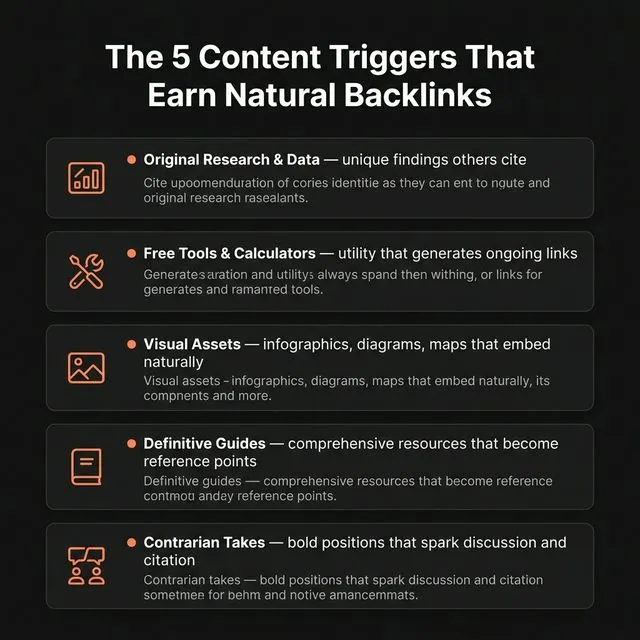
Trigger 1: Original research and data
Content that presents unique findings — surveys, studies, proprietary data analysis — earns natural links because it provides citable data points that other writers need. Nobody can link to your data if they can replicate it themselves. Originality is the scarcity that drives citation.
Example: Ahrefs publishes regular industry studies (search traffic analysis, content marketing benchmarks) that earn thousands of natural backlinks because the data doesn’t exist anywhere else.
Trigger 2: Free tools and calculators
Interactive tools that solve specific problems earn ongoing natural links because they provide persistent utility. Unlike articles that may become outdated, tools remain linkable as long as they remain useful.
Example: SparkToro’s free audience research tool earns natural links from marketers who recommend it in their content — no outreach required.
Trigger 3: Visual assets
Infographics, diagrams, data visualizations, and maps earn natural links because they’re embeddable. Writers who need a visual explanation will embed and link to the source rather than create their own.
Trigger 4: Definitive guides
Comprehensive, authoritative guides on specific topics become reference documents that other writers link to when they need to support a claim or provide additional context. The key is comprehensiveness — surface-level guides don’t earn links because they don’t add enough value to justify citation.
Trigger 5: Contrarian takes with evidence
Bold positions backed by data earn natural links from both supporters (who cite the evidence) and critics (who link to refute). Controversy drives citation — but only when the position is defensible and backed by substance.
Natural vs. Built: The Real Framework
The industry frames natural and built backlinks as opposing strategies. The more productive framework treats them as complementary layers:
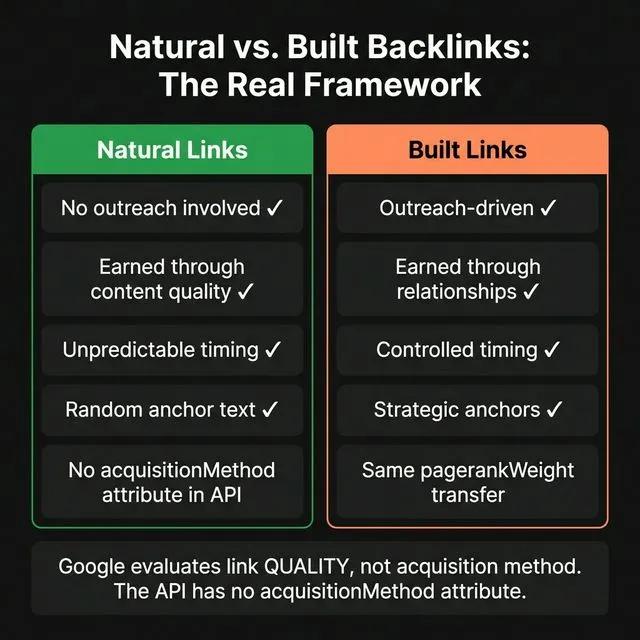
| Dimension | Natural links | Built links | Best approach |
|---|---|---|---|
| Acquisition effort | Zero (content does the work) | Active (outreach required) | Both |
| Anchor text control | None | Moderate | Natural diversity + strategic placement |
| Timing control | Unpredictable | Controllable | Build early, earn naturally long-term |
| Quality floor | Variable (any site can link) | Controllable (you choose prospects) | Supplement natural with quality-filtered outreach |
| Scalability | Unlimited (compounds) | Limited (requires ongoing investment) | Natural for scale, built for speed |
The healthiest link profiles combine both:
- Build strategically in the first 3–6 months to establish initial authority and contextual backlinks from niche relevant sources
- Earn naturally as the content’s authority grows and it begins attracting passive citations
- Maintain with outreach to fill gaps where natural acquisition is slow (competitive keywords, new topic areas)
No link building agency can manufacture natural backlinks by definition. What we can do is build the strategic foundation that enables natural link acquisition — and supplement with high-quality outreach placements that produce identical algorithmic signals. That dual approach — build for speed, earn for scale — is central to every campaign at Get Me Links. See how we engineer link profiles for compounding growth →
What This Means for GEO and Source Authority
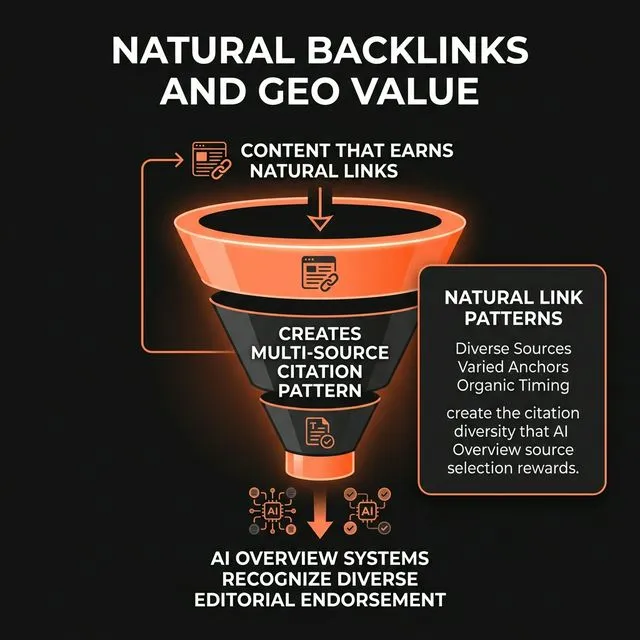
Natural backlinks contribute to GEO in a way that volume-focused built links cannot — because they create the Source → Consensus → Trust pattern in its most organic form.
AI Overview systems favor sources with diverse, organic citation patterns. A page cited by a variety of independent sources (natural links), across different site types (blogs, news, educational), with diverse anchor text (brand, generic, descriptive) — demonstrates exactly the kind of broad-based authority that the AI Overview source selection patent (US20240289407A1) rewards.
This is Source authority earned through genuine consensus: your content becomes the reference point that independent publishers cite (Source), those diverse citations create a web-wide pattern of validation (Consensus), and both ranking algorithms and AI systems elevate your content accordingly (Trust).
Based on our reading of patent US20240289407A1: GEO source selection weights citation diversity as a quality signal. Natural backlink profiles naturally produce this diversity — making them essential for qualifying content for AI Overview citation.
At Get Me Links, we build the strategic link foundation that accelerates natural acquisition — creating the conditions where your content earns passive citations at scale. Talk to us about building for compounding authority →
Frequently Asked Questions
What are natural backlinks?
Natural backlinks are links that other websites place to your content without any outreach, request, or exchange. They are earned purely because your content provided value worth referencing — through original research, useful tools, comprehensive guides, or other high-value content formats.
Are natural backlinks better than built backlinks?
Not inherently. Google’s leaked API shows no attribute that distinguishes natural from built links. Both types are scored identically across the same quality factors. However, natural backlinks have structural advantages: diverse anchor text, organic velocity patterns, and compounding growth over time.
How do you get natural backlinks?
Create content that provides unique value others can’t replicate: original research with citable data, free tools, comprehensive guides, or visual assets. Content that earns natural links solves a specific problem, presents original data, or provides a resource that writers in your niche need to reference.
How many natural backlinks should a site have?
There’s no target number. A healthy link profile includes a mix of naturally earned and strategically built links. The ratio depends on your content strategy — sites that invest heavily in original research and tools naturally earn more passive links than sites focused on service pages.
Can you tell if a backlink is natural?
Not definitively from the link itself. Natural links tend to have diverse anchor text (brand, generic, descriptive), come from varied source types, and accumulate in event-driven patterns rather than linear growth. But Google’s algorithm evaluates quality signals, not acquisition methods — making the distinction less important than link quality.
References:
- Google. (2024). Content Warehouse API Documentation (Leaked). Attributes cited:
pagerankWeight,sourceType,context2,siteFocusScore,contentEffort,lastLongestClicks,anchorMismatch. - SparkToro & Fishkin, R. (2024). An Anonymous Source Shared Thousands of Leaked Google Search API Documents with Me. SparkToro Blog.
- Google. (2014). Patent US9165040B1: Ranking search results based on entity metrics (siteFocusScore). USPTO.
- Google. (2024). Patent US20240289407A1: AI Overview source selection and scoring. USPTO.
- Google. (2024). Link spam policies and SpamBrain. Google Search Central.
- Google. (2017). Patent US9953049B1: NavBoost — modifying search result ranking based on implicit user feedback. USPTO.
- Wikipedia. (2025). Backlink.
- Wikipedia. (2025). PageRank.