
- A contextual backlink is a link embedded within the body content of a page — as opposed to links in sidebars, footers, navigation menus, or widget areas.
- The leaked Google API reveals a
context2hash attribute that fingerprints the text surrounding each link. This hash is compared against the target page’s topic vector to determine topical alignment — making surrounding content a direct ranking input. - Link placement matters algorithmically. Links in body paragraphs carry maximum
pagerankWeight. Links in headers, sidebars, footers, and boilerplate sections carry progressively less weight based ondocumentSectionclassification. - The
siteFocusScorefield — a leaked Google API attribute, not a patent — evaluates how topically focused the linking domain is: a contextual link from a niche-relevant site carries a highersiteFocusScoremultiplier than one from a topically broad site, even at the same Domain Rating. - Non-contextual links (sidebar widgets, footer links, blogroll links) are not ignored — but they carry a fraction of the signal that in-content contextual links carry. The gap is widening as Google moves toward a quality-first link index.
The difference between a link in a blog post’s body and a link in its sidebar is not just about user experience. It’s an algorithmic distinction that determines how much ranking signal reaches your page.
Google’s leaked API documentation reveals a multi-layered contextual scoring system. It hashes the text surrounding each link, classifies the document section the link sits in, and evaluates the topical focus of the linking domain — all before deciding how much pagerankWeight to assign. Most SEO guides define “contextual backlinks” as links within content. That’s true, but it’s only the surface.
In this article, we go deeper: how the context2 hash works, why document section classification changes link value, and how to build a contextual backlink profile that maximizes every signal Google measures.
What Is a Contextual Backlink?
A contextual backlink is a hyperlink placed within the editorial body content of a page — embedded naturally within a paragraph, surrounded by relevant text, and positioned where a reader would encounter it as part of the content’s narrative flow.
The opposite is a non-contextual link: links placed in sidebars, footers, navigation menus, author bio sections, comment areas, or widget zones. These links exist on the page but are not embedded within substantive content.
Here is the critical distinction:
<!-- Contextual link (in body content) -->
<p>Our analysis across 200 campaigns confirms that
<a href="https://example.com/data">anchor text ratios</a>
directly influence ranking volatility.</p>

<!-- Non-contextual link (in sidebar widget) -->
<div class="sidebar-widget">
  <h4>Resources</h4>
  <a href="https://example.com">Example Site</a>
</div>
Both are dofollow backlinks. Both point to the same domain. But they produce fundamentally different algorithmic signals because Google’s link index processes them through different scoring pipelines.
How Google Scores Contextual Links: The context2 Hash
The most significant contextual signal in the API leak is the context2 attribute — a hash of the text surrounding each link that creates a topical fingerprint for the link’s context.
How the context2 hash works
When Google encounters a link within body content, it extracts the surrounding text (the paragraph, the section, and potentially the broader content block) and hashes it into a topical fingerprint. This fingerprint is then compared against the target page’s topic vector.
If the context matches the target’s topic: the link receives amplified pagerankWeight — it’s a relevant, contextual endorsement.
If the context conflicts with the target’s topic: the link triggers an anchorMismatchDemotion-like devaluation — the contextual signal becomes a negative signal.
This is why a contextual link about “link building strategies” pointing to your link building guide carries more weight than an identical link embedded in an article about cooking recipes. Same HTML. Different context2 hash. Different ranking impact.
Based on our reading of the API leak documentation: The context2 hash is not a simple keyword check. It uses topical fingerprinting — similar to the phrase-based indexing approach documented in Patent US7536408B2, and more precisely the surrounding-text “reference contexts” analysis of Patent US8577893B1 — to evaluate whether the surrounding content is semantically related to the target page.
documentSection: Where on the page the link sits
The API leak also documents a documentSection classification that tags each link by its position in the page’s content hierarchy:
| Section classification | Signal weight | Examples |
|---|---|---|
| Body content | Maximum | Paragraphs within the main article |
| Header/navigation | Reduced | Top navigation menus, header links |
| Author bio | Moderate | ”About the author” sections |
| Sidebar | Low | Widget areas, Related posts, Blogrolls |
| Footer | Minimal | Footer links, copyright sections |
| Comment/UGC | Low-Minimal | User comments, forum signatures |
Links in body content receive full contextual scoring (the context2 hash is applied). Links in sidebars and footers may be classified as boilerplate and excluded from the primary contextual scoring pipeline entirely.
The 5 Layers of Contextual Signal
A contextual backlink doesn’t produce a single signal. It produces a layered signal stack where each layer amplifies or diminishes the others:
Layer 1: Anchor text (normalizedTopicality)
The clickable text of the link serves as the first topical signal. The normalizedTopicality attribute — a confirmed leak field that expresses a page’s topical focus as a distribution summing to 1 — is one input into how strongly the anchor’s topic associates with the target page.
Layer 2: Surrounding content (context2 hash)
The paragraph and section surrounding the link create a topical fingerprint. This is the layer that makes contextual links fundamentally different from non-contextual links — sidebar and footer links have no meaningful surrounding content to hash.
Layer 3: Page topic (documentTopicality)
The overall topic of the linking page matters. A contextual link from an article about “SEO link building” has stronger page-level topical alignment to a link building guide than a contextual link from a general marketing roundup.
Layer 4: Domain focus (siteFocusScore)
siteFocusScore — a leaked Google API field, not a patent — evaluates how topically concentrated a domain is. A contextual link from a domain that focuses exclusively on SEO carries a higher siteFocusScore multiplier than one from a domain covering dozens of unrelated topics. This is why niche relevant backlinks from focused domains outperform same-DR links from topically broad sites.
Layer 5: Click behavior (lastLongestClicks)
Contextual links in body content are more likely to be clicked by readers than sidebar or footer links. The confirmed click fields — lastLongestClicks and goodClicks — measure clicks on search results, not clicks on the backlink itself, so treating a link’s own clicks as a direct ranking input is mechanism-class corroboration, not confirmed implementation. The documented grounding for click-validated quality is Click-Validated Quality (US9558233B1); NavBoost, Google’s click-reranking system, is grounded in DOJ testimony and the 2024 API leak rather than a single patent.
This suggests a plausible feedback loop — contextual links attract more reader clicks, and pages that earn engagement tend to rank better — though the on-link click-to-ranking loop is mechanism-class corroboration, not confirmed implementation.
Contextual vs. Non-Contextual Links
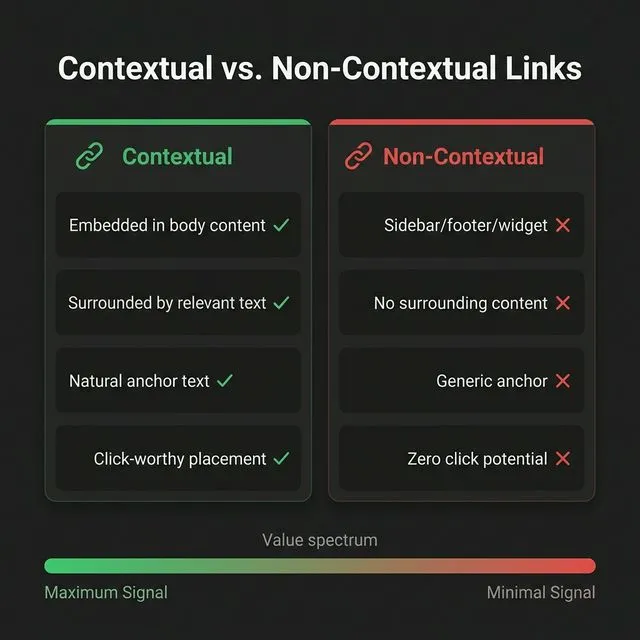
The value gap between contextual and non-contextual links is wider than most SEOs realize:
Why non-contextual links carry less weight
No context2 hash: Sidebar widgets and footer links have no surrounding editorial content to hash. They produce no contextual topical signal — just a raw link with an anchor.
Boilerplate classification: Links that appear on every page of a site (sitewide footer links, navigation links) are classified as boilerplate. Based on our reading of the leak, these repeated patterns have their per-page pagerankWeight reduced to a fraction of a unique contextual link’s.
Zero click expectation: Users rarely click sidebar widgets or footer links. The click-based quality tier for these links is lower, further reducing their ranking signal.
When non-contextual links still help
Non-contextual links aren’t worthless. They still:
- Contribute to overall referring domain count (diversity signal)
- Enable crawling of the target URL
- Pass a small amount of link equity per unique linking domain (though
pagerankWeightitself is computed per-link, not per-domain) - Build entity co-occurrence signals (your brand appears on the linking domain)
But volume-for-volume, 10 contextual links from relevant body content outperform 100 sidebar or footer links from the same domains. The signal architecture is fundamentally different.
Where Contextual Links Carry Maximum Weight
Not all body content positions are equal. Link placement within the content hierarchy affects signal strength:
First 25% of body content (maximum weight)
Links placed early in an article — within the introduction or first major section — carry the strongest contextual signal. This aligns with the Reasonable Surfer model (Patent US7716225B1, expired 2025-03-16), which weights links based on the probability that a user would click them — a predictive model, not a measure of actual clicks. The method may still inform ranking even though the patent has lapsed. Links at the top of substantive content have higher click probability.
Mid-body content (high weight)
Links embedded in the middle sections of an article still carry strong contextual signals. The context2 hash evaluates surrounding content quality regardless of position — but the Reasonable Surfer click probability decreases with scroll depth.
End-of-article sections (moderate weight)
Links in conclusion sections, “further reading” lists, or reference sections carry moderate weight. They have contextual value (they’re in body content) but lower click probability than early-article placements.
Author bios and About sections (low-moderate weight)
Links in author bios are contextual in the sense that they’re embedded in content — but the documentSection classification may reduce their weight compared to body paragraph links.
How to Build Contextual Backlinks That Move Rankings
Building contextual backlinks means securing placements within body content, not in sidebars or footers. Here are the strategies that consistently produce body-content placements:
Guest posting with body-content links
When contributing guest content, negotiate link placement within the article body — not in the author bio. An in-content contextual link from a DR 50 site outperforms an author-bio link from a DR 80 site because the context2 hash and documentSection classification favor body content.
Link insertions (niche edits)
Requesting link insertions into existing, relevant articles produces natural contextual placements. The link is embedded within already-published content that has an established topical fingerprint — producing strong context2 alignment from day one.
Digital PR and data-driven outreach
Pitching original research to journalists produces editorial backlinks embedded within news articles. These are the highest-quality contextual links because they combine editorial sourceType, body-content placement, topical relevance, and click traffic.
Resource page placements
Resource pages — “best tools for X,” “recommended reading for Y” — provide contextual placements because the links are embedded within curated content about a specific topic. The context2 hash captures the resource page’s topical focus, which aligns with the target page’s topic.
No link building agency, including ours, can control where every link appears on the linking page. What we can do is prioritize strategies that produce body-content placements — and decline opportunities that would only produce sidebar or footer links. Every placement we build at Get Me Links is evaluated against the context2 and documentSection signals before we pursue it. See how we evaluate link opportunities →
What This Means for GEO and Source Authority
Contextual backlinks feed the GEO pipeline in a way that non-contextual links cannot — and they’re a direct input into the Source → Consensus → Trust cycle.
The AI Overview source selection patent application (US20240289407A1, pending) evaluates source trust through Layer 2 (query-independent trust via links). Contextual links with verified topical alignment (via context2) contribute more to the trust score than non-contextual links with no topical fingerprint.
Additionally, AI Overview systems use entity co-occurrence to determine whether a source is authoritative on a topic. Contextual links create stronger entity co-occurrence signals because the surrounding text associates your brand with specific topical entities. A sidebar link with “example.com” as anchor text produces no entity association. A body-content link with “Get Me Links’ research on anchor text ratios” in a relevant paragraph produces strong entity association.
This is Source authority in its most concrete form: your content is cited in context, surrounded by topically aligned text, on a relevant domain — creating the consensus pattern that search engines and AI systems use to determine trust.
Based on our reading of patent application US20240289407A1 (pending): GEO source selection rewards contextual citations because they reflect genuine editorial endorsement with verifiable topical alignment — the same signals that context2 captures.
Building contextual links that produce maximum context2 alignment requires systematic evaluation of every placement opportunity. That’s what we do at Get Me Links. Talk to us about your contextual link strategy →
Frequently Asked Questions
What are contextual backlinks?
Contextual backlinks are links embedded within the body content of a page, surrounded by relevant editorial text. Unlike sidebar, footer, or navigation links, contextual links produce a context2 topical fingerprint that Google uses to verify topical alignment between the linking content and the target page.
Why are contextual backlinks better than other links?
Contextual links produce a multi-layered signal: anchor text relevance, surrounding content alignment (context2 hash), page-level topicality, domain focus, and click behavior. Non-contextual links (sidebars, footers) miss most of these layers — particularly the context2 hash — which reduces their ranking impact significantly.
How do I check if a backlink is contextual?
View the linking page and examine where the link is placed. A contextual backlink appears within a body paragraph, surrounded by related editorial text. A non-contextual link appears in a sidebar widget, footer, navigation menu, or other non-content section. In Ahrefs Site Explorer, the “Link context” column shows the text surrounding each backlink.
How many contextual backlinks do I need?
Quality and relevance matter more than count. Based on our agency data, a page with 10–15 contextual backlinks from topically relevant, authoritative sites (DR 30+) consistently outranks pages with 50+ non-contextual links. Prioritize body-content placements from niche relevant sources over volume.
Do footer and sidebar links have any SEO value?
They provide marginal value: crawl paths, referring domain diversity, and weak entity co-occurrence. But they carry a fraction of the ranking signal of body-content contextual links because they lack the context2 hash, have lower documentSection classification, and generate near-zero click engagement.
References:
- Google. (2024). Content Warehouse API Documentation (Leaked). Attributes cited:
context2,documentSection,normalizedTopicality,documentTopicality,pagerankWeight,anchorMismatchDemotion. - SparkToro & Fishkin, R. (2024). An Anonymous Source Shared Thousands of Leaked Google Search API Documents with Me. SparkToro Blog.
- Google. (2014). Patent US9165040B1: Producing a ranking for pages using distances in a web-link graph — Seed Distance family. USPTO.
- Google. (2010). Patent US7716225B1: Reasonable Surfer model — ranking links by predicted click probability (expired 2025-03-16). USPTO.
- Google. (2009). Patent US7536408B2: Phrase-based indexing and information retrieval. USPTO.
- Google. (2011). Patent US8001127B1: Boilerplate detection using distant supervision. USPTO.
- Google. (2017). Patent US9953049B1: Producing a ranking for pages using distances in a web-link graph — Seed Distance PageRank. USPTO.
- Google. (2024). Patent Application US20240289407A1: AI Overview source selection and scoring (pending). USPTO.
- Wikipedia. (2025). Backlink.
- Meyerhans, A. (2026). Reference Contexts — US8577893B1. alejandromeyerhans.com research.
- Meyerhans, A. (2026). Click-Validated Quality — US9558233B1. alejandromeyerhans.com research.