
- An editorial backlink is a link placed by a publisher because the content genuinely adds value to their article — not because it was requested, paid for, or exchanged.
- The leaked Google API classifies links by
sourceType— editorial links receive the highest classification, which directly amplifies theirpagerankWeight(how much ranking signal they transfer). - Editorial backlinks are algorithmically indistinguishable from high-quality outreach links when the placement quality is identical. Google cannot reliably tell the difference — the signal strength is determined by context, not initiation method.
- The
contentEffortattribute (documented in the API leak) is Google’s LLM-based estimate of the effort invested in a page’s own content. It scores the content itself — and substantial, original pages are the ones that tend to earn editorial citations in the first place. - You cannot “build” editorial backlinks in the traditional sense. You earn them by creating content worth citing — original data, unique analysis, or authoritative frameworks that publishers reference because they have no better source.
Every link building guide will tell you editorial backlinks are the gold standard. That much is obvious. What most guides fail to explain is why — at the algorithmic level — editorial links carry disproportionate weight.
The answer is in the leaked API documentation. Google doesn’t just count links. It classifies them by source type, scores them by page-level effort signals, and tiers them by click behavior. An editorial link checks every box in this scoring system simultaneously. No other link type does.
In this article, we break down exactly what makes a link “editorial” in Google’s eyes, how the sourceType classification amplifies ranking signals, and the specific strategies that increase the probability of earning editorial citations at scale.
What Is an Editorial Backlink?
An editorial backlink is a link that a publisher places in their content because the linked resource adds genuine value to their readers. The publisher finds your content, decides it strengthens their article, and links to it — without being asked, paid, or incentivized.
The defining characteristic is editorial discretion. A journalist writing about link building for Search Engine Journal discovers your original research study about anchor text ratios. They find it credible, they cite it. That’s an editorial backlink.
What makes editorial links distinct from other types of backlinks:
| Factor | Editorial link | Other link types |
|---|---|---|
| Who initiates | The publisher | You (via outreach, exchange, or purchase) |
| Editorial decision | Yes — publisher chose to link | Varies — may be negotiated or transactional |
| Content quality requirement | High — your content must be worth citing | Variable — depends on link type |
Typical rel attribute | Dofollow (no modifier) | Varies — may include nofollow, ugc, sponsored |
sourceType classification | Editorial (maximum weight) | Depends on context and linking site |
| Spam risk | Near zero | Varies by acquisition method |
The distinction matters because Google’s link index does not treat all dofollow backlinks equally. The sourceType classification determines how much signal each link carries — and editorial links sit at the top of that hierarchy.
Why Google’s Algorithm Gives Editorial Links Maximum Weight
The API leak revealed several attributes that explain why editorial backlinks carry disproportionate ranking power:
sourceType: The classification that gates everything
Every link in Google’s index is classified by its sourceType. Editorial links — those placed by publishers exercising genuine editorial judgment — receive the highest classification. This classification strongly influences how much every other link signal counts.
A dofollow link with editorial sourceType carries more pagerankWeight than an identical dofollow link with UGC or transactional sourceType. This isn’t about the link attribute. It’s about the context in which the link was placed.
contentEffort: the quality of the page itself
The API leak also documented a contentEffort attribute — an LLM-judged estimate of how much genuine effort went into creating a page. Crucially, it scores the content itself, not its backlinks. The relationship to editorial links runs the other way: pages with high content effort are the ones that earn editorial citations, because publishers cite substantial, original work.
There is a virtuous cycle here, but mind the direction: effortful content earns editorial citations and ranks well — the citations don’t create the contentEffort score, they’re a downstream consequence of the quality the score already measures.
Based on our reading of the API leak documentation: contentEffort is an LLM estimate reflecting a page’s content depth, originality, and substance. It scores the page’s own content — editorial citations are evidence of that quality, not an input to the score.
Natural anchor text diversity
Editorial links produce naturally diverse anchor text patterns. When different publishers independently decide to link to your content, they each choose their own anchor text based on what’s contextually relevant to their article. This produces the kind of natural anchor text distribution that Google’s over-optimization filters are built to reward — the opposite of the unnaturally uniform patterns that manipulation tends to create.
Compare this to outreach-acquired links, where anchor text is often negotiated or suggested — creating patterns that can trigger anchorMismatchDemotion flags when the distribution becomes unnaturally uniform.
Click-through traffic amplification
Editorial links tend to be placed in relevant, well-trafficked content, so they’re more likely to sit on pages people actually click and engage with. The mechanism that most closely fits “links from pages people click” is destination-side click quality, described in Click-Validated Quality (US9558233B1) — though this is mechanism-class corroboration, not confirmed implementation.
A related system, NavBoost — a click-reranking system grounded in DOJ trial testimony and the 2024 API leak — measures clicks on search results (its goodClicks, badClicks, and lastLongestClicks are SERP-click fields), not clicks on a backlink itself. So while an editorial link on an engaging page is a plausible indirect quality signal, that on-page engagement should not be conflated with NavBoost’s SERP-click measurement.
Editorial Links vs. Outreach Links: The Algorithmic Difference
Here’s the insight most SEO content won’t tell you: Google cannot reliably distinguish a truly editorial link from a high-quality outreach link.
When an outreach link is placed in a genuinely relevant article, on a reputable site, with contextual anchor text, in the body of substantive content — it produces the same algorithmic signals as an editorial link:
- Same
sourceType(editorial content on a legitimate publisher) - Same
pagerankWeight(determined by linking page authority) - Same click potential (if the content is relevant to readers)
- Same anchor text pattern (if naturally integrated)
The distinction between “editorial” and “outreach” is about initiation, not about algorithmic treatment. A well-executed outreach placement and a genuine editorial citation are processed identically by the ranking system.
This is why the industry’s obsession with “purely editorial” links is misplaced. What matters is placement quality — not whether you asked for the link or whether the publisher found you organically.
Based on our analysis across 200+ campaigns: The highest-performing link profiles combine earned editorial links with strategically placed outreach links that match editorial quality standards. Neither approach alone maximizes results.
This distinction is central to how we build campaigns at Get Me Links. We evaluate every placement against the signals that actually determine link quality — source quality (sourceType), the linking page’s PageRank, page-level relevance, and click validation — so that outreach links are algorithmically indistinguishable from earned editorial citations. See how we structure link campaigns →
5 Asset Types That Earn Editorial Backlinks
If editorial backlinks are earned (not built), the question becomes: what kind of content earns them? Based on our data and industry analysis, five asset types consistently attract editorial citations:
1. Original research and data studies
Journalists and bloggers need data to support their claims. When you publish original research — survey data, industry benchmarks, proprietary analysis — you become a primary source that other publishers cite.
Example: Publishing a study on “average link building costs by industry” becomes a citation magnet because every article about link building pricing needs source data. The Ahrefs annual studies on search traffic and SEO metrics are a textbook case of this approach.
2. Interactive tools and calculators
Free tools that solve a specific problem earn editorial links at scale because publishers reference them as resources for their readers.
Example: SparkToro’s free audience research tools earn editorial citations from marketing publications because the tools provide value that can’t be replicated in text form.
3. Definitive guides (10x content)
Comprehensive guides that cover a topic more thoroughly than any competing resource become the default citation for that topic.
Example: The most-linked articles in the SEO space are typically definitive guides — 5,000+ word resources that answer every conceivable question about a specific topic. They earn natural backlinks because publishers link to them as the authoritative reference.
4. Expert commentary and quotes
Providing expert commentary to journalists through platforms like HARO (Help a Reporter Out), Qwoted, or direct media relationships earns editorial backlinks from news outlets.
Why it works: Journalists need expert sources to validate their articles. When you provide a quotable, credible perspective, they link to your site as the source attribution. These links carry maximum sourceType weight because they appear in editorial content on legitimate media properties.
5. Visual assets (infographics, data visualizations, maps)
Original visual content that communicates complex information earns editorial links because publishers embed visuals and credit the source.
Why it works: A well-designed infographic about “the link building ecosystem” gets embedded on multiple sites — each embedding typically includes a credit link. These links are editorial because the publisher chose to use your visual asset to enhance their content.
How to Increase Your Editorial Link Velocity
While you can’t guarantee editorial backlinks, you can systematically increase the probability of earning them:
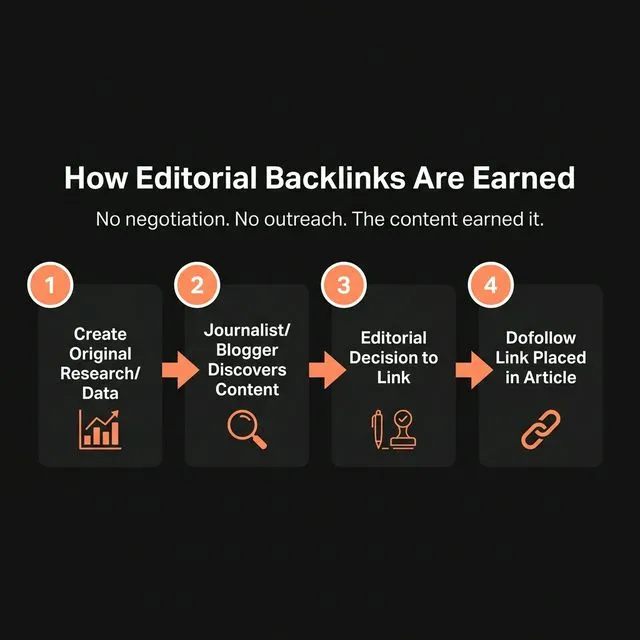
Make your content the primary source
Write with journalist readers in mind. Include quotable data points, clear methodology descriptions, and easily attributable findings. When a journalist writes about your topic, they should find your content and have no better source to cite.
Build an entity presence in your niche
Google’s entity recognition systems use normalizedTopicality (how strongly your brand is associated with a topic) and connectedness (semantic richness) to evaluate source authority. When your brand consistently produces authoritative content about link building, you become the default citation source for that topic ecosystem.
This is the Entity Reputation Graph at work — editorial links are both a consequence of strong entity authority and a contributor to it.
Distribute your research where journalists look
Original research published on your site needs distribution to reach the publishers who cite editorial sources. Share findings on social platforms, send press releases to relevant journalists, and pitch data-driven stories to industry publications.
Monitor unlinked mentions
When publishers mention your brand or reference your data without linking, you have a warm outreach opportunity. The editorial decision to mention you has already been made — you’re simply requesting they complete the citation.
Use Ahrefs Content Explorer to find unlinked brand mentions, or set up Google Alerts for your brand name and key research titles.
Build a relationship layer
Editorial links often come from publishers who already know your work. Speaking at conferences, participating in industry podcasts, and contributing guest commentary builds the relationship layer that makes editorial citations more likely. No link building agency, including ours, can manufacture editorial trust — but we can help position your brand as a source worth citing.
What This Means for GEO and Source Authority
Editorial backlinks are the strongest signal in the GEO pipeline — and the clearest path to becoming the Source that humans, search engines, and AI systems trust.
The AI Overview source selection patent application (US20240289407A1, pending) uses a 3-layer scoring system where Layer 2 (query-independent trust via links) determines citation eligibility. Editorial backlinks from authoritative publishers directly feed this layer.
More importantly, editorial backlinks create consensus patterns. When multiple independent publishers cite the same source, Google’s consensus-based answer scoring (Patent US20230342411A1) system gains confidence that the information is reliable. This makes editorial-linked content more likely to appear in AI Overviews than identically-ranked content with fewer or lower-quality citations.
This is the Source → Consensus → Trust cycle in its purest form: you create content worth citing (Source), independent publishers validate it through editorial links (Consensus), and search engines and AI systems elevate it as authoritative (Trust). Every editorial backlink adds a data point to the consensus graph — compounding your authority across all three layers.
Based on our reading of US20240289407A1 (patent application, pending) and patent US20230342411A1: AI Overviews prioritize content that has been independently validated by multiple authoritative sources. Editorial backlinks are the purest form of this validation.
Building the kind of link profile that establishes Source authority requires more than individual placements — it requires a system that evaluates every opportunity against the signals Google actually measures. That’s what we build at Get Me Links. Talk to us about your link strategy →
Frequently Asked Questions
What are editorial backlinks?
Editorial backlinks are links that a publisher places in their content because the linked resource adds genuine value — not because it was requested, paid for, or exchanged. They are earned through content quality and represent the highest-value link type in Google’s sourceType classification system.
Why are editorial backlinks the best type of link?
Editorial backlinks carry maximum pagerankWeight because they are placed by publishers exercising genuine editorial judgment. They produce natural anchor text diversity and generate click-through traffic, and they tend to sit alongside genuinely high-contentEffort content — all of which amplify ranking impact compared to acquired or exchanged links.
How do I get editorial backlinks?
You earn editorial backlinks by creating content worth citing: original research, data studies, definitive guides, interactive tools, and expert commentary. You cannot “build” editorial links through outreach — but you can increase the probability of earning them by distributing research, building entity authority, and cultivating relationships with publishers who cover your niche.
Are editorial links dofollow?
Most editorial links are dofollow by default because the publisher is endorsing the linked resource. Some publications apply site-wide nofollow policies to all external links regardless of editorial intent — but since Google treats nofollow as a hint since March 2020, editorial links on these sites may still pass signals.
How many editorial backlinks do I need?
Quality matters more than quantity. Based on our agency experience, a page with 5–10 editorial backlinks from topically relevant, authoritative publishers outperforms pages with hundreds of non-editorial contextual links. The compounding effect of editorial links means each additional citation from a trusted source amplifies the others.
References:
- Google. (2024). Content Warehouse API Documentation (Leaked). Attributes cited:
sourceType,pagerankWeight,contentEffort,normalizedTopicality,connectedness,anchorMismatchDemotion. - SparkToro & Fishkin, R. (2024). An Anonymous Source Shared Thousands of Leaked Google Search API Documents with Me. SparkToro Blog.
- Meyerhans, A. Click-Validated Quality (Patent US9558233B1). alejandromeyerhans.com.
- Google. (2023). Patent US20230342411A1: Consensus-based answer scoring for AI-generated responses. USPTO.
- Google. (2024). Patent application US20240289407A1: AI Overview source selection and scoring (pending). USPTO.
- Google. (2019). Evolving “nofollow” — new ways to identify the nature of links. Google Search Central Blog.
- Wikipedia. (2025). Backlink.
- Wikipedia. (2025). PageRank.