
- A sitewide backlink is a link that appears on every page (or most pages) of a linking website — typically in the footer, sidebar, header, or navigation. A single sitewide link can generate hundreds or thousands of individual backlinks in your profile.
- Google does not count sitewide links as multiple links. The leaked API and confirmed Google patents show that link signals are consolidated at the domain level — one sitewide link from a DR 60 site provides essentially the same
pagerankWeightas one page-level link from that same site. - Natural sitewide links (partner badges, “built by” credits, resource sidebar recommendations) are not penalized. They’re simply consolidated into a single domain-level signal.
- The risk with sitewide links is anchor text amplification: if 1,000 pages link to you with the same exact-match anchor, it creates a suspicious pattern — even though Google consolidates the link signal into one.
- Sitewide links are most valuable for brand visibility and crawl efficiency, not for direct ranking signal. Their real power is referral traffic from high-traffic sites.
Your backlink profile shows 5,000 links from a single domain. Before you panic — or celebrate — understand what that number actually means. In nearly every case, it means a single sitewide link: one placement in a footer, sidebar, or navigation element that gets replicated across every page on the linking site.
SEO tools report each instance as a separate backlink, inflating your raw backlink count. Google’s systems, however, process these differently. Understanding the difference between what tools report and what Google actually counts is essential for accurate link profile analysis.
What Is a Sitewide Backlink?
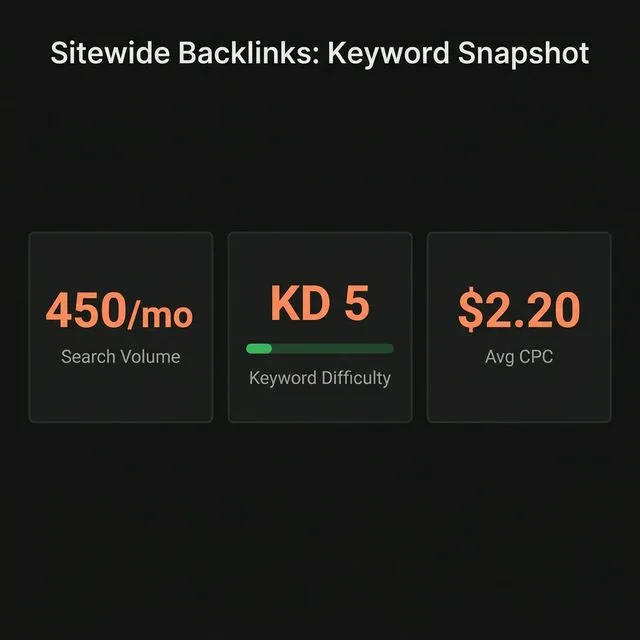
A sitewide backlink is a link embedded in a template element that appears across all pages (or a large subset of pages) on the linking website. Common locations include:
| Placement | Example | Typical anchor text |
|---|---|---|
| Footer | ”Website by [Agency Name]“ | Brand name |
| Sidebar | ”Recommended tools: [Tool Name]“ | Brand or product name |
| Header/Navigation | ”Partners: [Company]“ | Brand name |
| Blog sidebar | ”Resources we use: [Service]“ | Descriptive |
| Widget | ”Powered by [Platform]“ | Brand + generic |
The defining characteristic: one editorial decision creates links from multiple pages. The webmaster adds the link once to a template, and it propagates to every page using that template.
How sitewide links inflate backlink counts
A single sitewide footer link on a 500-page website generates:
- 500 backlinks in Ahrefs/Semrush reports
- 1 linking domain (referring domain count)
- ~1 link signal in Google’s processing (domain-level consolidation)
This is why the referring domains metric is far more meaningful than raw backlink count. A profile with 10,000 backlinks from 50 referring domains tells a very different story than 10,000 backlinks from 5,000 referring domains.
How Google Actually Processes Sitewide Links
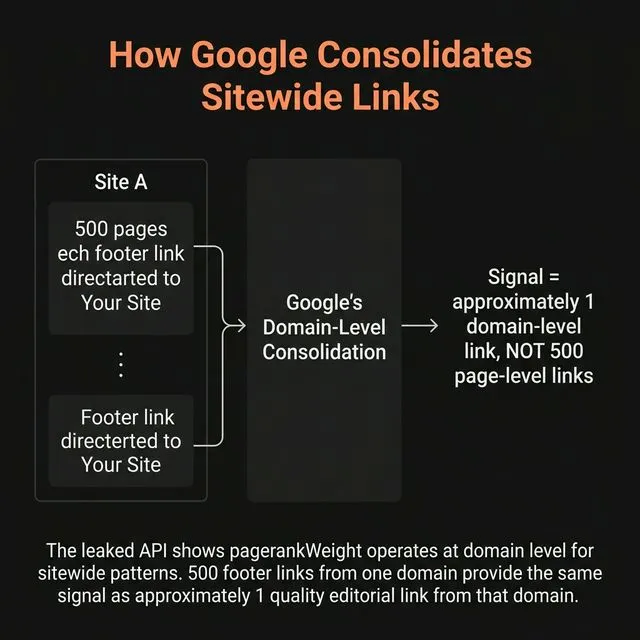
The leaked API and Google’s patents reveal that sitewide links are processed through domain-level consolidation:
Domain-level signal aggregation
Google’s link graph operates primarily at the domain-to-domain level, not page-to-page. When multiple pages on Site A link to the same page on Site B:
- Google identifies all unique linking pages from the domain
- The
pagerankWeightcontribution is consolidated — roughly equivalent to a single link from the domain’s strongest page - Additional pages linking from the same domain provide diminishing returns rather than additive signal
This means a sitewide link from a DR 60 site provides approximately the same ranking signal as a single contextual backlink from that same site.
Boilerplate detection
Google’s systems explicitly identify boilerplate content — elements repeated across multiple pages of a site. The boilerplate detection system:
- Identifies template elements (headers, footers, sidebars, navigation)
- Distinguishes boilerplate links from editorial, in-content links
- Weights boilerplate links lower than content-embedded links
This is the context2 hash in action: sitewide links in template areas produce no contextual signal because the surrounding text is generic boilerplate, not editorial content about the target page.
A sitewide link in a footer that says “SEO services by Get Me Links” provides zero context2 value — the surrounding text provides no topical context. Compare this to a single in-content mention in a blog post about link building, where the surrounding paragraphs create rich contextual signal.
Based on our reading of the API leak and boilerplate detection patents: Sitewide links are processed through at least two consolidation filters — domain-level aggregation and boilerplate detection. Both reduce the effective signal to approximately one link’s worth of pagerankWeight, with minimal context2 contribution.
sourceType classification
Sitewide links from template elements are likely classified differently than editorial links in Google’s sourceType taxonomy. A footer credit link and a blog post mention both come from the same domain — but they carry different sourceType classifications that affect how pagerankWeight flows.
When Sitewide Backlinks Help
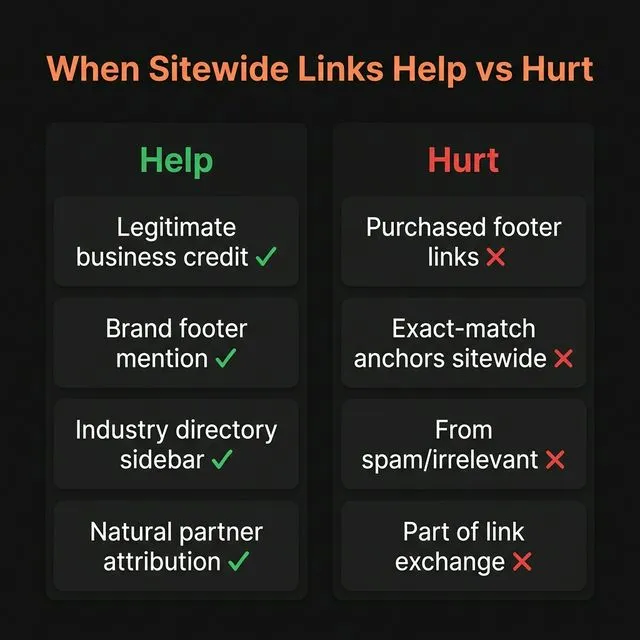
Despite the signal consolidation, sitewide links provide legitimate value in several scenarios:
Brand visibility at scale
A sitewide link on a site with 100,000 monthly visitors means your brand appears on every page those visitors see. The cumulative brand exposure can be significant — especially for brand awareness campaigns or new product launches.
Crawl efficiency
Sitewide links ensure Google discovers (or re-discovers) your pages regularly. When a frequently crawled site links to you from every page, Google’s crawlers find the link repeatedly — keeping your pages in the crawl queue.
Referral traffic from high-traffic pages
A sidebar “recommended tools” link on a blog with high-traffic individual posts can drive meaningful referral traffic. Each post that ranks well sends visitors who see and potentially click your link.
Legitimate partnerships
“Built by [Agency]” credits, technology partner badges, and genuine business relationship acknowledgments are natural sitewide links. Google expects to see them and processes them as brand signals.
Trust signal consolidation
While one sitewide link ≈ one link for ranking purposes, it validates the domain-level relationship between the linking site and yours. This is a legitimate signal when the relationship is real.
When Sitewide Backlinks Hurt
Anchor text manipulation at scale
This is the primary risk. If your sitewide link uses exact-match keyword anchor text — and it appears on 500+ pages — it creates an anchorMismatch pattern that looks manipulative:
Dangerous: <a href="https://getmelinks.com">best link building services</a> × 500 pages
Safe: <a href="https://getmelinks.com">Get Me Links</a> × 500 pages
The first example creates 500 instances of exact-match keyword anchor text — a pattern consistent with link schemes. The second uses brand anchor text, which is exactly what Google expects from sitewide placements.
Low-quality link networks
Sitewide links from networks of low-quality sites — especially if the sites were created primarily to pass links — constitute a PBN pattern. One sitewide PBN link creates hundreds of individual backlinks from a suspicious source, making the pattern more detectable.
Excessive sitewide-to-editorial ratio
A link profile dominated by sitewide links (high raw count, low referring domain count) signals that most of your links are template-based rather than earned through content quality. While Google doesn’t penalize this directly, it means your profile lacks the editorial backlinks and contextual backlinks that drive actual ranking signal.
Best Practices for Sitewide Link Management
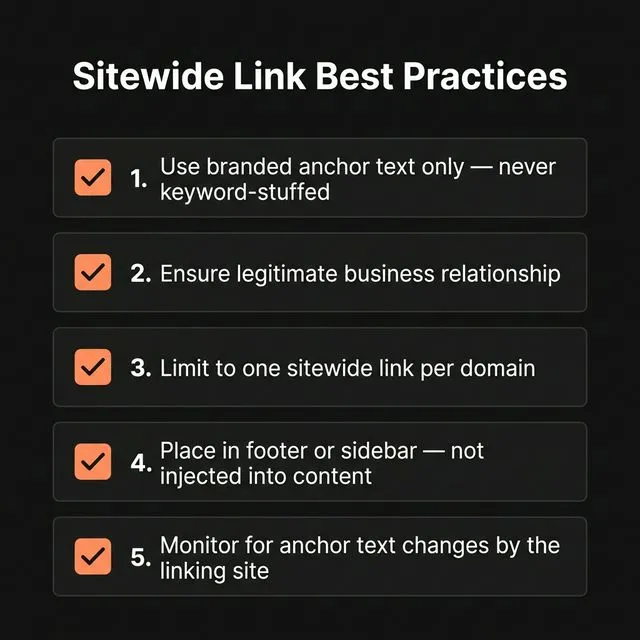
If you’re receiving sitewide links:
- Review anchor text — ensure sitewide links use brand anchors, not keyword-rich text
- Evaluate the source — sitewide links from legitimate partners are fine; sitewide links from suspicious networks are not
- Don’t count them as link wins — one sitewide link ≈ one link for ranking purposes; plan your link building strategy accordingly
- Monitor for changes — if a partner changes their sitewide link anchor text without your knowledge, it could affect your anchor distribution
If you’re placing sitewide links:
- Use brand anchors — always link with the brand name, not keyword text
- Consider
rel="nofollow"orrel="sponsored"— for paid placements, widget links, or partnerships where you need compliance - Limit per-domain exposure — one sitewide link to one target is expected; sitewide links to multiple pages on the same target may look engineered
- Place naturally — footer credits, sidebar recommendations, and partner badges are natural; link farms disguised as blogrolls are not
Sitewide Links vs. Page-Level Links: The Value Comparison
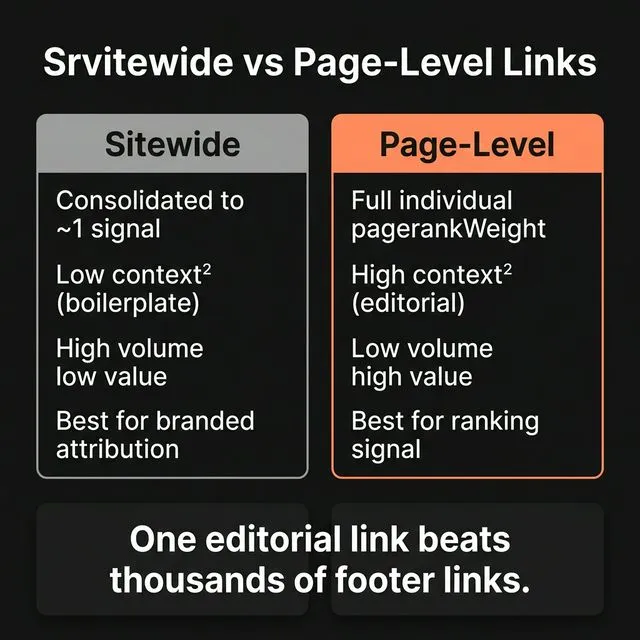
| Dimension | Sitewide link | Page-level link |
|---|---|---|
pagerankWeight | ~1 consolidated signal | 1 full signal |
context2 value | None (boilerplate) | Full (editorial context) |
sourceType | Template/boilerplate | Editorial/content |
| Anchor text risk | High (multiplied across pages) | Low (single instance) |
| Brand visibility | High (appears everywhere) | Low (single page) |
| Referral traffic | Moderate (many pages) | Varies (depends on page traffic) |
| Crawl value | High (frequent discovery) | Standard |
The bottom line: A single high quality backlink from a relevant article on a DR 60 site provides more ranking signal than a sitewide footer link from that same site. But the sitewide link provides more brand visibility and crawl value. Understanding this distinction is central to how we build link profiles at Get Me Links — we optimize for ranking signal, not vanity metrics. See how we evaluate link quality ?
What This Means for GEO and Source Authority
Sitewide backlinks contribute minimally to GEO because AI Overview source selection weights editorial citation over template-level placement.
The AI Overview source selection patent (US20240289407A1) evaluates sources through trust layers that prioritize:
- Contextual relevance (sitewide links provide none)
- Editorial endorsement (
sourceTypematters — boilerplate links don’t qualify) - Citation diversity (many sitewide links from few domains ≠diverse citation)
Sitewide links may contribute to GEO through the impliedLinks channel — brand mentions on authoritative pages help establish entity recognition. But for direct AI Overview citation qualification, editorial backlinks and contextual backlinks are far more effective.
In the Source → Consensus → Trust framework, sitewide links provide brand visibility (which supports entity recognition) but don’t create the editorial consensus pattern that AI systems require. They’re a supporting signal, not a primary driver — and building a strategy around them is a common mistake we help clients correct.
At Get Me Links, we help clients understand the difference between link volume and link value — and build profiles that prioritize the editorial citations that actually move rankings. Talk to us about a quality-first link strategy →
Frequently Asked Questions
What are sitewide backlinks?
Sitewide backlinks are links that appear on every page (or most pages) of a linking website — typically in footers, sidebars, headers, or navigation elements. A single sitewide link from a 500-page site generates 500 individual backlinks in SEO tool reports, but Google consolidates them to approximately one domain-level signal.
Are sitewide backlinks bad for SEO?
Not inherently. Natural sitewide links from legitimate partners, “built by” credits, and genuine recommendations are expected and not penalized. They become problematic when they use exact-match keyword anchors (creating anchor text manipulation patterns) or come from low-quality link networks.
How do sitewide links affect domain authority?
Sitewide links from one domain count as approximately one link for ranking purposes — Google consolidates them at the domain level. Your referring domains count (not raw backlink count) is the meaningful metric. 100 sitewide links from 1 domain ≈ 1 link for authority purposes.
Should I disavow sitewide backlinks?
Only if the sitewide links come from known spam sites or PBNs that you previously used for link building. Natural sitewide links from legitimate sites should not be disavowed — Google already processes them as single domain-level signals. Disavowing legitimate sitewide links removes the small positive signal they provide.
How can I tell if a sitewide link is helping or hurting?
Check two things: (1) Is the anchor text brand-based or keyword-stuffed? Brand anchors are safe; keyword-rich anchors at scale are risky. (2) Is the linking site legitimate with real traffic and content? If yes, the sitewide link is fine. If the site exists primarily to link out, consider disavowing.
References:
- Google. (2024). Content Warehouse API Documentation (Leaked). Attributes cited:
pagerankWeight,context2,sourceType,anchorMismatch,impliedLinks. - SparkToro & Fishkin, R. (2024). An Anonymous Source Shared Thousands of Leaked Google Search API Documents with Me. SparkToro Blog.
- Google. (2004). Patent US7058628B1: Information retrieval based on boilerplate detection. USPTO.
- Google. (2024). Link spam policies. Google Search Central.
- Google. (2024). Patent US20240289407A1: AI Overview source selection and scoring. USPTO.
- Google. (2014). Patent US9165040B1: Ranking search results based on entity metrics (siteFocusScore). USPTO.
- Wikipedia. (2025). Backlink.
- Wikipedia. (2025). PageRank.