
- A sponsored backlink uses the
rel="sponsored"attribute to declare that the link placement was paid for, incentivized, or part of a commercial arrangement. - Google introduced
rel="sponsored"in September 2019 as a refinement ofrel="nofollow"— giving webmasters a way to specifically identify paid links without losing therel="nofollow"signal for non-commercial use cases (UGC, untrusted content). - Sponsored links do not pass direct
pagerankWeight— at least not in the traditional sense. However, Google treatsrel="sponsored"andrel="nofollow"as hints, not directives, meaning Google can choose to credit the link if it determines the editorial context warrants it. - Using
rel="sponsored"protects both the linking and target sites from unnatural backlinks manual actions. It converts a potentially manipulative link into a compliant one. - Sponsored backlinks still provide value through brand visibility, referral traffic, entity co-occurrence, and indirect ranking signals — even when they don’t pass direct
pagerankWeight.
When Google introduced rel="sponsored" in September 2019, the SEO industry treated it as a death sentence for paid link building. If the link doesn’t pass PageRank, why pay for it?
That analysis is incomplete. The leaked API documentation and Google’s own guidance reveal a more nuanced system. Sponsored links are treated as “hints” — not hard blocks — and they continue to pass value through channels that aren’t captured by the pagerankWeight attribute alone.
In this article, we explain exactly how rel="sponsored" works, when sponsored backlinks still help rankings, and how the “hint” model changes the paid-link calculus.
What Is a Sponsored Backlink?
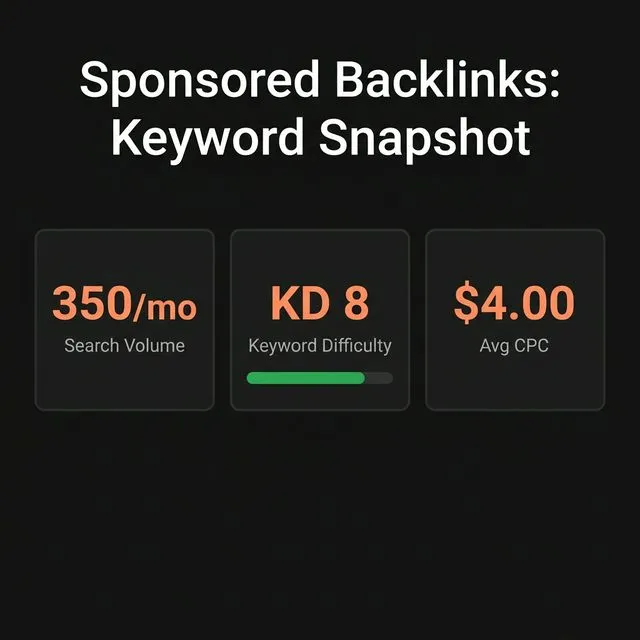
A sponsored backlink is any link that uses the rel="sponsored" HTML attribute:
<a href="https://example.com" rel="sponsored">Example Site</a>This attribute tells Google that the link exists as part of a commercial arrangement — the placement was paid for, incentivized, or involves compensation (monetary or otherwise).
The link annotation timeline
| Date | Development |
|---|---|
| 2005 | rel="nofollow" introduced for spam control |
| 2005–2019 | nofollow used for all non-editorial links (paid, UGC, untrusted) |
| September 2019 | rel="sponsored" and rel="ugc" introduced |
| March 2020 | Google shifts from treating nofollow as directive to hint |
Before 2019, all paid links were supposed to use rel="nofollow". The problem: nofollow was also used for user-generated content, untrusted external links, and any link the publisher didn’t want to vouch for. Google couldn’t distinguish paid links from other non-endorsed links.
rel="sponsored" solved this by creating a specific declaration: this link is commercial. This gives Google cleaner data for:
- Understanding which links are paid (and adjusting
pagerankWeightaccordingly) - Distinguishing paid links from UGC or other non-endorsed links
- Evaluating whether a paid placement has editorial merit worthy of credit
How Google Treats rel="sponsored": The Hint Model
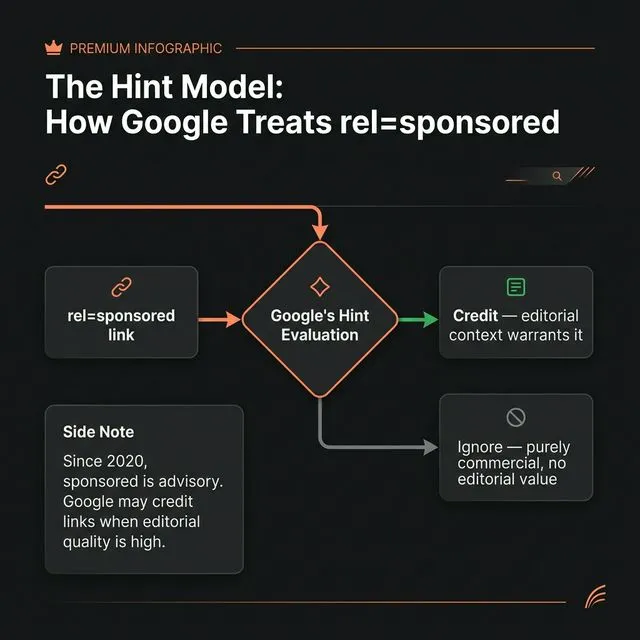
The critical change happened in March 2020: Google announced that all link annotations — nofollow, sponsored, and ugc — would be treated as hints rather than directives.
What “hint” means algorithmically
- Directive (pre-2020):
rel="nofollow"= Google ignores the link completely. ZeropagerankWeightpasses. - Hint (post-2020):
rel="sponsored"= Google generally won’t passpagerankWeight, but reserves the right to credit the link if it determines the editorial context warrants it.
This means Google can choose to:
- Ignore the link (most common) — treat
rel="sponsored"as a signal to not passpagerankWeight - Credit the link partially — if the editorial context, relevance, and quality signals suggest the link has genuine value despite being paid
- Use the link for crawling and understanding — follow the URL, discover the content, and process the entity relationships — even without passing
pagerankWeight
Based on our reading of Google’s official 2019 announcement and the API leak: The hint model means rel="sponsored" is not a binary on/off switch for link value. It’s a signal that Google factors into its overall quality assessment — alongside sourceType, context2, siteFocusScore, and other attributes.
Do Sponsored Backlinks Pass Link Value?
The honest answer: partially, and through indirect channels.
Direct pagerankWeight: Generally no
The primary ranking signal from links — pagerankWeight transfer — is generally not passed by sponsored links. This is the signal that dofollow backlinks are valued for, and rel="sponsored" explicitly tells Google that this link shouldn’t be treated as an editorial endorsement.
Entity co-occurrence: Yes
When a sponsored article on a DR 70 marketing site mentions “Get Me Links” alongside “link building” and “SEO,” it creates entity co-occurrence signals regardless of the rel attribute. Google’s Knowledge Graph processes entity relationships from the page’s content — not just from the links.
Brand visibility signals: Yes
The impliedLinks attribute in the leaked API captures brand mentions that don’t include hyperlinks. By extension, brand mentions with sponsored links create the same brand-signal value. Google processes the linking page’s content and associates your brand entity with the topical context.
Referral traffic: Yes
Sponsored links on high-traffic pages drive real visitors to your site. These visitors generate engagement signals — time on site, pages per session, return visits — that feed back into your site’s quality assessment through NavBoost and similar user engagement systems.
Crawl discovery: Yes
Google follows sponsored links for crawling purposes. A sponsored link from a frequently crawled site can help Google discover and index new pages on your site — valuable for new content, new product pages, or recently launched sections.
When Sponsored Backlinks Are Worth the Investment
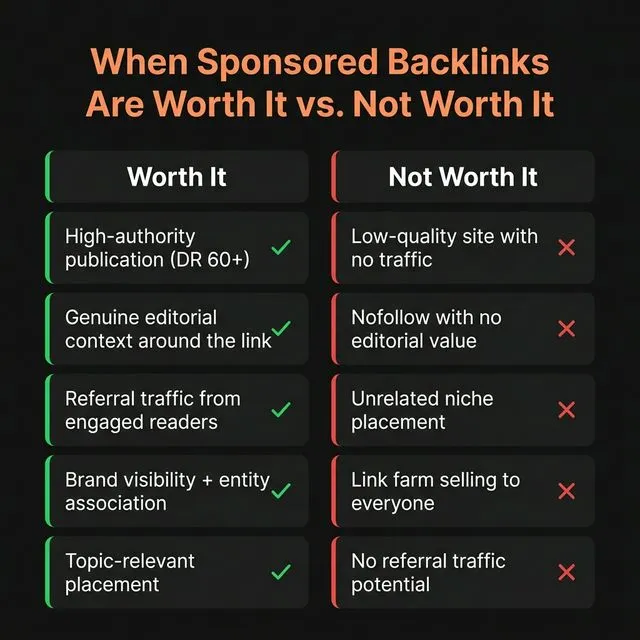
Not all sponsored placements are equal. Here’s when they provide genuine value:
High-traffic publications
A sponsored placement on a site with 500K+ monthly visitors drives significant referral traffic. The direct traffic value — leads, conversions, brand awareness — justifies the investment regardless of pagerankWeight transfer.
Entity establishment campaigns
For new brands or new product launches, sponsored placements on authoritative industry sites build entity associations in Google’s Knowledge Graph. Being mentioned alongside established entities in your niche accelerates entity recognition — which feeds into both organic ranking and GEO qualification.
Topic authority signaling
Multiple sponsored placements across authoritative sites in your niche create a pattern of association: your brand appears consistently alongside topical entities in your field. This pattern may influence siteFocusScore-like entity evaluation even without direct pagerankWeight flow.
Audience building
Sponsored content on niche-relevant sites reaches your exact target audience. The readers who click through become potential customers, newsletter subscribers, and future natural linkers — creating a downstream link acquisition channel.
When Sponsored Backlinks Are NOT Worth It
Low-traffic placements for “link juice”
Paying for a sponsored link on a site with no traffic, purely for SEO value, produces near-zero return. No direct pagerankWeight, no referral traffic, no brand visibility. The only result: a link with rel="sponsored" that Google likely ignores.
Sites that don’t use rel="sponsored"
If a publisher offers to place your paid link as dofollow (without rel="sponsored") — this is a link scheme. Both your site and the publisher risk unnatural backlinks manual actions. The short-term pagerankWeight gain isn’t worth the penalty risk.
Mass-distributed advertorials
Syndicating the same sponsored article across dozens of sites creates a pattern that SpamBrain is designed to detect. Even with rel="sponsored" on every link, the content duplication and distribution pattern may trigger quality concerns.
rel="sponsored" vs. rel="nofollow" vs. rel="ugc"
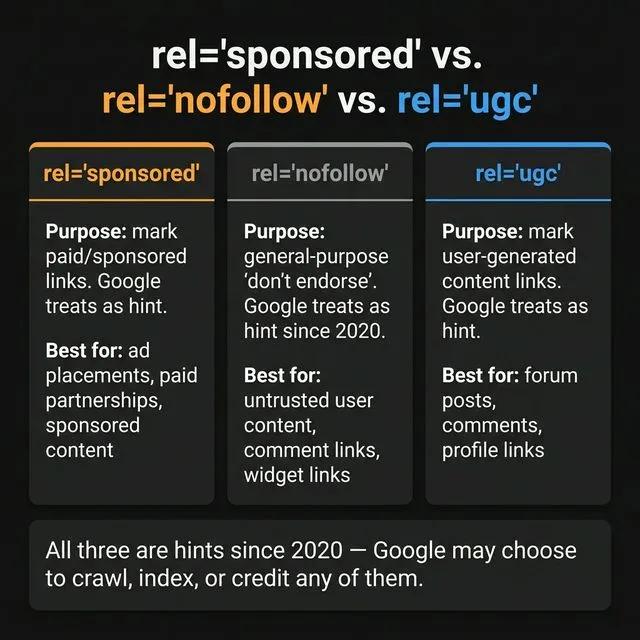
Understanding the three link annotations:
| Attribute | Purpose | Use case | Hint behavior |
|---|---|---|---|
rel="sponsored" | Commercial/paid links | Ads, paid placements, affiliate links | Google generally ignores for ranking |
rel="nofollow" | Links you don’t want to endorse | External links you can’t vouch for | Google generally ignores for ranking |
rel="ugc" | User-generated content links | Comments, forum posts, wiki edits | Google generally ignores for ranking |
| (no rel attribute) | Editorial endorsement | Editorial backlinks | Full pagerankWeight transfer |
Key nuance: All three annotated types are hints. Google can choose to credit any of them. But in practice, rel="sponsored" links are the least likely to be credited because they explicitly declare a commercial relationship.
Combinations are valid: rel="sponsored nofollow" is redundant but harmless. Some CMSs apply both by default.
The Compliance Imperative
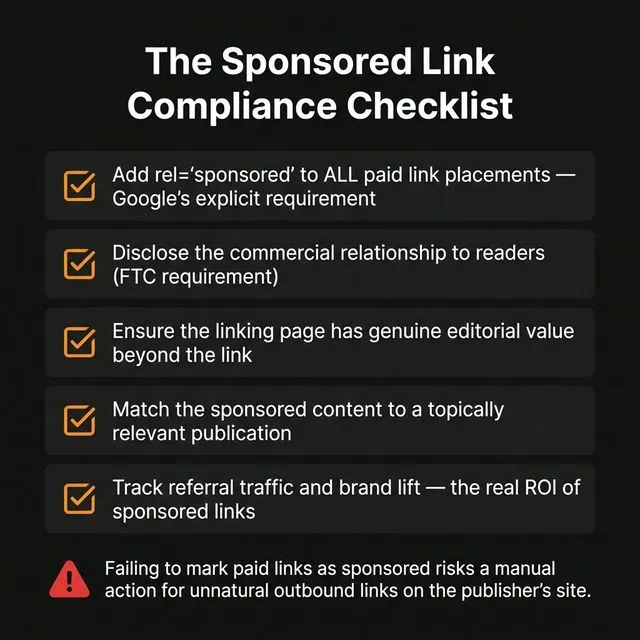
Using rel="sponsored" isn’t optional for paid links — it’s a compliance requirement:
Google’s explicit policy
Google’s link spam policies state: “Buying or selling links that pass PageRank… This includes exchanging money for links, or posts that contain links; exchanging goods or services for links; or sending someone a ‘free’ product in exchange for them writing about it and including a link.”
If you pay for a link and don’t use rel="sponsored", you’re operating a link scheme. Period.
Protection for both parties
rel="sponsored" protects:
- Your site from “Unnatural links to your site” manual actions
- The publisher from “Unnatural links from your site” manual actions
- Both sites from SpamBrain’s paid-link pattern detection
No reputable link building agency should offer or facilitate paid links without proper rel="sponsored" disclosure — unless the placement is genuinely editorial (the publisher chose to link without payment or incentive).
What This Means for GEO and Source Authority
Sponsored backlinks contribute to GEO through entity association channels, not direct trust signals.
The AI Overview source selection patent (US20240289407A1) evaluates source trust through Layer 2 (query-independent trust via links). Sponsored links contribute minimally to Layer 2 because they don’t establish editorial endorsement.
However, sponsored placements on authoritative sites contribute to entity recognition — the system’s understanding of what your brand is, what topics it covers, and what category it belongs to. This entity-level understanding feeds into query-source matching, which determines whether your content is considered for AI Overview citation.
In other words: sponsored links don’t make you trustworthy, but they can make you known. And being known is a prerequisite for being cited.
Based on our reading of patent US20240289407A1: Sponsored placements are most valuable for GEO when they build entity associations on authoritative, topically relevant sites — rather than when they target direct link value.
In the Source → Consensus → Trust framework, sponsored links operate at the entity recognition layer: they help AI systems identify your brand (Source), but they don’t create the editorial consensus pattern that builds trust (Consensus → Trust). That requires the earned editorial citations that digital PR and editorial backlinks provide.
At Get Me Links, we use sponsored placements strategically — for entity establishment and audience exposure — while building the editorial link foundation that drives rankings and AI citations. Talk to us about a balanced link strategy →
Frequently Asked Questions
What are sponsored backlinks?
Sponsored backlinks are links that use the rel="sponsored" HTML attribute to declare that the placement was paid for or involves commercial compensation. Google introduced this attribute in September 2019 to help identify paid links specifically, separating them from other non-endorsed links (nofollow, ugc).
Do sponsored links help with SEO?
Not through direct pagerankWeight transfer — Google generally doesn’t pass ranking signal through rel="sponsored" links. However, sponsored links provide value through referral traffic, brand visibility, entity co-occurrence signals, and crawl discovery. These indirect benefits can contribute to overall ranking improvement.
What is the difference between sponsored and nofollow links?
Both are treated as “hints” that generally prevent pagerankWeight transfer. The difference is semantic: rel="sponsored" specifically identifies paid/commercial links, while rel="nofollow" is a general “I don’t endorse this link” signal. Using rel="sponsored" for paid links gives Google cleaner data about your link profile’s composition.
Should paid links always use rel=“sponsored”?
Yes — without exception. Google’s link spam policies require paid links to be annotated. Using a dofollow attribute on a paid link constitutes a link scheme that risks unnatural backlinks manual actions for both the linking and target sites.
Are sponsored backlinks worth buying?
Sponsored placements on high-traffic, niche-relevant sites can be worth the investment for brand visibility, referral traffic, and entity association — not for direct ranking signal. Evaluate ROI based on traffic, audience quality, and brand-building value rather than SEO metrics alone.
References:
- Google. (2024). Content Warehouse API Documentation (Leaked). Attributes cited:
pagerankWeight,sourceType,impliedLinks. - SparkToro & Fishkin, R. (2024). An Anonymous Source Shared Thousands of Leaked Google Search API Documents with Me. SparkToro Blog.
- Google. (2019). Evolving “nofollow” — new ways to identify the nature of links. Google Search Central Blog.
- Google. (2024). Link spam policies. Google Search Central.
- Google. (2024). Qualify your outbound links — nofollow, sponsored, ugc. Google Search Central.
- Google. (2024). Patent US20240289407A1: AI Overview source selection and scoring. USPTO.
- Wikipedia. (2025). Nofollow.
- Wikipedia. (2025). Backlink.