
- A gov backlink is a link from a
.govdomain — a government website operated by a federal, state, or local government agency. These links carry disproportionately high trust signals. - Google’s leaked API contains no TLD-specific bonus for
.govdomains. The high value of gov backlinks comes from the quality signals that government sites naturally produce: highpagerankWeight(accumulated from years of authoritative citations), strict editorial standards, and low spam probability. - The practical reality is that one
.govlink carries more trust signal than dozens of commercial links — not because Google gives.gova magic multiplier, but because government domains score extremely high on every quality factor the algorithm uses. - Legitimate acquisition paths exist: community resource pages, FOIA data citations, public comment programs, and government partnerships. But no ethical approach can guarantee
.govlinks — they’re earned through genuine public value. - Buying
.govlinks from expired domains or link sellers is one of the most reliably penalized link schemes. Google detects ownership changes, content pivots, and linking pattern shifts on.govdomains.
Every SEO guide lists “.gov backlinks” as the gold standard of link building. The advice usually stops there — get more .gov links, they’re worth more than regular links. But nobody explains why they’re worth more, whether that value comes from a TLD bonus (it doesn’t), or how a commercial business can realistically earn them.
The leaked API documentation provides the clearest explanation: .gov links are valuable not because of their domain extension, but because government websites systematically produce the highest possible quality signals across every attribute Google measures. Understanding this distinction is essential for building a realistic strategy.
What Is a Gov Backlink?
A gov backlink is a link from any website using the .gov top-level domain (TLD). In the United States, .gov domains are exclusively available to:
- Federal government agencies
- State government organizations
- Local government entities (cities, counties, municipalities)
- Native American tribal governments
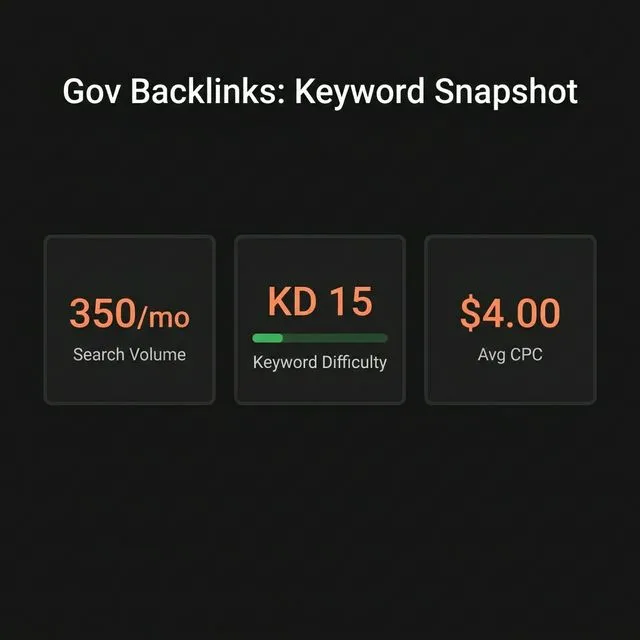
The restricted registration means every .gov domain has:
- Institutional backing — a real government entity operates the site
- Editorial oversight — government content goes through review processes
- Persistent authority — government agencies accumulate links over decades
- Low spam probability — government sites rarely participate in link schemes
These characteristics create a domain class that consistently scores at the top of Google’s quality assessments — naturally, without any TLD-specific algorithmic bonus.
The TLD Myth: Google Doesn’t Give .gov Bonus Weight
This needs to be stated clearly: the leaked API contains no attribute that assigns bonus weight based on TLD. There is no .gov multiplier, no institutional domain bonus, no TLD-specific ranking factor.
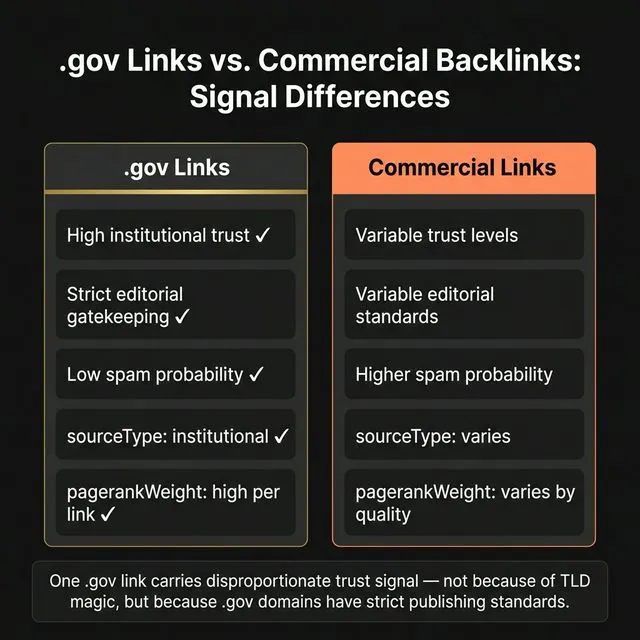
What .gov domains do have is systematically high scores on the attributes Google uses for all domains:
| API attribute | Why .gov domains score high | Equivalent for commercial sites |
|---|---|---|
pagerankWeight | Government sites receive millions of links from news, academic, and institutional sources | Build authority through quality content and earned links |
siteFocusScore | Government sites cover defined jurisdictional topics consistently | Maintain topical focus on your niche |
sourceType | Government content is editorial by nature — reviewed and approved | Produce genuine editorial content |
contentEffort | Government resources are comprehensive and regularly updated | Invest in comprehensive, maintained content |
domainTrust | Decades of consistent, authoritative publishing | Build trust over time through quality |
The value of a .gov link is the cumulative result of these quality factors — not a TLD badge. A .gov link from a page with no traffic, no content, and no authority is worth far less than an editorial backlink from a high-authority industry publication.
Based on our reading of the API leak and Google’s public statements: Matt Cutts, former head of Google’s Web Spam team, publicly stated that Google doesn’t give special weight to .gov or .edu TLDs. The leaked API confirms this — there is no TLD-specific attribute in the link scoring system.
The .gov Trust Signal Hierarchy
Not all government links are equal. The trust and accessibility vary significantly by level:
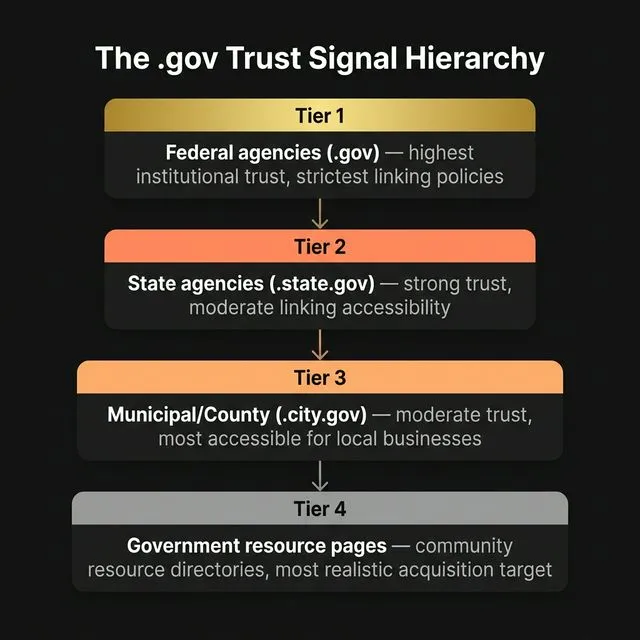
Tier 1: Federal agencies
Sites like usa.gov, nih.gov, cdc.gov, epa.gov. These carry the highest authority but have the strictest linking policies. Getting a link from a federal agency requires genuine public relevance — original research cited in policy documents, tools used by the public, or resources that serve a government mission.
Tier 2: State agencies
State-level .gov domains like state health departments, education departments, and economic development agencies. These have strong authority and moderately accessible linking opportunities — especially through state business directories and resource pages.
Tier 3: Municipal and county government
City and county .gov sites are the most accessible tier for local businesses. Community resource directories, local business listings, and municipal partnership programs provide realistic acquisition paths.
Tier 4: Government resource pages
The most realistic target: specific pages on government sites that list community resources, business directories, or educational links. These pages exist to serve the public by connecting residents to relevant services and information.
4 Legitimate Paths to .gov Backlinks
Earning .gov links requires providing genuine public value. No outreach template will work on a government webmaster — and no ethical approach can guarantee results. But these paths create realistic opportunities:
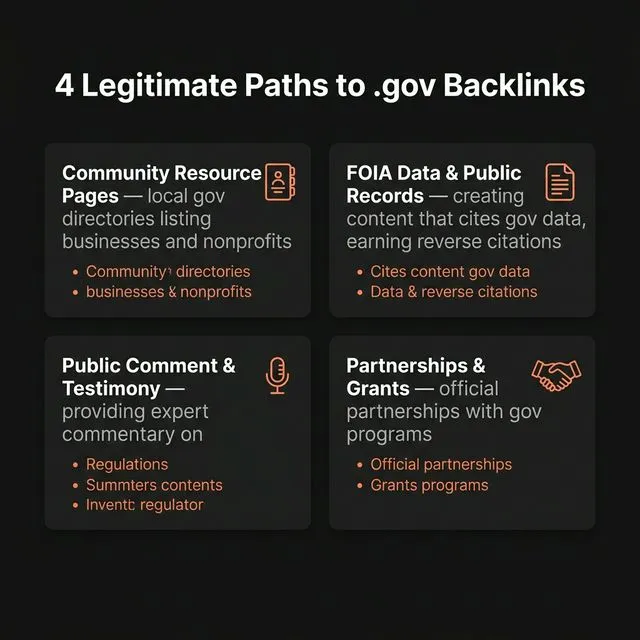
Path 1: Community resource directories
Many city and county .gov sites maintain directories of local businesses, nonprofits, and services. If your business serves the local community — especially in healthcare, education, legal services, financial services, or social services — you may qualify for listing.
How to find opportunities:
- Search
site:.gov "add a resource"orsite:.gov "submit a link" - Check your city or county
.govsite for business directories - Look for economic development pages that list local businesses
Success rate: Moderate for locally-relevant businesses. Negligible for businesses with no local community connection.
Path 2: Creating content that cites government data
Government agencies publish enormous amounts of data — census data, health statistics, economic indicators, environmental reports, educational research. Creating content that analyzes, visualizes, or makes government data more accessible can earn reverse citations.
How it works:
- Find government data relevant to your industry
- Create original analysis, visualization, or interpretation
- The government agency (or journalists covering the agency) may cite your analysis
Example: An SEO agency that analyzes SBA small business data and creates an accessible report on business survival rates could earn links from sba.gov resource pages or from journalists citing the analysis.
Path 3: Public comment and expert testimony
Government agencies regularly accept public comment on proposed regulations, environmental impact studies, and policy changes. Providing expert commentary — especially with data and citations — can result in mentions and links in government documents.
This path is narrow but powerful for businesses in regulated industries: healthcare, finance, environmental services, legal, and education.
Path 4: Government partnerships and grants
Official partnerships with government programs — Small Business Development Centers, SCORE mentoring, workforce development programs — create legitimate .gov backlinks through program listings, partner directories, and press releases.
.gov Backlink Myths vs. Reality
The .gov link building space is plagued by myths that lead to wasted effort or outright penalties:
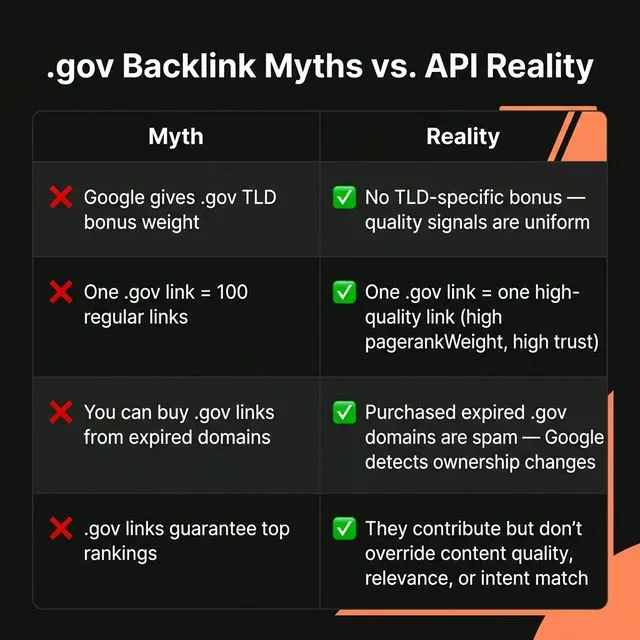
Myth: “Google gives .gov a special TLD bonus”
Reality: No TLD bonus exists in the API. .gov links are valuable because gov domains score high on universal quality metrics — not because of the domain extension.
Myth: “One .gov link equals 100 normal links”
Reality: One .gov link equals one high quality backlink — with high pagerankWeight, high trust, and strong editorial signals. It’s not a multiplier; it’s a consistently high-quality source.
Myth: “You can buy .gov links from expired domain services”
Reality: Google tracks domain ownership transitions. A .gov domain that changes ownership and suddenly links to commercial services triggers immediate spam detection. The pageHistory and registrantChange patterns (tracked at the infrastructure level) make this scheme reliably detectable.
Myth: “Every business needs .gov backlinks”
Reality: .gov links are valuable but not necessary. A link profile with editorial backlinks from relevant industry publications, contextual backlinks from niche sites, and natural backlinks from diverse sources can outperform a profile with a single .gov link but weak commercial coverage.
What This Means for GEO and Source Authority
.gov links contribute powerfully to GEO because the AI Overview source selection patent (US20240289407A1) uses Layer 2 (query-independent trust) as a qualifying filter — and .gov citations are among the strongest trust signals available.
A site cited by government agencies:
- Passes the Layer 2 trust threshold more easily
- Demonstrates institutional endorsement (the strongest form of editorial trust)
- Creates entity associations with government-level authority
- Qualifies for citation in queries where AI Overview prioritizes authoritative sources (health, legal, financial)
For GEO in YMYL (Your Money or Your Life) categories, .gov backlinks may be essential — not just valuable. AI Overview systems in health, legal, and financial queries strongly prefer sources with institutional trust signals, and .gov citations are the most unambiguous form of that trust.
No link building agency can manufacture .gov links ethically. What we can do is help you identify legitimate acquisition paths and create the kind of public-value content that makes government citation realistic. See how we approach institutional link acquisition →
This is the Source → Consensus → Trust cycle at the institutional level: government agencies citing your content represents the highest-tier validation available (Source), that institutional endorsement signals trust to every downstream system (Consensus), and both ranking algorithms and AI overview systems treat .gov citations as near-unassailable authority signals (Trust).
At Get Me Links, we help clients build the content and public-value assets that make .gov citation realistic — not through shortcuts, but through genuine institutional relevance. Talk to us about building institutional authority →
Frequently Asked Questions
What are gov backlinks?
Gov backlinks are links from .gov domains — websites operated by government agencies at the federal, state, or local level. They carry high trust signals because government sites have strict editorial standards, institutional backing, and decades of accumulated authority. However, Google does not give .gov domains a special TLD bonus — their value comes from quality signals, not the domain extension.
How do I get .gov backlinks?
Four legitimate paths: (1) Get listed on community resource directories maintained by city/county .gov sites. (2) Create content that analyzes government data, earning reverse citations. (3) Provide expert public comment on proposed regulations. (4) Partner with government programs (SBA, SCORE, workforce development). No ethical approach guarantees .gov links.
Are .gov backlinks more valuable than regular backlinks?
In practice, yes — because government domains consistently score high on Google’s quality factors. But the value comes from high pagerankWeight, strict editorial standards, and institutional trust — not from a TLD-specific bonus. A .gov link from a page with no traffic or authority is worth less than an editorial link from a high-authority industry publication.
Can I buy .gov backlinks?
Never buy .gov links. Sellers offering .gov backlinks are typically using expired/hijacked domains, hacked government sites, or fraudulent listings — all of which violate Google’s link spam policies and will be detected. Google tracks ownership changes on .gov domains, making purchased .gov links one of the most reliably penalized link schemes.
Do I need .gov backlinks to rank well?
No. .gov links are valuable additions to a link profile but not requirements. Many sites rank extremely well with profiles built from editorial backlinks, contextual backlinks, and natural backlinks — without any .gov links. Focus on quality across all link types rather than chasing a specific TLD.
References:
- Google. (2024). Content Warehouse API Documentation (Leaked). Attributes cited:
pagerankWeight,siteFocusScore,sourceType,contentEffort. - SparkToro & Fishkin, R. (2024). An Anonymous Source Shared Thousands of Leaked Google Search API Documents with Me. SparkToro Blog.
- Cutts, M. (2010). Does Google give higher rankings to .gov and .edu domains? [Public video response]. Google Webmasters.
- Google. (2024). Link spam policies. Google Search Central.
- Google. (2024). Patent US20240289407A1: AI Overview source selection and scoring. USPTO.
- CISA. (2024). .gov domain registration requirements. Cybersecurity and Infrastructure Security Agency.
- Google. (2014). Patent US9165040B1: Ranking search results based on entity metrics (siteFocusScore). USPTO.
- Wikipedia. (2025). .gov top-level domain.