
- A dofollow backlink is any hyperlink that does not carry a
rel="nofollow",rel="ugc", orrel="sponsored"attribute — meaning search engine crawlers will follow it and it can transfer ranking signals to the target page. - “Dofollow” is not an HTML attribute. There is no
rel="dofollow"tag. A link is dofollow by default — it only stops being dofollow when a modifier is explicitly added. - The leaked Google API reveals that dofollow link value is determined by at least three attributes:
pagerankWeight(how much ranking signal transfers),sourceType(editorial, UGC, or spam classification), andanchorMismatch(whether the anchor text conflicts with the target page’s topic). - Since March 2020, Google treats
nofollow,ugc, andsponsoredas hints, not directives — meaning some links you think are nofollow may still pass signals, and some dofollow links may be algorithmically ignored. - The quality of a dofollow backlink depends on the linking site’s authority, topical relevance, editorial context, and whether real users click the link — not simply on the absence of a
nofollowtag.
The SEO industry has spent two decades splitting links into two buckets: dofollow (good) and nofollow (ignored). That model was always an oversimplification. Since the API leak, we know it’s wrong.
Google doesn’t use a binary switch. It uses a multi-attribute scoring system where every link — dofollow or not — is weighted across dimensions that most SEOs never examine. A dofollow link from a low-quality site may carry less ranking signal than a nofollow link from a Wikipedia article.
In this article, we explain what dofollow backlinks actually are at the code level, how Google’s link index processes them, and what determines whether a dofollow link helps your rankings — or gets quietly devalued.
What Is a Dofollow Backlink?
A dofollow backlink is a standard hyperlink with no restrictive rel attribute. In HTML, it looks like this:
<a href="https://example.com">anchor text</a>That’s it. There is no rel="dofollow" tag. The term “dofollow” is an SEO convention, not an HTML specification. Every link on the web is dofollow by default unless a webmaster or CMS explicitly adds a rel modifier.
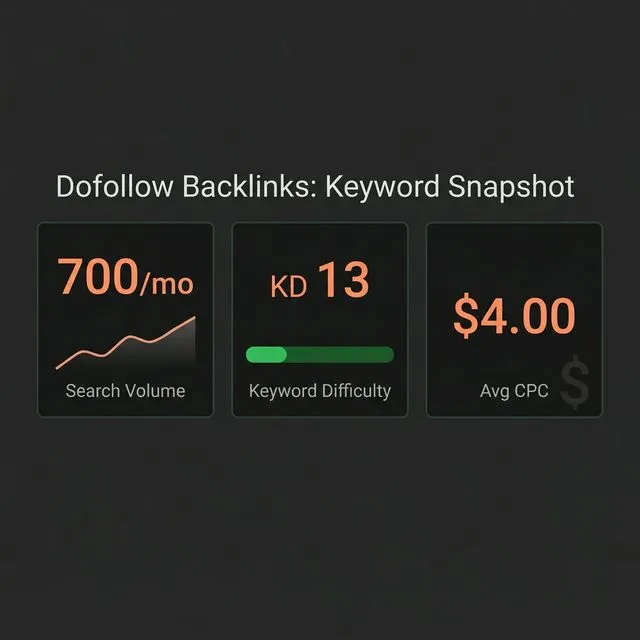
When a dofollow link points to your page, search engine crawlers:
- Follow the link — adding the target URL to the crawl queue
- Transfer ranking signals — passing a portion of the linking page’s authority (what the industry calls “link equity” or “PageRank”) to the target
- Use the anchor text — processing the clickable text as a topical relevance signal for the target page
- Score the link — classifying it across multiple quality dimensions before applying it to rankings
Steps 1–3 are well understood. Step 4 is where the API leak changed everything.
How Google’s Link Index Scores Dofollow Links
The existence of a dofollow attribute is the starting point, not the endpoint. What determines whether that link actually moves rankings is a multi-attribute scoring process documented in the leaked Content Warehouse API.
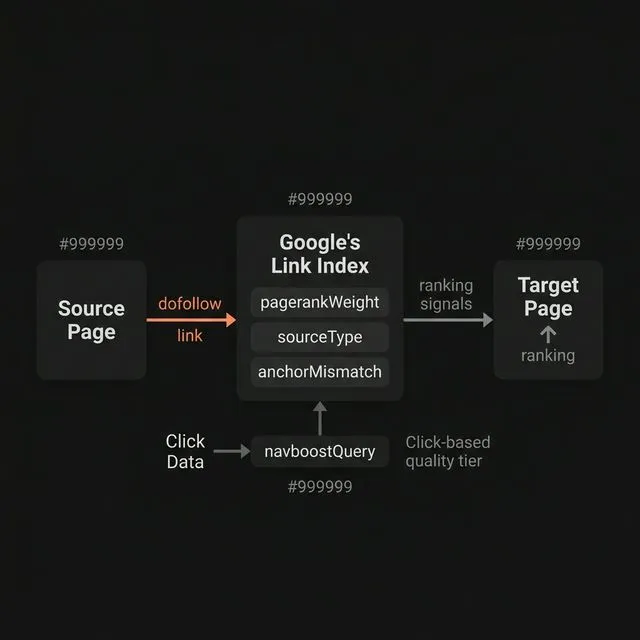
pagerankWeight: The link equity multiplier
Not all dofollow links pass the same amount of ranking signal. The API leak revealed a pagerankWeight attribute that acts as a multiplier on each link’s contribution. A dofollow link from a high-authority, topically relevant page carries a higher pagerankWeight than a dofollow link from an irrelevant, low-traffic page.
This is why chasing dofollow links from any available source is a flawed strategy. Two dofollow links from the same page are identical in their HTML. Their pagerankWeight values are identical. But two dofollow links from different domains can carry fundamentally different ranking signals.
Based on our reading of the API leak documentation: pagerankWeight is not a fixed value per domain. It’s calculated per-link, factoring in the linking page’s authority, the topical relationship between linker and target, and the link’s position within the page’s content hierarchy.
sourceType: Classification matters more than the attribute
The API documents a sourceType attribute that classifies the origin of every link. A dofollow link from an editorial article on a news site is classified differently than a dofollow link from a user-generated forum post — even if both are technically dofollow.
This classification feeds directly into how much weight the link receives in the ranking algorithm. Editorial source types carry maximum weight. UGC source types carry reduced weight. Spam-classified source types may carry zero or negative weight regardless of the dofollow attribute.
anchorMismatch: When anchor text hurts instead of helps
One of the most overlooked attributes in the API leak is anchorMismatch, which flags links where the anchor text has no topical relationship to the target page’s content. For dofollow links, this creates a paradox: a dofollow link with mismatched anchor text may actually send a negative relevance signal.
This is why exact-match anchor text strategies from 2012 are actively dangerous. If your dofollow link uses “best link building agency” as anchor text but the target page is about cooking recipes, the anchorMismatch flag diminishes the link’s value — and may trigger over-optimization filters documented in the Penguin patent family (Patent US8719257B1).
Click-based quality tiering
The API leak also revealed that links are tiered by click behavior. Dofollow links that generate genuine user clicks are placed in higher-quality link indices. Dofollow links with zero clicks may be relegated to a low-quality tier with minimal ranking weight.
This means a dofollow link on a visible, relevant page that people actually interact with is fundamentally more valuable than a dofollow link buried in a sidebar widget that nobody ever clicks. Same attribute. Different algorithmic treatment.
Dofollow vs. Nofollow: What Actually Changed in 2020
The traditional model was binary:
- Dofollow = passes signals
- Nofollow = blocks signals
In March 2020, Google officially changed this model. All link attributes — nofollow, ugc, and sponsored — are now treated as hints, not directives. This means:
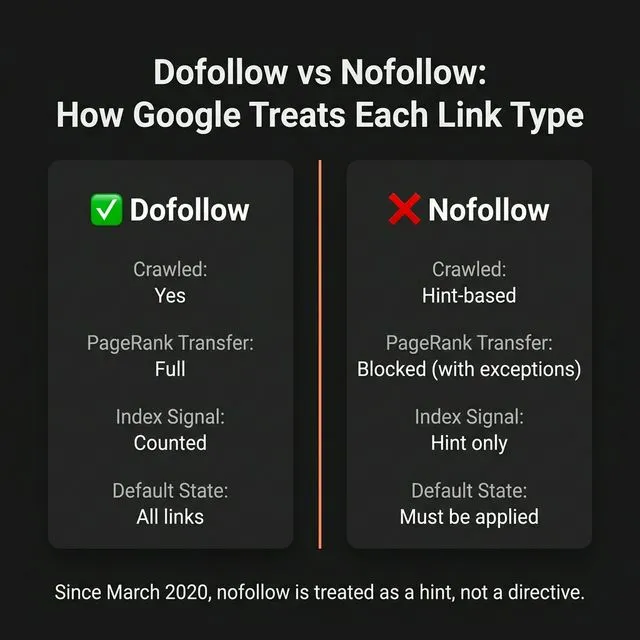
| Attribute | Pre-2020 behavior | Post-2020 behavior |
|---|---|---|
| No attribute (dofollow) | Always followed, always passed signals | Always followed, signal weight varies by quality scoring |
rel="nofollow" | Never followed, never passed signals | Hint — Google may choose to follow and pass signals |
rel="ugc" | (didn’t exist before 2019) | Hint — signals user-generated content, may pass signals if high-quality |
rel="sponsored" | (didn’t exist before 2019) | Hint — signals paid placement, typically blocked from passing signals |
The practical implication: the dofollow vs. nofollow distinction is less meaningful than the industry assumes. A nofollow link from Wikipedia may carry more value than a dofollow link from a low-quality blog because Google can override the attribute when it determines the link provides genuine value.
What matters more is the quality ecosystem around the link: the linking site’s authority, the content’s topical relevance, the editorial context, and whether real users engage with the link.
Based on our reading of Google’s 2019 announcement and the API leak: The shift to hints means Google’s link graph is now fully algorithmic. No webmaster can guarantee a link passes — or doesn’t pass — signals. The algorithm makes that determination per-link, per-crawl, based on quality scoring.
The 4 Tiers of Dofollow Backlink Quality
Not all dofollow links are equal. Based on the API leak signals and our agency’s operational data, here is how the quality spectrum breaks down:
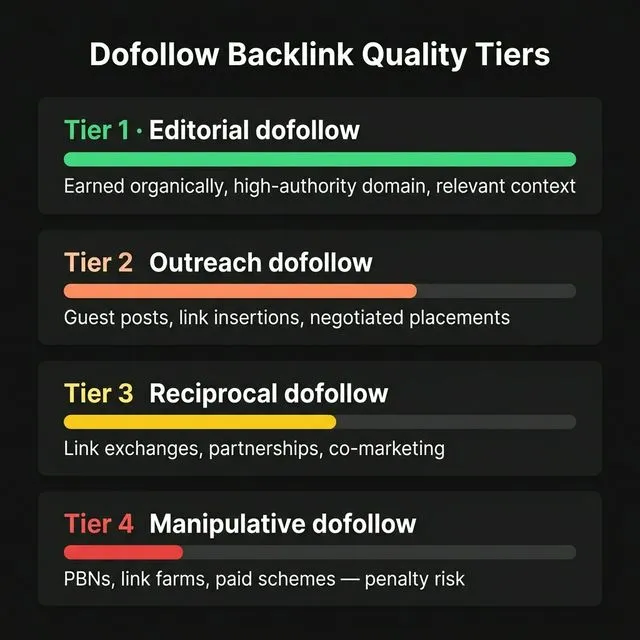
Tier 1: Editorial dofollow (highest value)
Links earned organically because your content genuinely answers a question, provides data, or offers a perspective that the linking author references. These are the gold standard.
Why they work: Maximum pagerankWeight multiplier, strong sourceType classification (editorial), natural anchor text variation, high click-through rates. These are the high-quality backlinks that compound over time.
Tier 2: Outreach dofollow (high value)
Links acquired through strategic outreach — guest posts, link insertions, digital PR placements. The link is editorially placed, but initiated by the site owner rather than earned passively.
Why they work: Still classified as editorial sourceType when placed in relevant, quality content. The outreach method matters less than the placement quality. A well-placed guest post link is algorithmically indistinguishable from an earned editorial link.
Tier 3: Reciprocal dofollow (moderate value)
Links exchanged between sites — “I link to you, you link to me.” Google’s link spam classifiers specifically identify excessive reciprocal linking as a spam signal.
Why they’re limited: When two sites link to each other and the relationship is algorithmically obvious (same contact information, similar content, mutual linking patterns), the pagerankWeight of both links may be reduced. Small-scale, contextually relevant reciprocal links between genuinely related sites are lower risk.
Tier 4: Manipulative dofollow (negative value)
Links from PBNs (private blog networks), link farms, automated blog comments, paid link schemes, and other manipulative sources. These are detectable by SpamBrain (Patent US8719257B1) and carry escalating penalties.
Why they fail: Google’s spam classifiers identify patterns — identical hosting, thin content, unnatural link density — that mark these sources as manipulative. A dofollow link from a spam-classified source doesn’t just carry zero weight. It may trigger a manual action or algorithmic penalty against your entire site.
How to Check if a Backlink Is Dofollow
Checking whether a link is dofollow or nofollow requires inspecting the HTML source:
- Right-click the link and select “Inspect” (in Chrome, Firefox, or Edge)
- Look at the
<a>tag in the Elements panel - Check for a
relattribute — if it containsnofollow,ugc, orsponsored, it’s not dofollow - No
relattribute = dofollow by default
For bulk checking across your entire backlink profile, use Ahrefs Site Explorer → Backlinks report. Filter by link type to see the dofollow/nofollow breakdown. Pay attention to the referring domain’s Domain Rating (DR) and the linking page’s traffic — these are proxies for the pagerankWeight the link carries.
How to Build High-Quality Dofollow Backlinks
Building dofollow backlinks that actually move rankings requires focusing on the quality signals Google measures — not just the absence of a nofollow tag.
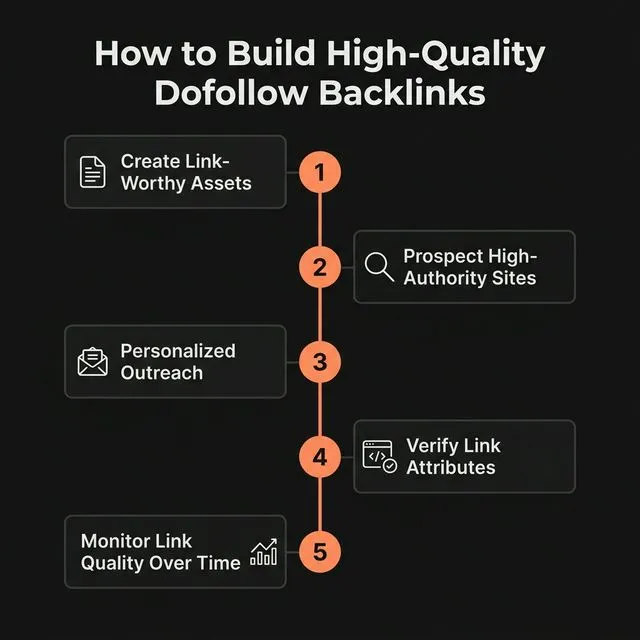
Step 1: Create link-worthy assets
Pages that earn dofollow backlinks naturally share common traits: original data, unique analysis, visual frameworks, or comprehensive coverage that other authors reference. Thin pages don’t attract editorial links — regardless of how much outreach you do.
Step 2: Prospect high-authority, topically relevant sites
Use Ahrefs Content Explorer to find sites that regularly link to content in your niche. Filter for domains with DR 30+ and pages with organic traffic. A dofollow link from a relevant DR 40 site outperforms a dofollow link from an irrelevant DR 80 site because of the sourceType and topical relevance scoring.
Step 3: Personalized outreach
Template-based mass outreach generates low response rates and low placement quality. Reference specific content on the target site, explain why your resource adds value to their readers, and propose a natural integration point. The goal is an editorial placement — not a negotiated link swap.
Step 4: Verify link attributes post-placement
After a link is placed, verify it’s dofollow. Check the HTML source for rel attributes. Some CMS platforms auto-apply nofollow to external links. If the link is nofollow, request a dofollow placement — but accept the outcome either way. A nofollow link on a high-authority site still drives referral traffic and entity association.
Step 5: Monitor link quality over time
Dofollow links can degrade. The linking page may be deleted, the domain may lose authority, or the site may add nofollow retroactively. Use Ahrefs Alerts to monitor your backlink profile for lost or changed links. Proactive monitoring prevents link equity erosion.
No link building agency, including ours, can guarantee every placement will be dofollow forever. What we guarantee is the quality of the placement itself — because the algorithm cares more about the source quality than the attribute. Learn how we evaluate link quality beyond the dofollow tag →
What This Means for GEO and Source Authority
Dofollow backlinks don’t just affect traditional organic rankings. They’re a critical input into whether your content becomes the Source that AI systems cite.
The AI Overview source selection patent (US20240289407A1) reveals a 3-layer scoring system:
- Layer 1 (Query-Dependent): Ranking position, CTR for this query
- Layer 2 (Query-Independent): Trust via author + domain + links, popularity, freshness
- Layer 3 (User-Dependent): User profile, browsing history, expertise level
Dofollow backlinks directly feed Layer 2. The aggregate PageRank flowing into your page from dofollow links contributes to the trust score that determines whether your content is eligible for AI citation.
This is the Source → Consensus → Trust cycle applied to link attributes: quality dofollow links from authoritative, relevant sources (Source) build a diversified citation pattern (Consensus) that signals genuine trust to both ranking algorithms and AI overview systems (Trust). A profile dominated by low-quality dofollow links signals manipulation — and may disqualify your content entirely.
Based on our reading of patent US20240289407A1: GEO is not a separate discipline. The same quality signals that determine organic rankings — including dofollow link quality — feed the AI Overview source selection pipeline.
At Get Me Links, we evaluate every dofollow link opportunity across all 6 quality factors — not just the attribute. Talk to us about building a quality-first dofollow profile →
Frequently Asked Questions
What is a dofollow backlink?
A dofollow backlink is a standard HTML hyperlink that does not carry a restrictive rel attribute (such as nofollow, ugc, or sponsored). By default, every link on the web is dofollow. When a page links to another with a dofollow link, it signals to search engines that the linking site endorses the target page, potentially passing ranking signals (PageRank) and contributing to the target’s search performance.
Are dofollow backlinks better than nofollow?
Not always. Since March 2020, Google treats nofollow as a hint, not a directive — meaning some nofollow links may still pass signals. The quality of the linking site, the topical relevance of the content, and whether users actually click the link matter more than the dofollow/nofollow distinction. A dofollow link from a spam site is worse than a nofollow link from a trusted publication.
How do I check if a backlink is dofollow?
Right-click the link in your browser, select “Inspect,” and look at the <a> tag’s rel attribute. If there is no rel attribute, or if it doesn’t contain nofollow, ugc, or sponsored, the link is dofollow. For bulk analysis, use Ahrefs Site Explorer > Backlinks and filter by link attribute.
How many dofollow backlinks do I need?
The number matters far less than the quality distribution. Based on our agency data across hundreds of campaigns, a page with 15–20 dofollow backlinks from topically relevant, high-authority domains consistently outranks pages with 200+ dofollow links from low-quality sources. Focus on Tier 1 and Tier 2 dofollow links rather than volume.
Do dofollow backlinks still matter for SEO?
Yes — dofollow backlinks remain one of the strongest types of backlinks for ranking. Google has repeatedly confirmed links are a top-3 ranking factor. What has changed is how the algorithm evaluates link quality: the pagerankWeight, sourceType, and click-based tiering systems mean that not all dofollow links carry equal value.
References:
- Google. (2019). Evolving “nofollow” — new ways to identify the nature of links. Google Search Central Blog.
- Google. (2024). Content Warehouse API Documentation (Leaked). Attributes cited:
pagerankWeight,sourceType,anchorMismatch. - SparkToro & Fishkin, R. (2024). An Anonymous Source Shared Thousands of Leaked Google Search API Documents with Me. SparkToro Blog.
- Google. (2015). Patent US8719257B1: Characterizing site quality. USPTO.
- Google. (2016). Penguin 4.0 Real-Time Update. Google Search Central Blog.
- Google. (2024). Patent US20240289407A1: AI Overview source selection and scoring. USPTO.
- Google. (2024). Link spam policies. Google Search Central.
- Wikipedia. (2025). Backlink.
- Wikipedia. (2025). PageRank.