
- Unnatural backlinks are links that Google considers to be part of a link scheme — links created primarily to manipulate PageRank rather than provide genuine editorial value.
- Google communicates unnatural link detected through two mechanisms: manual actions (human-reviewed penalties visible in Search Console) and algorithmic devaluation (SpamBrain quietly reduces or nullifies the link’s signal).
- The leaked API’s
linkPenaltyInfoattribute stores penalty data for links flagged through manual review. It is applied to link patterns, not individual links — meaning isolated low-quality links don’t trigger it. - The “unnatural links” manual action comes in two forms: “Unnatural links to your site” (inbound manipulation you participated in) and “Unnatural links from your site” (outbound link selling or cloaked link schemes).
- Recovery requires a reconsideration request demonstrating that you’ve removed or disavowed the manipulative links and changed the practices that created them. Average recovery time: 2–8 weeks after submission.
“Unnatural links to your site” is the most feared message in Google Search Console. Unlike algorithmic ranking fluctuations that leave you guessing, a manual action for unnatural links is explicit: Google’s Quality team has reviewed your link profile, identified a pattern of manipulation, and demoted your site.
But here’s what most recovery guides miss: the “unnatural links” classification is not about individual link quality. It’s about pattern-level manipulation — and understanding the pattern is the key to both recovery and prevention.
What Are Unnatural Backlinks?
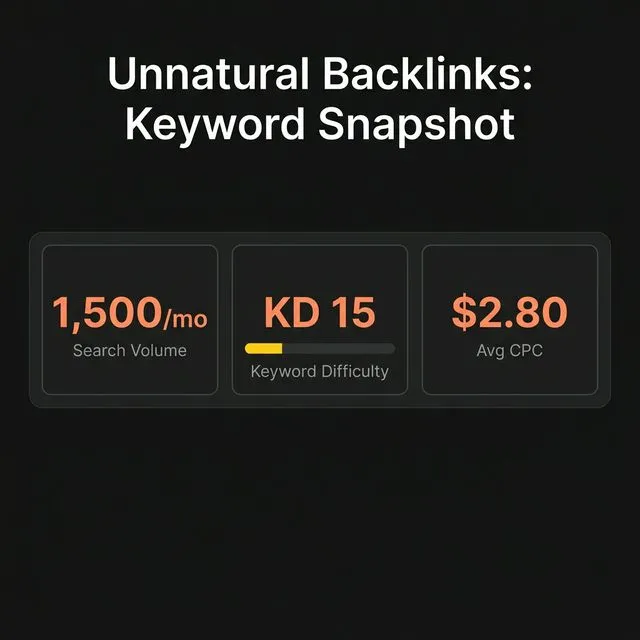
Unnatural backlinks are links that violate Google’s link spam policies because they were created, exchanged, or purchased primarily to manipulate search rankings rather than to provide genuine editorial value to users.
The distinction from toxic backlinks is important:
- Toxic is a third-party SEO tool classification with no Google equivalent
- Unnatural is Google’s official terminology, used in manual actions
- All unnatural links are problematic; not all links labeled “toxic” by tools are unnatural
Google defines unnatural links through specific examples in their link spam policies:
| Unnatural link type | Google’s classification | Detection method |
|---|---|---|
| Buying or selling links that pass PageRank | Link scheme | SpamBrain pattern analysis |
| Excessive link exchanges (“you link to me, I’ll link to you”) | Link scheme | Reciprocal pattern detection |
| Large-scale guest posting with keyword-rich anchors | Link scheme | Anchor text + velocity analysis |
| Automated link creation (comment spam, forum bots) | Link spam | SpamBrain classification |
| Links embedded in widgets distributed across sites | Link scheme | Template/boilerplate detection |
Advertorials or native ads without rel="sponsored" | Undisclosed paid links | Content quality + pattern analysis |
| Private Blog Networks (PBNs) | Link scheme | Hosting, registrant, and content pattern analysis |
How Google Detects Unnatural Links
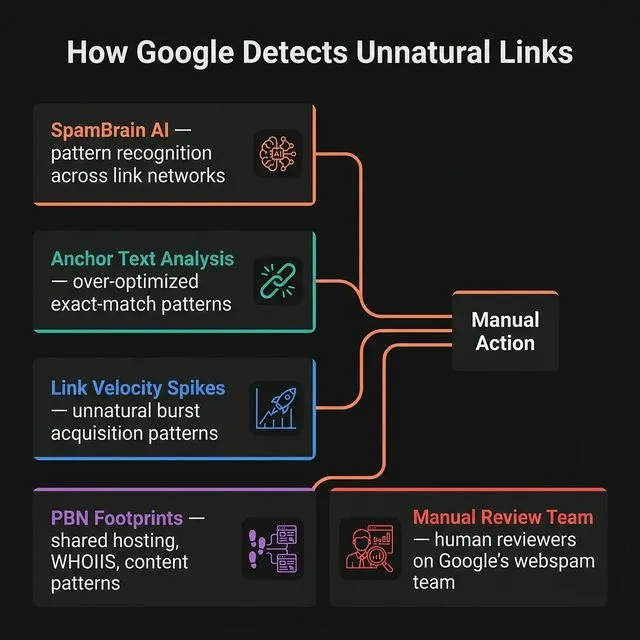
The detection system operates at two levels:
Level 1: SpamBrain (algorithmic)
SpamBrain is Google’s machine learning system specifically trained to identify link spam. It evaluates links at scale and classifies them as spam, suspicious, or legitimate.
When SpamBrain identifies a link as spam, its default behavior is neutralization — it removes the link’s pagerankWeight contribution, reducing the link’s value to zero. This happens silently, without notification to the site owner. Your rankings may decrease, but you won’t see a manual action in Search Console.
Level 2: Manual action (human review)
When SpamBrain’s confidence exceeds a threshold, or when a manual review is triggered (by webmaster reports, quality rater audits, or systematic campaigns), a human reviewer at Google examines the link profile and can issue a manual action.
The leaked API’s linkPenaltyInfo attribute stores the penalty data associated with manual actions. Based on our analysis, this attribute:
- Is applied to link patterns (groups of links from related sources), not individual links
- Stores the severity level (partial match vs. site-wide)
- Is connected to the reconsideration request workflow
Based on our reading of the API leak documentation: linkPenaltyInfo is not a universal link quality score applied to every link. It’s a penalty-specific attribute that is only populated when a manual action has been issued — making it a consequence of human review, not automated classification.
The Two Types of Unnatural Link Manual Actions
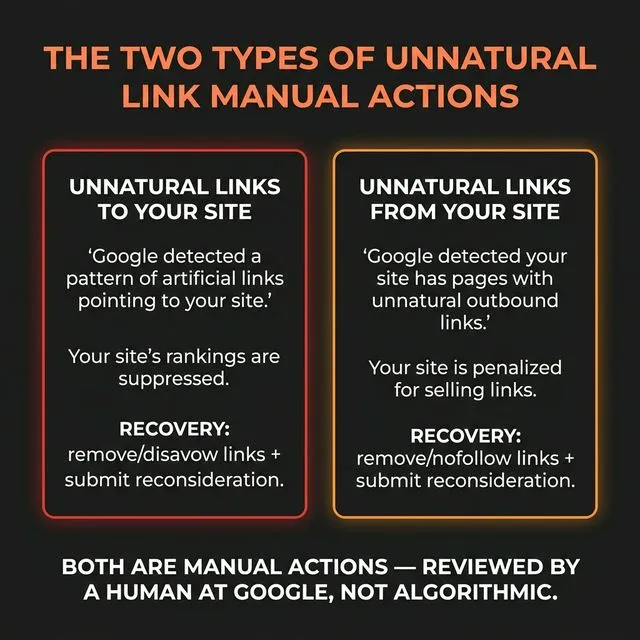
Google issues two distinct manual actions related to unnatural links:
“Unnatural links to your site” (inbound)
What it means: Google has detected that links pointing to your site were created as part of a link scheme. You either participated in the scheme (bought links, used PBNs, ran aggressive guest posting campaigns) or benefited from it.
Severity levels:
- Partial match: Affects specific pages or sections where manipulative links were detected
- Site-wide: Affects your entire domain — typically reserved for systematic, large-scale link schemes
Impact: Ranking demotion for affected pages or the entire site. In severe cases, pages may be removed from the index entirely.
”Unnatural links from your site” (outbound)
What it means: Google has detected that your site is selling links, running a link farm, or hosting paid links that pass PageRank without proper rel="sponsored" or rel="nofollow" attribution.
This is particularly relevant for publishers who monetize through link placements. If you accept payment for links and don’t use rel="sponsored", your site is at risk for this manual action — regardless of the quality of the content surrounding the link.
What Unnatural Links Look Like in Practice
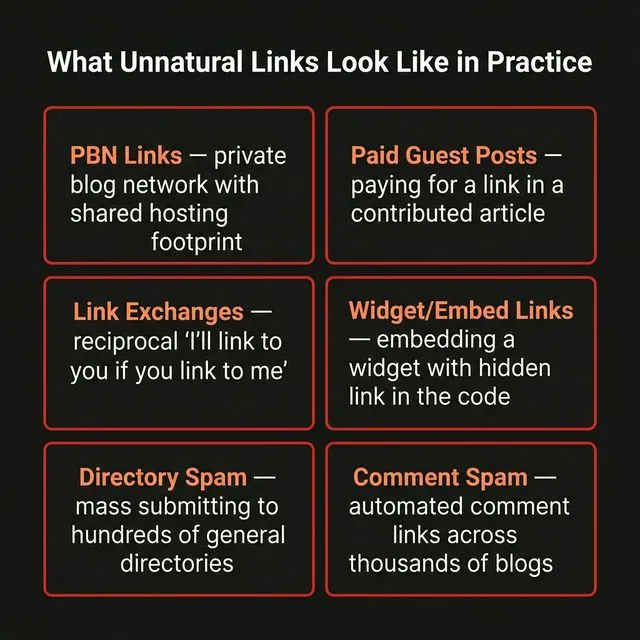
Understanding the patterns that trigger manual actions is more useful than memorizing a list of link types:
Pattern 1: Anchor text manipulation
A natural link profile has diverse anchor text — brand names, generic phrases, partial matches, naked URLs. An unnatural profile shows a disproportionate concentration of exact-match keyword anchors.
Detection signal: The anchorMismatch attribute flags links where anchor text appears engineered rather than natural. When dozens of links use the same exact-match anchor from different domains, it creates a pattern signature that SpamBrain recognizes.
Pattern 2: Link velocity spikes
Acquiring 200 links in a week when your historical rate is 5 per month creates a velocity spike. Natural backlinks accumulate in event-driven patterns — content goes viral, earns a media mention, or gets shared by an influencer. Unnatural velocity lacks these correlating events.
Pattern 3: Source homogeneity
Links exclusively from one type of source — all from guest posts, all from directories, all from press releases — suggest a systematic campaign rather than organic citation. Natural link profiles show diverse source types.
Pattern 4: Content-link mismatch
Links from pages where the content has no editorial reason to reference your page. A cooking blog linking to your SEO guide with anchor text “best link building strategies” is a clear content-link mismatch that the context2 hash (see our contextual backlinks analysis) would flag.
Pattern 5: Network signatures
Links from sites that share hosting, registrants, IP addresses, or content management patterns. PBN detection has become increasingly sophisticated — Google cross-references WHOIS data, hosting infrastructure, content patterns, and linking behavior to identify network relationships.
How to Recover from an Unnatural Links Manual Action
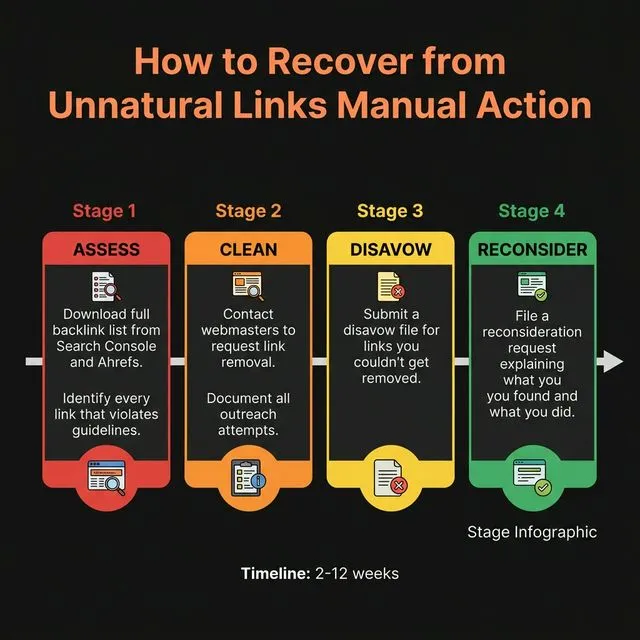
If you receive an “Unnatural links to your site” manual action, here’s the evidence-based recovery process:
Step 1: Identify the manipulative links
Download your complete backlink profile from Google Search Console (Links report) and cross-reference with Ahrefs data. Look for the patterns described above:
- Clusters of exact-match anchors from different domains
- Links from known PBN providers or link sellers you used
- Links from sites with clear network relationships (shared hosting, similar content)
- Guest post links with keyword-stuffed anchors
Step 2: Remove what you can
Contact webmasters and request link removal for links you can attribute to schemes you participated in. Document every outreach attempt — Google wants to see that you made genuine effort to clean up.
Focus on links you actively built or paid for. Don’t try to remove natural backlinks that happen to be from low-quality sites — those aren’t what triggered the manual action.
Step 3: Disavow the remainder
Upload a disavow file for links that you couldn’t remove through direct outreach. Be comprehensive but targeted — disavow the domains and URLs associated with the scheme, not your entire backlink profile.
Step 4: Submit a reconsideration request
In Search Console, submit a reconsideration request that includes:
- Acknowledgment of the practices that led to the manual action
- Documentation of removal efforts (emails sent, responses received)
- The disavow file reference
- A commitment to future compliance with link spam policies
Step 5: Wait and iterate
Google reviews reconsideration requests manually. Average processing time: 2–8 weeks. If the request is denied:
- Review the denial reason (usually “not enough links removed”)
- Expand your disavow file to cover additional suspicious links
- Resubmit with additional documentation
Recovery timeline
| Phase | Timeline | Expected outcome |
|---|---|---|
| Audit + cleanup | 1–2 weeks | Comprehensive link audit, removal requests sent |
| Reconsideration | 2–8 weeks | Manual review by Google Quality team |
| Recovery (if approved) | 2–4 weeks | Gradual ranking restoration |
| Full recovery | 2–6 months | Pre-penalty ranking levels (in most cases) |
Prevention: How to Avoid Unnatural Link Actions
Build high quality backlinks that satisfy all 6 quality factors
Links that satisfy authority, relevance, context, editorial intent, engagement, and anchor alignment don’t trigger spam patterns — because they behave exactly like natural backlinks.
Diversify anchor text
Keep exact-match keyword anchors below 5–10% of your total profile. Use brand mentions, generic anchors, and partial matches for the majority of placements.
Avoid link schemes at scale
One paid link from a relevant site is unlikely to trigger a manual action. But a systematic campaign of paid links across dozens of sites creates the pattern-level signal that SpamBrain is designed to detect.
Use rel="sponsored" for paid placements
If you pay for a link or receive compensation for publishing a link, use rel="sponsored". This converts the link from a potential dofollow scheme into a compliant sponsored backlink — eliminating the manipulation signal entirely.
Work with agencies that prioritize quality over volume
No responsible link building agency should build links using PBNs, link exchanges, or schemes. The short-term ranking gains never justify the recovery cost when a manual action hits. At Get Me Links, we build exclusively through editorial placements and genuine outreach � the methods that produce durable rankings and zero manual action risk. See how we approach compliant link building ?
What This Means for GEO and Source Authority
Unnatural link manual actions have an outsized impact on GEO because AI Overview source selection has a higher trust threshold than organic ranking.
A site with a current or historical manual action for unnatural links may:
- Be excluded from AI Overview citation entirely (trust score below threshold)
- Have its
contentEffortassessment reduced (Google questions the editorial integrity of a site that participated in link schemes) - Require a longer recovery period for GEO qualification than for organic ranking recovery
The AI Overview source selection patent (US20240289407A1) uses Layer 2 (query-independent trust) as a qualifying filter. A manual action directly compromises this layer — making unnatural link avoidance a GEO prerequisite, not just an SEO best practice.
Based on our reading of patent US20240289407A1: Manual actions likely create a persistent trust deficit that takes longer to recover from in the GEO pipeline than in organic ranking. Prevention is significantly more valuable than recovery.
In the Source ? Consensus ? Trust framework, unnatural links are the direct antithesis: they attempt to manufacture trust through artificial means, bypassing the genuine editorial consensus that the framework requires. The result is always temporary � and the recovery cost always exceeds the original ranking gain.
At Get Me Links, every link we build passes the same quality evaluation that Google’s own systems use. No PBNs, no link exchanges, no schemes � just editorial placements that build genuine Source authority. Talk to us about sustainable, compliant link building ?
Frequently Asked Questions
What are unnatural backlinks?
Unnatural backlinks are links created primarily to manipulate search rankings rather than provide genuine editorial value. They include links from PBNs, paid link schemes, excessive link exchanges, automated spam, and advertorials without proper disclosure. Google detects them through SpamBrain’s algorithmic analysis and human manual review.
How do I know if I have unnatural backlinks?
Check Google Search Console → Manual Actions. If you have an “Unnatural links to your site” action, Google has confirmed unnatural links. If no manual action exists, any low-quality links in your profile are likely being ignored by Google’s algorithms rather than causing harm.
What happens if Google finds unnatural links?
Two outcomes: SpamBrain neutralizes the links silently (removes their ranking signal with no notification), or Google issues a manual action that demotes your rankings with an explicit notification in Search Console. The manual action requires a formal recovery process including cleanup and reconsideration request.
How long does recovery from an unnatural link penalty take?
Typical timeline: 1-2 weeks for audit and cleanup, 2-8 weeks for Google’s reconsideration review, and 2-4 weeks for ranking restoration after approval. Full recovery to pre-penalty levels usually takes 2-6 months. Some sites never fully recover if the penalty was site-wide and the damage was prolonged.
Is all link building considered unnatural by Google?
No. Google’s link spam policies target manipulative schemes, not all outreach. Editorial backlinks earned through genuine value, guest posts with editorial merit, and outreach-based placements that produce contextual backlinks in relevant content are all legitimate — because they produce the same signals as naturally earned links.
References:
- Google. (2024). Content Warehouse API Documentation (Leaked). Attributes cited:
linkPenaltyInfo,pagerankWeight,anchorMismatch,sourceType,context2. - SparkToro & Fishkin, R. (2024). An Anonymous Source Shared Thousands of Leaked Google Search API Documents with Me. SparkToro Blog.
- Google. (2024). Link spam policies. Google Search Central.
- Google. (2024). Manual actions report documentation. Google Search Central.
- Google. (2024). Disavow Tool documentation. Google Search Central.
- Google. (2024). Reconsideration request documentation. Google Search Central.
- Google. (2024). Patent US20240289407A1: AI Overview source selection and scoring. USPTO.
- Wikipedia. (2025). Backlink.