
- A YouTube backlink is a link from YouTube to your website — placed in video descriptions, pinned comments, end screens, channel about pages, or community posts. All external YouTube links are
rel="nofollow". - YouTube links don’t pass traditional
pagerankWeight. Their value comes from entity co-occurrence (Google processes video transcripts, titles, and descriptions to associate your brand with topics), referral traffic (YouTube is the world’s second-largest search engine), and Google’s hint model (nofollow is advisory since 2020). - Google owns YouTube and has deep integration between YouTube data and web search signals. Video descriptions containing your URL create entity associations that operate independently of the link’s follow status.
- The video description is the highest-value link placement — the first 3 lines appear above the fold without users clicking “show more.” Pinned comments provide secondary value through engaged audience interactions.
- YouTube backlinks are best understood as entity building and traffic generation tools, not link building tools. They complement a dofollow backlink strategy but don’t replace it.
YouTube sends more daily traffic than any social platform. It’s also owned by Google — meaning YouTube data feeds directly into the same systems that process web search. Yet most SEO discussions about YouTube backlinks stop at “they’re nofollow, so they don’t count.”
That analysis is incomplete. While YouTube links don’t pass pagerankWeight through the traditional link graph, they contribute to ranking through channels that are unique to Google’s first-party platforms: entity co-occurrence from video transcripts, implicit brand associations, and referral traffic that generates engagement signals.
What Is a YouTube Backlink?
A YouTube backlink is any external link from a YouTube page to your website. YouTube adds rel="nofollow" to all external links, whether they appear in:
- Video descriptions
- Pinned and regular comments
- Channel about pages
- End screen cards (as redirecting URLs)
- Community post tab
- Playlist descriptions
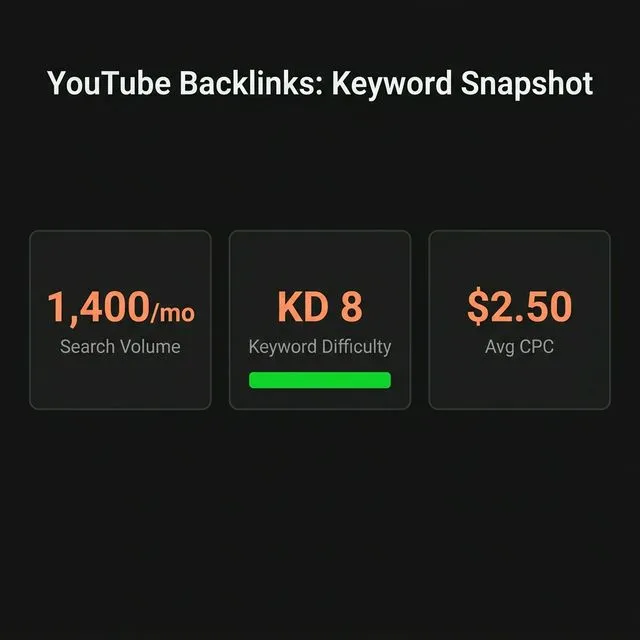
The nofollow attribute means YouTube links don’t transfer pagerankWeight through Google’s standard link graph — the same mechanism that governs how value flows from dofollow backlinks. But YouTube is a Google property, and the data flows between YouTube and web search operate through channels beyond the backlink graph.
How YouTube Links Actually Pass Signal
YouTube links provide value through 3 channels that are distinct from traditional backlinks:
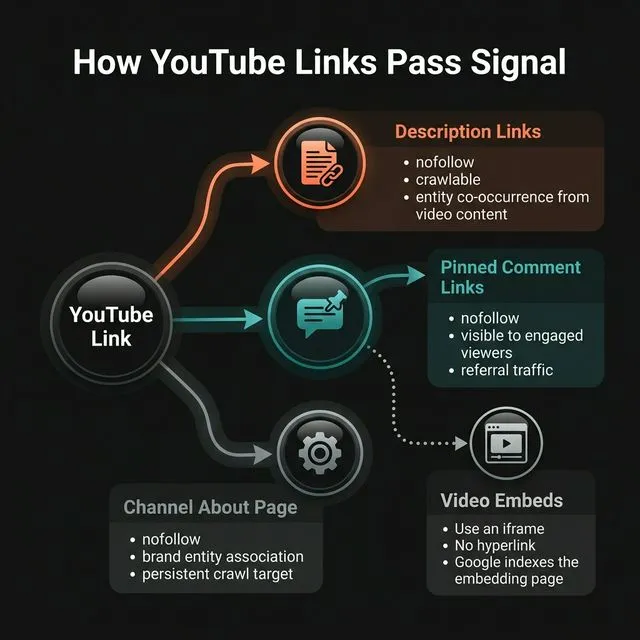
Channel 1: Entity co-occurrence from video content
This is YouTube’s unique value proposition for SEO. When you create a video about a topic and include your URL in the description, Google processes:
- Video title — associated with your channel (brand entity)
- Video transcript — auto-generated or manual, creating rich topical context
- Description text — including your URL alongside topic-relevant content
- Tags and hashtags — explicit topic signals
- Viewer engagement — watch time, comments, and shares on the topic
This creates entity co-occurrence: your brand appears alongside specific topics across multiple signals. Over time, Google’s entity recognition systems associate your brand with the topics you consistently cover on video.
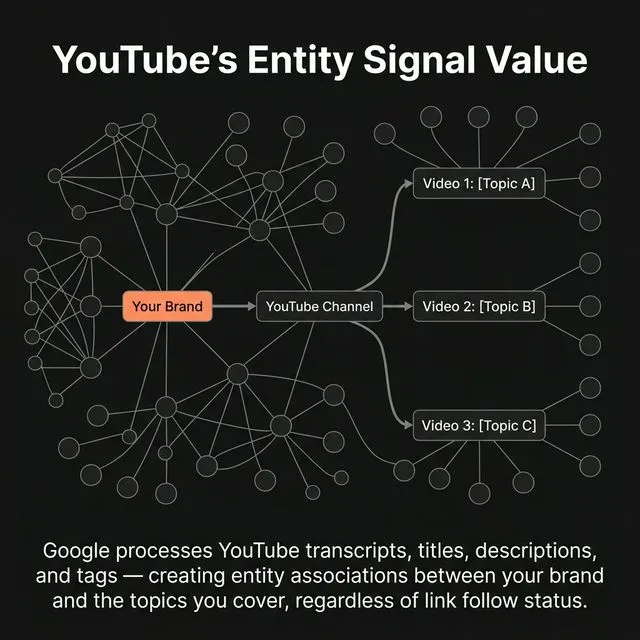
Entity co-occurrence operates independently of the link’s follow/nofollow status because it’s a content signal, not a link signal. Google indexes YouTube video pages, processes their text content, and uses that information for entity disambiguation and topical authority assessment.
Channel 2: Referral traffic and engagement signals
YouTube has approximately 2.5 billion monthly active users. Videos that rank in YouTube search or appear in recommendations can drive significant traffic to your site through description links.
This referral traffic generates real engagement signals:
- Users who arrive from a relevant YouTube video are typically highly engaged (they just watched content about the topic)
- Time on site, pages per session, and return visit rates tend to be strong
- These engagement patterns feed into NavBoost and similar systems
A YouTube video that ranks for a relevant search query and consistently sends engaged visitors to your site can influence your web search performance — through engagement quality, not through the link itself.
Channel 3: Google’s hint model + first-party data
Since 2020, Google treats nofollow as a hint — meaning Google can choose to credit nofollow links when the editorial context warrants it. YouTube presents a unique case because:
- YouTube is a Google-owned property with deep data integration
- YouTube’s editorial gatekeeping (community guidelines, spam detection) provides quality signals
- The first-party relationship means Google has complete data about every YouTube page
Whether Google treats YouTube nofollow links differently from other nofollow links is not publicly confirmed. But the hint model combined with first-party data access creates a special case that’s fundamentally different from a nofollow link on a random blog.
Based on our reading of Google’s 2019 nofollow announcement and YouTube’s integration with web search: YouTube links likely carry more weight than comparable nofollow links from other platforms — not through a YouTube-specific bonus, but because Google has complete first-party data on YouTube content quality, engagement, and editorial context.
Where to Place Links on YouTube
Link placement matters significantly on YouTube because different locations have dramatically different visibility and click-through rates:
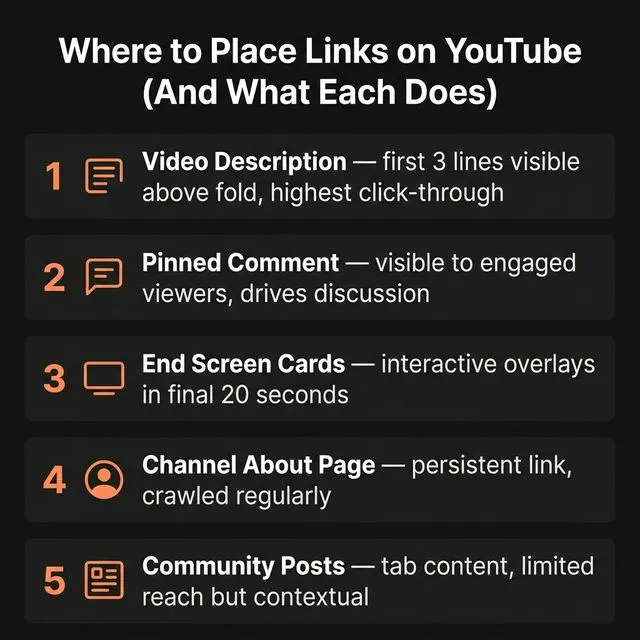
1. Video description (highest value)
The first 3 lines of the video description appear above the “Show more” fold. Links placed here have the highest visibility and click-through rate. Best practices:
- Place your most important link in the first 3 lines
- Include context around the link (what it leads to, why it’s relevant)
- Use tracking parameters (
?utm_source=youtube&utm_medium=video) to measure traffic
2. Pinned comment
A pinned comment appears at the top of the comments section — visible to viewers who are engaged enough to scroll past the description. Pinned comments work well for:
- Time-sensitive links (event registrations, limited offers)
- Supplemental resources (“Download the template mentioned in this video”)
- Community engagement (“Read the full study here”)
3. End screen cards
Interactive overlays that appear in the last 5–20 seconds of a video. These can link to external URLs (for channels with 1,000+ subscribers). End screen cards work because viewers who watch to the end are the most engaged segment.
4. Channel about page
A persistent link that appears on your channel’s about tab. This is a persistent crawl target — Google regularly crawls YouTube channel pages, making this a stable entity association point.
5. Community posts
Posts in the community tab can include links. These have limited visibility but provide contextual placement alongside tab-specific content.
YouTube vs. Traditional Backlinks
Understanding the distinction prevents misallocation of link building effort:
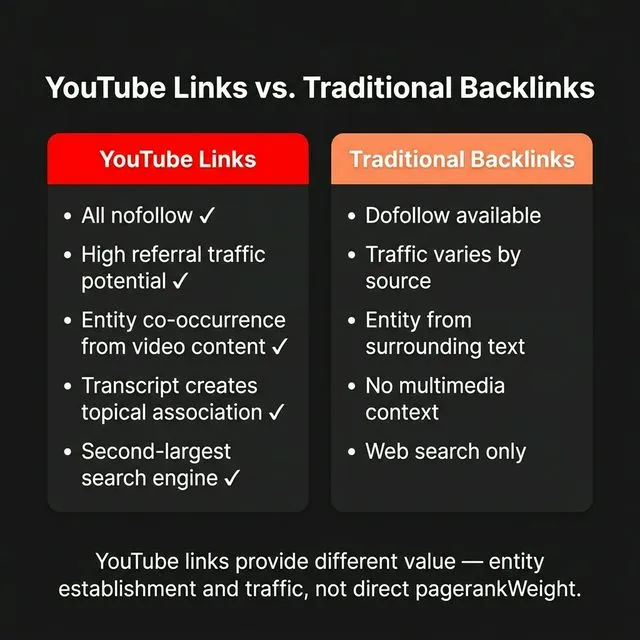
| Dimension | YouTube links | Traditional backlinks |
|---|---|---|
pagerankWeight | None (nofollow) | Full (dofollow) |
| Entity value | High (transcript + topic) | Moderate (surrounding text) |
| Traffic potential | Very high (2.5B MAU) | Varies by source |
| Content context | Video + transcript + tags | Text only |
| Signal durability | Permanent (videos stay live) | Varies (pages can be removed) |
| Crawl frequency | High (Google owns YouTube) | Standard |
| Effort required | Video production (high) | Outreach/content (moderate) |
The practical takeaway: YouTube backlinks are a supplement to traditional link building, not a replacement. They build entity authority and drive traffic, but they don’t directly transfer the pagerankWeight that drives keyword rankings. A complete strategy includes both YouTube entity building and editorial backlinks from relevant publications. At Get Me Links, we design multi-platform authority strategies that combine YouTube entity signals with editorial link acquisition. See how we build cross-platform authority ?
YouTube Backlinks for GEO and Source Authority
YouTube backlinks have growing relevance for GEO because AI Overview systems process video content as supplementary source material:
The AI Overview source selection patent (US20240289407A1) evaluates sources through entity-level trust signals. YouTube videos create entity associations that feed directly into this evaluation:
- Entity establishment: Consistently covering a topic on YouTube creates entity recognition that AI systems can reference
- Multimedia context: AI Overview has access to YouTube transcripts, providing richer context than text-only sources
- Brand authority: A YouTube channel with substantial viewership on a topic demonstrates public authority that AI systems evaluate
- Cross-platform presence: Being cited across YouTube, web, and potentially Wikipedia creates multi-platform entity validation
For GEO specifically, YouTube content serves as entity supporting evidence rather than a direct ranking factor. If your web content is already cited in AI Overview, YouTube videos on the same topics reinforce that entity authority.
The most effective GEO strategy combines YouTube entity presence with high quality backlinks from authoritative web sources — creating a multi-platform entity footprint that AI systems recognize.
In the Source u{2192} Consensus u{2192} Trust framework, YouTube operates at the entity layer: video content on your topic establishes your brand as a recognized Source, cross-platform presence (YouTube + web + potentially Wikipedia) creates multi-dimensional Consensus, and AI systems recognize that multi-platform entity footprint as genuine Trust. YouTube doesn’t replace editorial links u{2014} it amplifies them.
At Get Me Links, we build the editorial link foundation that YouTube entity signals amplify u{2014} creating the compounding multi-platform authority that both ranking algorithms and AI systems reward. Talk to us about building multi-platform authority u{2192}
Frequently Asked Questions
What are YouTube backlinks?
YouTube backlinks are links from YouTube pages (video descriptions, comments, channel about pages, end screens) to your website. All YouTube external links use rel="nofollow". They don’t pass direct pagerankWeight but provide value through entity co-occurrence, referral traffic from YouTube’s 2.5 billion monthly users, and Google’s hint model.
Do YouTube links help SEO?
YouTube links help SEO indirectly — through entity establishment (Google processes video transcripts and titles, associating your brand with topics), referral traffic (engaged visitors generate positive engagement signals), and the hint model (Google may credit nofollow links from high-quality contexts). They don’t directly transfer pagerankWeight like dofollow backlinks.
Are YouTube backlinks dofollow or nofollow?
All YouTube external links are rel="nofollow". YouTube applies nofollow to every outbound link — regardless of where it appears (description, comment, about page, community post). This has been YouTube’s policy since the platform began including external links.
How many YouTube backlinks do I need?
YouTube link quantity is irrelevant for SEO. What matters is the entity co-occurrence created by your video content — covering topics relevant to your niche, consistently producing quality videos, and including your URL in well-crafted descriptions. One video that ranks well and drives engaged traffic is worth more than 100 video descriptions with links but no viewership.
Should I buy YouTube backlinks?
Never buy YouTube backlinks. Services that offer YouTube link placement use spam accounts, bot-generated comments, or low-quality channels that violate YouTube’s community guidelines. These accounts get banned, their content gets removed, and the links disappear — providing zero long-term value while risking association with spam networks.
References:
- Google. (2024). Content Warehouse API Documentation (Leaked). Attributes cited:
pagerankWeight, entity co-occurrence signals,impliedLinks. - SparkToro & Fishkin, R. (2024). An Anonymous Source Shared Thousands of Leaked Google Search API Documents with Me. SparkToro Blog.
- Google. (2019). Evolving “nofollow” — new ways to identify the nature of links. Google Search Central Blog.
- YouTube. (2025). External links on YouTube — Community Guidelines. YouTube Help.
- Google. (2024). Patent US20240289407A1: AI Overview source selection and scoring. USPTO.
- Statista. (2025). YouTube monthly active users worldwide. Statista.
- Google. (2024). How Google Search works — Crawling, indexing, and serving. Google Search Central.
- Wikipedia. (2025). YouTube.