
- PR backlinks are links earned through public relations activities — either digital PR (proactive campaigns that earn editorial coverage) or press release distribution (wire service syndication). These two approaches produce fundamentally different link types.
- Digital PR links are among the most valuable backlinks you can earn. They’re editorial backlinks from journalists — dofollow, contextually relevant, and placed in high-authority publications with full
pagerankWeighttransfer and strongcontext2signal. - Press release wire links (PRWeb, Business Wire, GlobeNewsWire) are syndicated nofollow links with minimal SEO value. They appear on dozens of sites simultaneously but carry near-zero
pagerankWeightbecause they’re duplicate boilerplate content. - The leaked API differentiates between editorial citations (high
sourceTypeclassification) and syndicated content (boilerplate detection). A single digital PR placement in a DR 70 publication provides more ranking signal than press releases distributed to 500 syndication sites. - 6 asset types consistently earn digital PR links: original research, data visualizations, free tools, expert commentary, contrarian takes with data, and localized data angles.
“PR backlinks” is a term that covers two completely different link building approaches. Digital PR — earning editorial coverage through newsworthy campaigns — produces some of the most valuable backlinks available. Press release distribution — syndicating announcements through wire services — produces large volumes of low-value nofollow links.
Understanding the difference is essential because the industry uses “PR backlinks” interchangeably for both. A link building agency offering “PR link building” might mean proactive journalist outreach and data-driven campaigns, or it might mean distributing press releases to wire services. The links these approaches produce are not comparable.
What Are PR Backlinks?
PR backlinks are links earned through public relations activities. They fall into two distinct categories:
Digital PR backlinks
Links earned when a journalist or editor covers your story, cites your data, or references your research in an editorial article. These are:
- Dofollow (in most cases — publishers link naturally)
- Editorial — placed by a journalist making an editorial decision
- Contextual — surrounded by relevant editorial content
- High authority — from established publications with strong
pagerankWeight
Press release wire backlinks
Links included in press releases distributed through wire services (PRWeb, Business Wire, PR Newswire, GlobeNewsWire). These are:
- Nofollow (wire services add nofollow to all links)
- Syndicated — the same text appears on hundreds of sites
- Boilerplate — identical content detected by Google’s duplicate content systems
- Low authority — syndication sites carry minimal editorial value
Digital PR vs. Press Release Wire Services
The distinction is fundamental:
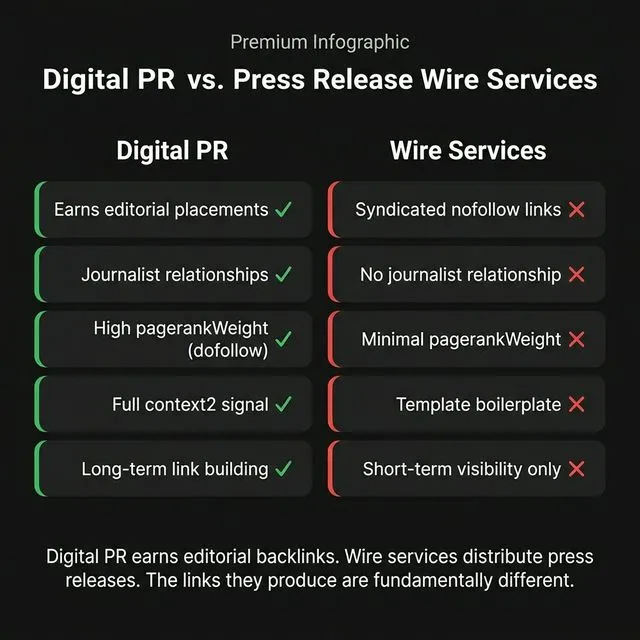
| Dimension | Digital PR | Wire services |
|---|---|---|
| Link type | Dofollow editorial | Nofollow syndicated |
pagerankWeight | Full transfer | Near zero |
context2 signal | Full (editorial context) | None (duplicate boilerplate) |
sourceType | Editorial | Syndicated/boilerplate |
| Boilerplate detection | Unique content per placement | Detected as duplicate |
| Cost per link | $200–$2,000+ (varies by quality) | $100–$500 per distribution |
| Volume | 5–50 placements per campaign | 100–500 syndication sites |
| Relationship building | Yes (journalist networks) | No |
Why wire service links provide minimal SEO value
Google’s boilerplate detection system identifies duplicate press release content across syndication networks. When the same text appears on 300 sites, Google:
- Identifies the primary source (the wire service origin)
- Classifies syndicated copies as boilerplate/duplicate — reducing their individual signal value
- Consolidates the signal to approximately one link’s worth of value
- Applies nofollow — the wire services themselves add nofollow, and Google’s hint model has little reason to override it for syndicated content
A press release distributed to 300 sites produces approximately the same ranking signal as one nofollow link from a low-authority site. The distribution creates brand visibility (your company name appears on many sites) but not meaningful link signal.
Based on our reading of the API leak and Google’s boilerplate detection patents: Syndicated press releases are processed similarly to sitewide backlinks — consolidated to avoid counting duplicate content as multiple endorsements. The combination of nofollow + boilerplate + syndication makes wire service links among the lowest-value link types available.
The PR Backlink Spectrum
Not all PR backlinks are equal. They exist on a spectrum from commodity syndication to exceptional editorial placement:
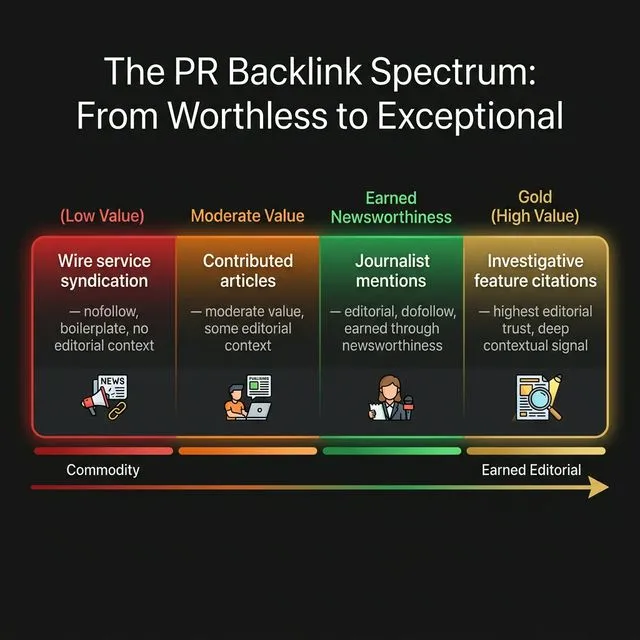
Level 1: Wire syndication (lowest value)
Press releases distributed through wire services. Nofollow, duplicate content, no editorial context. Value: brand awareness only.
Level 2: Contributed/sponsored articles (low-moderate)
Articles you write and place on publications — sometimes marked as “contributed,” “sponsored,” or “partner content.” These may carry nofollow or sponsored attributes, and Google’s sourceType classification may distinguish them from true editorial content.
Level 3: Journalist mentions (high value)
A journalist covering your industry mentions your company, product, or data in their reporting. These are genuine editorial backlinks — the journalist made an editorial decision to include you. Dofollow, contextual, full signal.
Level 4: Feature citations (highest value)
An in-depth feature, investigative piece, or analysis that uses your research as a primary source. These citations carry the strongest context2 signal because your data is central to the journalist’s argument — not just a passing mention.
Anatomy of a Digital PR Campaign That Earns Links
The process for earning digital PR backlinks is fundamentally different from press release distribution:
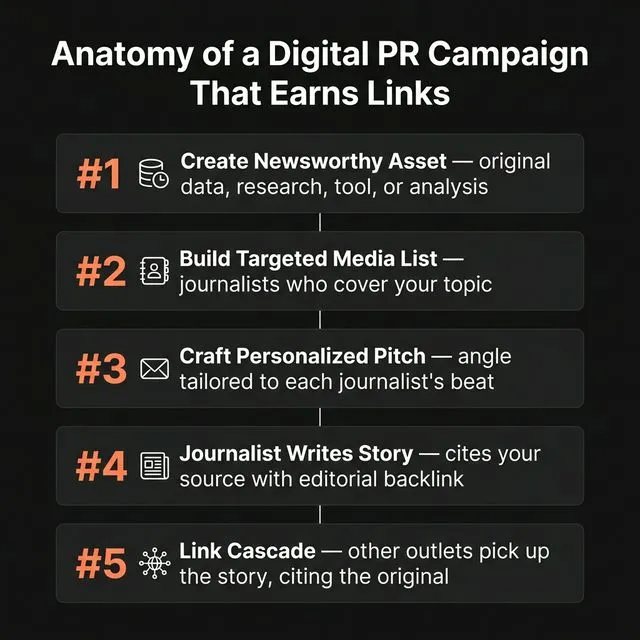
Step 1: Create a newsworthy asset
The foundation of digital PR is newsworthiness. Journalists don’t link to company announcements — they link to stories that serve their readers. Newsworthy assets include:
- Original data that reveals something surprising or confirms/contradicts a common belief
- Research findings that provide new insight into a trending topic
- Free tools that solve a real problem for a significant audience
- Expert analysis that provides unique perspective on breaking news
Step 2: Build a targeted media list
Identify journalists who cover your topic, read their recent work, and understand their editorial interests. A targeted list of 50 relevant journalists outperforms a generic blast to 5,000.
Step 3: Craft personalized pitches
Each pitch should explain why the specific journalist’s audience would care about your asset. Reference their recent work, offer exclusive angles, and make it easy for them to write the story.
Step 4: Journalist writes the story
If the pitch resonates, the journalist writes their own article — citing your source, linking to your research, and adding their editorial perspective. This produces a genuine editorial backlink with full pagerankWeight and context2 signal.
Step 5: The link cascade
Coverage in one publication often triggers coverage in others — especially for data-driven stories. Journalists monitor each other’s beats, and a story in a major publication can cascade into 10–50+ additional placements across regional and niche outlets.
6 PR Asset Types That Earn Backlinks
Not all content is suited for digital PR. These 6 asset types consistently earn journalist citations:
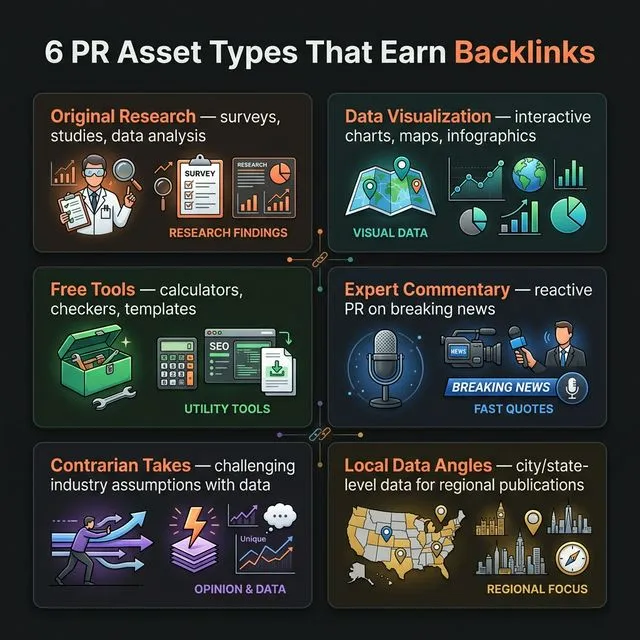
1. Original research
Surveys, studies, and data analysis that reveal new findings. The more surprising or counterintuitive the finding, the more newsworthy.
Example: “We analyzed 50,000 backlink profiles and found that 73% of sites in positions 1–3 have fewer than 50 referring domains” would be newsworthy because it challenges the assumption that top rankings require massive link profiles.
2. Data visualizations
Interactive charts, maps, and infographics that make complex data accessible. Journalists frequently embed or reference visual data in their reporting.
3. Free tools and calculators
Tools that solve specific problems generate ongoing link acquisition as users and writers recommend them. A well-built free tool can earn links for years after launch.
4. Expert commentary (reactive PR)
When breaking news hits your industry, being available with expert analysis within hours can earn citation in breaking coverage. This requires monitoring tools and rapid response capability.
5. Contrarian takes with supporting data
Challenging industry assumptions — with data to back your position — attracts journalist attention because it creates debate. “Here’s why the common advice about X is wrong, and here’s the data” is inherently newsworthy.
6. Local data angles
City-level, state-level, or regional data breakdowns earn links from local publications that cover their area. A national study broken down by city can generate 50+ local media placements.
Digital PR requires journalist-grade research assets and authentic editorial outreach � the kind of investment that separates intelligence-led link building from commodity outreach. See how Get Me Links approaches digital PR campaigns ?
What This Means for GEO and Source Authority
Digital PR backlinks are exceptionally valuable for GEO because they satisfy every qualification criterion in the AI Overview source selection patent (US20240289407A1):
- Trust (Layer 2): Editorial citations from established publications build institutional trust
- Relevance (Layer 3): Journalist-placed contextual links create strong topical associations
- Authority (Layer 4): Publications with high
pagerankWeighttransfer entity authority - Citation diversity: Multiple editorial placements across different publications create the citation breadth AI systems prioritize
For GEO, digital PR may be the single most effective link building strategy — because it produces exactly the kind of editorial, authoritative, contextual citations that AI Overview systems are designed to surface.
Wire service press releases provide near-zero GEO value. Syndicated duplicate content is not the kind of editorial endorsement that AI systems seek.
This is the Source ? Consensus ? Trust cycle at its most powerful: digital PR creates genuine editorial citations from trusted publications (Source), those independent journalistic endorsements form a distributed consensus pattern (Consensus), and both ranking algorithms and AI overview systems recognize that editorial validation as the highest form of trust (Trust).
At Get Me Links, digital PR is a core capability � we build the research assets and journalist relationships that produce the editorial citations AI systems reward. Talk to us about earning editorial placements ?
Frequently Asked Questions
What are PR backlinks?
PR backlinks are links earned through public relations activities. Digital PR backlinks are editorial links from journalists who cite your research or data — high value, often dofollow, with full contextual signal. Press release wire backlinks are syndicated nofollow links from distribution services — low value, duplicate content, minimal SEO impact.
Are press release backlinks good for SEO?
Press release wire backlinks provide minimal SEO value. They’re nofollow, syndicated across hundreds of sites (detected as duplicate content), and carry near-zero pagerankWeight. Their value is brand visibility, not ranking signal. Digital PR backlinks — editorial placements from journalists — are far more valuable.
How much do digital PR backlinks cost?
Digital PR campaigns typically cost $2,000–$15,000+ per campaign, producing 5–50+ editorial placements. The cost per individual link ($200–$2,000+) varies by publication authority. This is significantly higher than press release distribution ($100–$500) but produces fundamentally different link types with far greater ranking impact.
What’s the difference between digital PR and link building?
Digital PR is a specific link building method that earns links through journalism — creating newsworthy assets and earning editorial coverage. Traditional link building includes many methods: guest posting, resource page outreach, broken link building, and more. Digital PR typically produces the highest-quality links because they’re genuine editorial citations from high-authority publications.
Can digital PR help with brand building and SEO simultaneously?
Yes — this is digital PR’s unique advantage. Unlike most link building methods (which produce links with limited visibility), digital PR earns links within visible editorial content that real audiences read. Every editorial placement provides both a high-quality backlink for SEO and brand exposure to the publication’s audience.
References:
- Google. (2024). Content Warehouse API Documentation (Leaked). Attributes cited:
pagerankWeight,context2,sourceType, boilerplate detection. - SparkToro & Fishkin, R. (2024). An Anonymous Source Shared Thousands of Leaked Google Search API Documents with Me. SparkToro Blog.
- Google. (2004). Patent US7058628B1: Information retrieval based on boilerplate detection. USPTO.
- Google. (2024). Link spam policies. Google Search Central.
- Google. (2024). Patent US20240289407A1: AI Overview source selection and scoring. USPTO.
- Google. (2019). Evolving “nofollow” — new ways to identify the nature of links. Google Search Central Blog.
- Tow Knight Center. (2023). How newsrooms source stories in the digital age. Columbia University.
- Wikipedia. (2025). Digital public relations.