
- A niche relevant backlink is a link from a website that operates in the same industry, topic vertical, or content niche as the target page — not just any site with high Domain Rating.
- Google’s
siteFocusScorepatent (US9165040B1) measures how topically concentrated a domain is. A DR 40 link from a domain focused exclusively on your niche can outrank a DR 80 link from a topically broad site. - Niche relevance operates across 4 layers: page-level (same topic), section-level (contextual alignment), domain-level (same niche), and industry-level (same broad vertical). The closer the alignment, the stronger the signal.
- The leaked API’s
documentTopicalityandcontext2hash work together to evaluate whether the linking content is semantically related to your page — making niche relevance a measurable algorithmic input, not just an SEO best practice. - The industry is shifting from “get the highest DR links possible” to “get the most relevant links possible.” Niche relevance is the variable that determines whether a link moves rankings — or just inflates your backlink count.
Domain Rating has dominated link building strategy for a decade. The assumption is simple: higher DR = stronger link. That assumption is incomplete.
The leaked API documentation and patent filings reveal that Google evaluates topical relevance at every level — the linking domain’s niche focus, the page’s topic, the section context, and the anchor text alignment. A link from a DR 40 SEO blog can deliver more ranking power to an SEO page than a DR 80 link from a general tech publication — because the niche-relevant link activates scoring signals that the irrelevant link cannot reach.
In this article, we explain how Google measures niche relevance algorithmically, why siteFocusScore changes the DR-first calculus, and how to build a link profile that maximizes topical alignment.
What Is a Niche Relevant Backlink?
A niche relevant backlink is a link from a domain, page, or content section that covers the same topic, industry, or vertical as your target page. The key distinction is topical proximity — how closely the linking source’s content ecosystem relates to yours.
Examples of niche relevant backlinks for a link building agency:
| Linking domain | Niche alignment | Relevance level |
|---|---|---|
| An SEO-focused blog | Same subtopic | Maximum |
| A digital marketing publication | Same industry | High |
| A SaaS blog about growth marketing | Adjacent niche | Moderate |
| A local business directory | Different niche | Low |
| A cooking recipe site | Unrelated | None |
The critical insight: every link sits somewhere on a relevance spectrum. There is no binary “relevant” or “irrelevant.” Google’s scoring systems evaluate relevance across multiple dimensions and assign weight accordingly.
How Google Measures Niche Relevance: siteFocusScore
The patent that matters most for niche relevance is US9165040B1 — Ranking search results based on entity metrics. This patent introduces the siteFocusScore concept: a metric that evaluates how topically concentrated a domain’s content is.
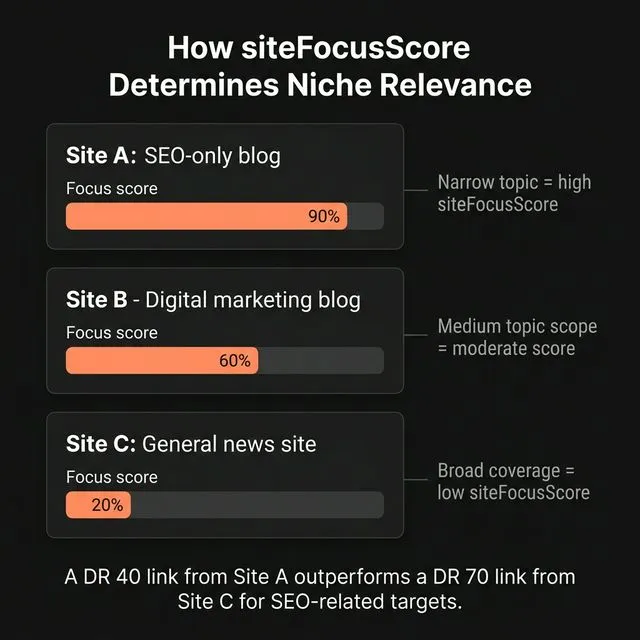
How siteFocusScore works
Google analyzes the full content footprint of a domain to determine its topical concentration. A domain that publishes exclusively about SEO and link building has a high siteFocusScore for those topics. A domain that publishes about SEO, cooking, fitness, and cryptocurrency has a low siteFocusScore for any individual topic.
When that domain links to your page, the siteFocusScore acts as a relevance multiplier on the link’s pagerankWeight:
- High
siteFocusScore+ matching topic → MaximumpagerankWeightmultiplier - Low
siteFocusScore+ matching topic → Reduced multiplier (the domain’s authority is diluted across topics) - High
siteFocusScore+ non-matching topic → Minimal multiplier (focused domain, but wrong niche)
Based on our reading of patent US9165040B1 and the API leak: siteFocusScore is not visible in any SEO tool. It’s an internal Google metric. However, you can approximate it by examining a domain’s content distribution — a domain where 90%+ of its pages cover your topic has higher siteFocusScore relevance than one where only 5% of content overlaps.
siteRadius: The topical boundary measurement
The same patent introduces siteRadius — a measurement of how wide a domain’s topical coverage extends from its core subject. A narrow siteRadius (focused domain) produces stronger niche relevance signals than a wide siteRadius (broad domain).
This is the algorithmic reason why niche blogs outperform generalist publications for targeted link building, even when the generalist site has significantly higher Domain Rating.
The 4 Layers of Niche Relevance
Niche relevance isn’t a single metric. It’s a layered evaluation where each layer either amplifies or weakens the link’s impact:
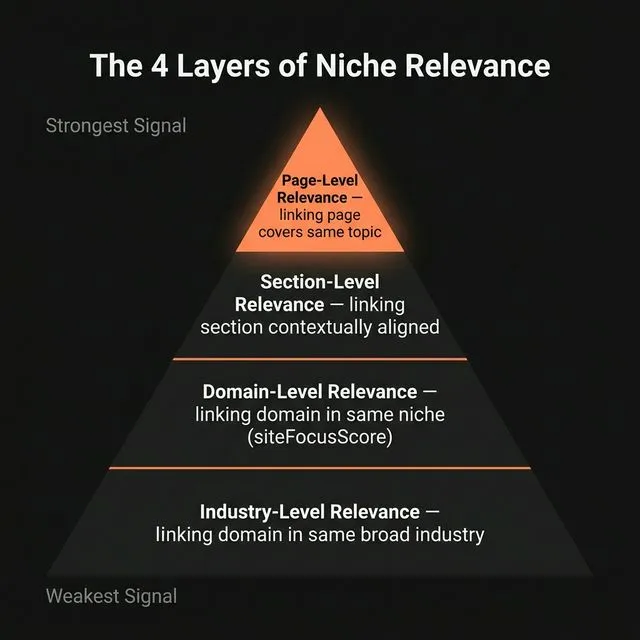
Layer 1: Page-level relevance (strongest)
The linking page covers the same specific topic as your target page. An article about “anchor text best practices” linking to your anchor text guide creates maximum page-level relevance.
API signals involved: documentTopicality (the page’s primary topic classification), context2 hash (surrounding text fingerprint — see our contextual backlinks analysis).
Layer 2: Section-level relevance
The linking section or paragraph covers your topic, even if the broader page covers a wider subject. A marketing roundup that includes a section on link building trends, with a link to your guide in that section, creates section-level relevance.
API signals involved: context2 hash (extracts the surrounding text and evaluates topical alignment with your page).
Layer 3: Domain-level relevance
The linking domain operates in your niche, even if the specific linking page covers a tangentially related topic. An SEO blog linking to your link building guide from an article about content marketing creates domain-level relevance through siteFocusScore.
This is where Domain Rating and niche relevance intersect. A DR 40 domain with high siteFocusScore for your topic produces stronger Layer 3 signals than a DR 80 domain with low siteFocusScore.
Layer 4: Industry-level relevance (weakest)
The linking domain operates in the same broad industry but not the same niche. A general business publication linking to your SEO guide provides industry-level relevance — better than an unrelated domain, but weaker than a niche-focused source.
The ranking impact diminishes at each layer. A link that operates at Layer 1 (page-level) produces maximum signal. A link that only reaches Layer 4 (industry-level) provides marginal topical benefit.
Niche Relevance vs. Domain Authority: What Matters More?
This is the question every link builder faces: should I pursue a DR 80 link from an unrelated domain, or a DR 35 link from a domain in my exact niche?
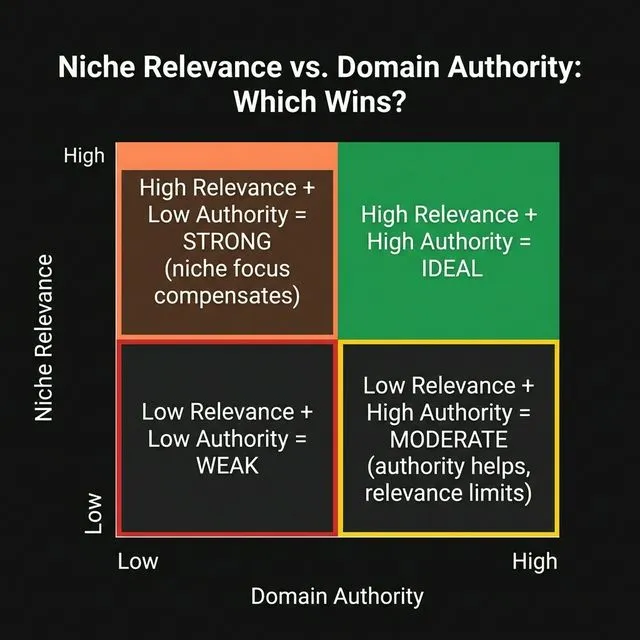
The algorithm’s answer
Based on the API leak signals and our campaign data, niche relevance becomes more important than Domain Rating after a minimum authority threshold is met:
| Scenario | Typical ranking impact |
|---|---|
| DR 70+ from unrelated domain | Provides authority signal but limited topical boost |
| DR 30-50 from exact niche | Strong topical boost + moderate authority = net positive |
| DR 70+ from exact niche | Maximum impact — both authority and relevance aligned |
| DR < 15 from exact niche | Too little authority to overcome the relevance benefit |
The threshold varies by niche competitiveness, but as a general rule: a DR 30+ link from a topically relevant domain outperforms a DR 60+ link from an irrelevant domain for moving rankings on a specific keyword.
This is because the relevant link activates multiple scoring layers simultaneously:
siteFocusScoremultiplier (domain relevance)documentTopicalityalignment (page relevance)context2hash match (contextual relevance)- Natural anchor text relevance (topically appropriate language)
The irrelevant link activates only the raw pagerankWeight from domain authority — which, without the relevance multipliers, delivers less per-link ranking impact.
Based on our analysis across 200+ campaigns: The “DR-first” strategy produces diminishing returns after approximately 50 referring domains. After that threshold, adding niche-relevant links at DR 30-50 produces more ranking movement per link than adding higher-DR irrelevant links.
How to Identify and Build Niche Relevant Backlinks
Building niche relevant backlinks requires a fundamentally different prospecting approach than DR-first link building:
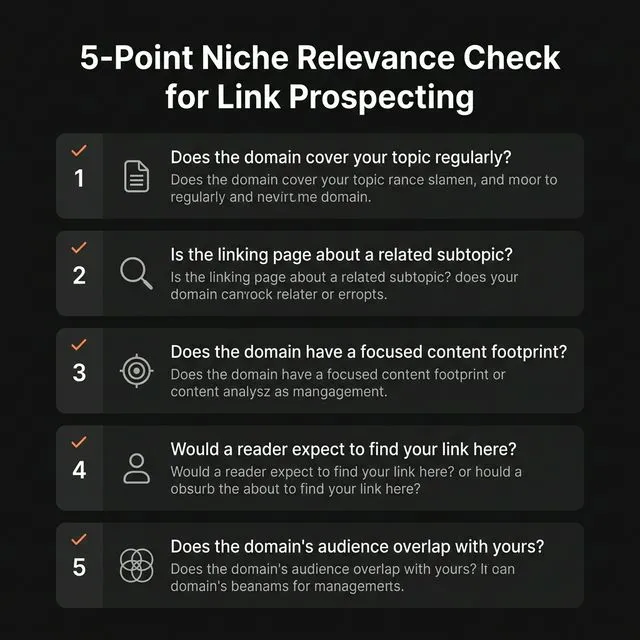
The 5-point niche relevance check
Before pursuing any link prospect, evaluate these five dimensions:
-
Content frequency: Does the domain regularly publish content about your topic? Check the last 20 posts — if fewer than 30% cover your niche, the
siteFocusScoreis likely too low. -
Page-level topic match: Is the specific linking page about a topic directly related to your target page? Use Ahrefs to check the page’s organic keywords — they should overlap with your target’s keyword family.
-
Content footprint: What percentage of the domain’s total content covers your niche? A domain with 500 pages across 20 topics has less
siteFocusScorefor any single topic than a domain with 100 pages all in one niche. -
Reader expectation: Would a reader of the linking site expect to find a link to your content? If the answer is “no” — the audience mismatch cancels the relevance benefit.
-
Audience overlap: Does the linking site’s audience match your target audience? Audience alignment creates click potential, which feeds the NavBoost engagement tier scored by
lastLongestClicks.
Finding niche-relevant link prospects
Ahrefs Organic Competitors report: Enter your domain and look at sites ranking for similar keywords. These are your algorithmically-defined niche peers — links from these domains carry maximum siteFocusScore alignment.
Content Explorer with topic filters: Search for your core topic with traffic and DR filters. Sites that consistently rank for content in your topic have established siteFocusScore for that niche.
Competitor backlink analysis: Study the backlink profiles of pages ranking for your target keyword. Identify which linking domains are niche-relevant — these same prospects are likely relevant for your content too.
Outreach for niche relevance
Niche-relevant sites respond better to outreach because your content genuinely fits their audience. The pitch becomes straightforward: “I noticed you write about [topic]. We published [resource] that your readers would find useful.”
This is fundamentally different from generic outreach to high-DR sites where the relevance justification has to be manufactured. No link building agency, including ours, can make an irrelevant link relevant. What we can do is identify the niche-relevant prospects that produce maximum signal per placement — because relevance multiplied by authority is the formula that moves rankings. See how we source niche-relevant placements →
What This Means for GEO and Source Authority
Niche relevant backlinks are essential for GEO because AI Overview source selection prioritizes topical authority — and topical authority is how you become the Source.
The AI Overview source selection patent (US20240289407A1) evaluates sources through Layer 2 (query-independent trust). Within this layer, links from topically aligned sources contribute more to the trust score than links from unrelated sources — because niche-relevant links create denser entity co-occurrence patterns.
When multiple niche-relevant sites cite your content, it creates a topical consensus signal — the Source → Consensus → Trust cycle operating at the niche level: “This source is recognized as authoritative specifically on this topic by other authorities in the same niche.” General authority sites can confirm you exist. Niche-relevant sites confirm you’re an authority on the specific topic the query is about.
This distinction determines whether your content appears in AI Overviews for niche queries. A page with 50 high-DR but irrelevant backlinks may rank organically but fail to qualify for AI citation — because the link profile doesn’t demonstrate niche-specific authority.
Based on our reading of patent US20240289407A1 and the siteFocusScore patent: GEO rewards topical depth over topical breadth. Niche relevant backlinks are the link-building equivalent of building topical authority — they prove your expertise to the specific audience asking the specific question.
At Get Me Links, niche relevance is the primary filter — not DR. We build link profiles where every placement strengthens your topical authority in the niche that matters. Talk to us about relevance-first link building →
Frequently Asked Questions
What are niche relevant backlinks?
Niche relevant backlinks are links from websites that operate in the same industry, topic vertical, or content niche as your target page. They are valued more highly by Google’s algorithm because the siteFocusScore, documentTopicality, and context2 hash signals all amplify the link’s ranking impact when topical alignment is strong.
Are niche relevant backlinks better than high DA links?
In most cases, yes — after a minimum authority threshold (approximately DR 30+) is met. A DR 40 link from a domain in your exact niche activates multiple relevance scoring layers simultaneously, producing more per-link ranking movement than a DR 80 link from an unrelated domain that only provides raw authority signal.
How do I find niche relevant link prospects?
Use Ahrefs Organic Competitors to identify sites ranking for similar keywords — these have algorithmically verified niche alignment. Also use Content Explorer filtered by your core topic + traffic requirements, and analyze competitor backlink profiles to find niche-relevant referring domains they’ve already earned.
How many niche relevant backlinks do I need?
Quality and niche alignment matter more than volume. Based on our agency data, a page with 15–25 contextual backlinks from niche-relevant sites (DR 30+) consistently outranks pages with 100+ links from mixed-relevance sources. The siteFocusScore multiplier on each niche link makes every placement more efficient.
Can I have too many backlinks from the same niche?
No — niche concentration is a strength, not a risk. Google’s link spam policies target unnatural patterns (PBNs, link farms, paid schemes), not legitimate niche authority. A profile dominated by editorial backlinks from niche-relevant sites is the healthiest possible link profile.
References:
- Google. (2024). Content Warehouse API Documentation (Leaked). Attributes cited:
siteFocusScore,siteRadius,documentTopicality,context2,pagerankWeight,normalizedTopicality. - SparkToro & Fishkin, R. (2024). An Anonymous Source Shared Thousands of Leaked Google Search API Documents with Me. SparkToro Blog.
- Google. (2014). Patent US9165040B1: Ranking search results based on entity metrics (siteFocusScore). USPTO.
- Google. (2009). Patent US7536408B2: Phrase-based indexing and information retrieval. USPTO.
- Google. (2017). Patent US9953049B1: NavBoost — modifying search result ranking based on implicit user feedback. USPTO.
- Google. (2024). Patent US20240289407A1: AI Overview source selection and scoring. USPTO.
- Google. (2024). Link spam policies. Google Search Central.
- Wikipedia. (2025). Backlink.
- Wikipedia. (2025). PageRank.