
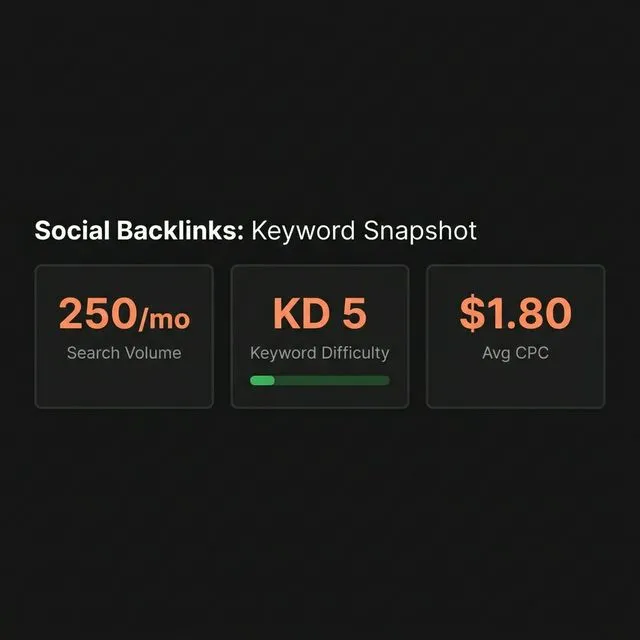
- Social backlinks are links from social media platforms — Twitter/X, LinkedIn, Reddit, Facebook, Pinterest, and others. All major social platforms add
rel="nofollow"to external links, meaning social links don’t directly transferpagerankWeight. - Social links influence rankings through 3 indirect channels: referral traffic (engagement signals via NavBoost), entity co-occurrence (
impliedLinksfrom brand mentions), and the social amplification loop (social sharing puts content in front of people who create dofollow editorial links). - Google has explicitly stated that social signals are not a direct ranking factor. The leaked API confirms no “social signal” metric exists. But the indirect effects — traffic, discovery, and entity mentions — are significant.
- The social amplification loop is the primary SEO value: social sharing distributes your content to journalists, bloggers, and writers who may link to it editorially. Social links don’t rank your content — but social distribution helps your content earn the editorial backlinks that do.
- Reddit stands out as the most SEO-relevant social platform because Google indexes Reddit threads, ranks them in search results, and uses Reddit discussions as a signal of content quality and relevance.
“Do social media links help SEO?” is one of the most debated questions in search marketing. The answer is nuanced: social links don’t pass pagerankWeight, aren’t a ranking factor, and Google has repeatedly said so. But the indirect effects of social sharing — content discovery, referral traffic, brand mentions, and editorial link acquisition — are demonstrably real.
The distinction matters because misunderstanding social signals leads to wasted effort (buying social shares, obsessing over share counts) instead of leveraging what social platforms actually provide: a distribution mechanism that puts your content in front of potential linkers.
What Are Social Backlinks?
A social backlink is any link from a social media platform to your website. This includes:
| Platform | Link locations | Follow status |
|---|---|---|
| Twitter/X | Tweets, profile bio, DMs | Nofollow |
| Posts, articles, profile | Nofollow | |
| Posts, comments | Nofollow | |
| Posts, profile, groups | Nofollow | |
| Pins, profile | Nofollow | |
| Bio link only | Nofollow |
Every major social platform applies rel="nofollow" (or equivalent JavaScript-based link handling) to external links. This has been consistent across platforms since the mid-2010s.
The Social Signals Myth vs. API Reality
What Google has said publicly
Google representatives have consistently stated that social signals are not a direct ranking factor:
- Matt Cutts (2014): Stated that Google doesn’t use social signals like Facebook likes or Twitter followers as ranking factors
- Gary Illyes (2016): Confirmed that social signals are not part of Google’s ranking algorithm
- John Mueller (2021): Reiterated that social shares don’t directly impact rankings
What the API shows
The leaked Content Warehouse API contains no attribute for “social signal count,” “share count,” or any social-platform-specific metric. This aligns with Google’s public statements.
However, the API does contain attributes that are indirectly affected by social activity:
impliedLinks— brand mentions without hyperlinks (social platforms generate massive volumes of brand mentions)- NavBoost engagement data — referral traffic from social platforms generates engagement signals
contentEffort— content that generates social discussion may score higher on effort/quality signals
Based on our reading of the API leak and Google’s public statements: There is no “social ranking factor.” But the engagement, entity mentions, and editorial link acquisition that result from social activity are captured by attributes that do influence rankings. Social signals aren’t a ranking factor — social effects are.
How Social Platforms Pass Signals to Google
Each social platform contributes different indirect signals:
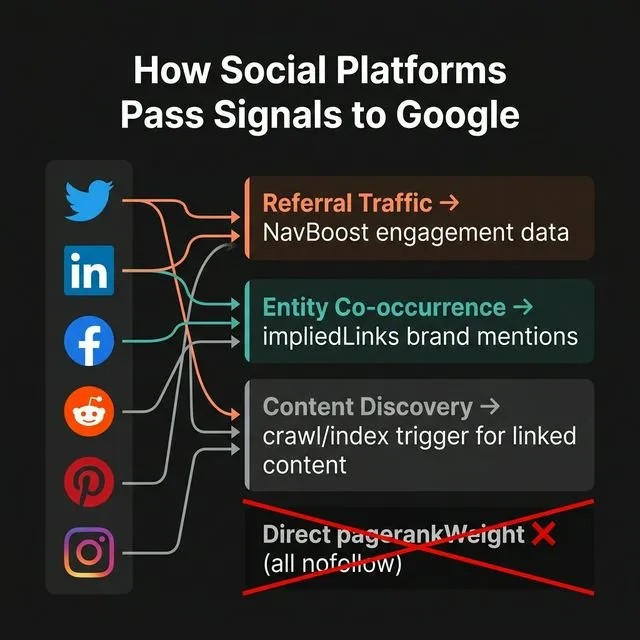
Signal 1: Referral traffic → NavBoost engagement
When social sharing drives visitors to your site, those visitors generate engagement data that feeds into NavBoost and similar systems:
- Time on page — socially-referred visitors who read your content signal quality
- Pages per session — engaged visitors who explore multiple pages
- Return visits — users who bookmark and return
- Bounce rate — visitors who leave immediately (negative signal)
The quality of social referral traffic matters more than the quantity. 100 engaged visitors from a targeted LinkedIn share provide better engagement signals than 10,000 bot-driven clicks from purchased social shares.
Signal 2: Entity co-occurrence → impliedLinks
Social platforms generate enormous volumes of brand mentions — discussions about your brand, product, or content that mention your name without necessarily linking to your site. The leaked API’s impliedLinks attribute captures exactly this: mentions that serve as implicit endorsements.
When people discuss your content on Twitter, debate your findings on Reddit, or share your article on LinkedIn with commentary — those mentions create entity associations that Google can process, regardless of whether the text contains a clickable link.
Signal 3: Content discovery → crawl triggers
Social sharing accelerates Google’s discovery and crawling of new content:
- Google crawls Twitter/X and indexes tweets
- Google indexes Reddit threads and ranks them in search results
- Pinterest pins are indexed and appear in Google Image Search
- Viral social sharing generates new web pages (blogs reacting to your content) that Google discovers
When content goes viral on social media, Google discovers the related web coverage much faster — and the resulting editorial coverage may generate dofollow backlinks.
Social Backlinks by Platform
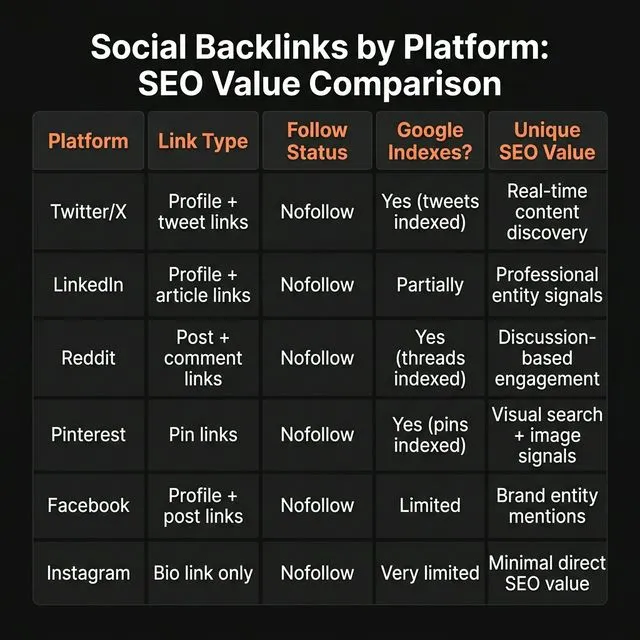
Each platform provides different SEO value:
Twitter/X
SEO value: Moderate-High
Twitter’s primary SEO contribution is real-time content discovery. Google indexes tweets and uses Twitter data for trending topics and fresh content signals. A tweet that goes viral creates a cascade of web coverage that Google discovers quickly.
Best practice: Share original research and data on Twitter with clear attribution to your site. Threads that generate discussion create multiple entity mention touchpoints.
SEO value: Moderate
LinkedIn provides professional entity signals — being discussed and shared by industry professionals creates topical authority associations. LinkedIn articles are partially indexed by Google and can rank in search results.
Best practice: Publish original analysis on LinkedIn with links to full studies on your site. Professional engagement (comments from recognizable industry figures) creates implicit authority signals.
SEO value: High
Reddit is the most SEO-relevant social platform because Google actively indexes and ranks Reddit threads. Reddit discussions frequently appear in Google search results — often on the first page for informational queries. Reddit’s 2024 data licensing deal with Google further deepened this integration.
Best practice: Participate authentically in relevant subreddits. Content shared on Reddit that generates genuine discussion creates both direct visibility (Reddit threads in Google results) and referral traffic.
SEO value: Moderate (visual niches)
Pinterest pins are indexed by Google and appear in image search results. For visual industries (food, design, fashion, home improvement), Pinterest provides meaningful direct search visibility.
Best practice: Create original, high-quality pinnable images with links to detailed content on your site.
SEO value: Low-Moderate
Facebook’s walled-garden approach limits Google’s ability to crawl and index Facebook content. Brand mentions on Facebook contribute to impliedLinks but provide less direct search visibility than Twitter or Reddit.
SEO value: Low
Instagram provides only one external link placement (bio link) and severely limits Google’s crawling access. Instagram’s primary SEO contribution is brand entity establishment — but this is weaker than platforms where Google can index content directly.
The Social Amplification Loop
This is the most important concept for understanding social backlinks’ SEO value:
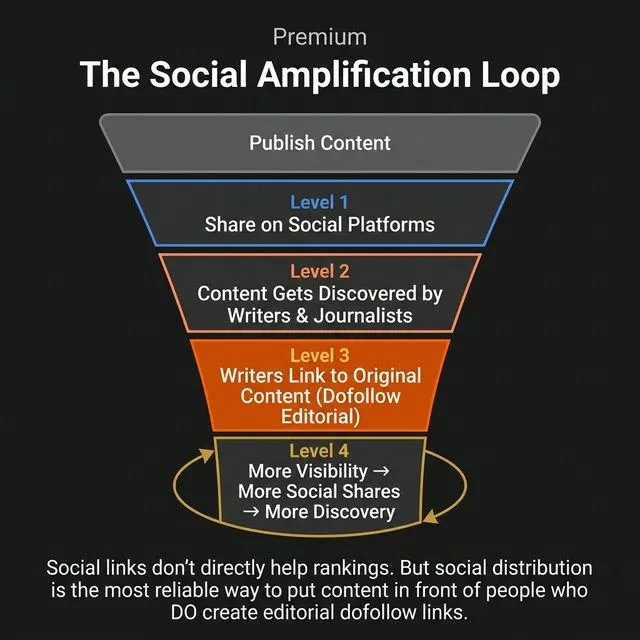
- You publish content with original research, data, or insights
- You share on social platforms — Twitter, LinkedIn, Reddit
- Writers and journalists discover your content through social distribution
- Writers cite your original source in their articles — with dofollow editorial backlinks
- The editorial coverage generates more social sharing — creating a self-reinforcing loop
The social links themselves don’t help rankings. But social distribution is the most efficient mechanism for getting your content in front of people who create the editorial links that do drive rankings.
This is why content marketing and link building are inseparable: you need citable content AND distribution to earn editorial links. Social platforms provide the distribution layer.
Social Links vs. Editorial Links
Understanding the distinction prevents strategic confusion:
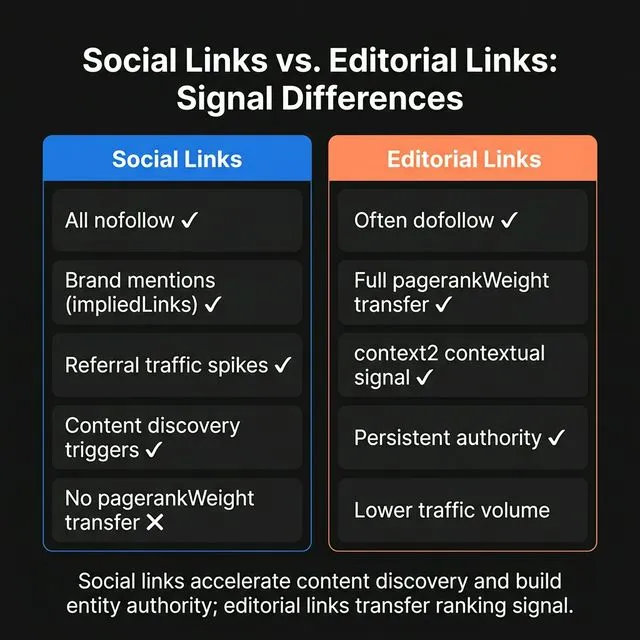
| Dimension | Social links | Editorial links |
|---|---|---|
pagerankWeight | None (all nofollow) | Full (typically dofollow) |
context2 value | None (platform-generated) | Full (editorial context) |
| Entity value | Moderate (impliedLinks) | High (editorial endorsement) |
| Traffic potential | High (social audiences) | Varies (depends on publication traffic) |
| Discovery speed | Immediate (real-time) | Slow (editorial publication cycles) |
| Durability | Low (social feeds move fast) | High (articles persist) |
| Acquisition method | Content quality + distribution | Content quality + outreach |
The strategic conclusion: Social backlinks and editorial backlinks serve different functions. Social links distribute content and build entity recognition; editorial links transfer ranking signal. An effective strategy uses social distribution to generate editorial link opportunities. At Get Me Links, we design campaigns where social amplification feeds editorial acquisition — creating the compounding cycle that builds authority. See how we integrate social signals into link campaigns ?
What This Means for GEO and Source Authority
Social backlinks contribute to GEO primarily through entity establishment and brand presence validation:
The AI Overview source selection patent (US20240289407A1) evaluates sources through entity trust layers. Social media presence contributes to:
- Entity recognition: Active social presence with consistent topical coverage helps AI systems identify your brand as a relevant entity
- Brand validation: Social mentions serve as
impliedLinksthat validate your entity’s existence and relevance - Multi-platform footprint: Being discussed across social platforms, YouTube, Wikipedia, and web creates the kind of cross-platform entity validation that AI Overview systems look for
For direct AI Overview citation, social links alone aren’t sufficient — you need editorial backlinks and contextual backlinks from authoritative web sources. But social presence strengthens the entity foundation that makes those citations more likely to be selected.
In the Source → Consensus → Trust framework, social backlinks operate at the entity recognition layer: they help establish your brand as a known entity (Source), create distributed social proof across platforms (Consensus), and build the entity foundation that editorial citations convert into trust (Trust). They’re not the end — they’re the beginning of the authority cycle.
At Get Me Links, social amplification is a strategic component of every link campaign — not an afterthought. Talk to us about building multi-platform authority →
Frequently Asked Questions
What are social backlinks?
Social backlinks are links from social media platforms (Twitter/X, LinkedIn, Reddit, Facebook, Pinterest, Instagram) to your website. All major social platforms apply rel="nofollow" to external links, meaning social links don’t directly transfer pagerankWeight. Their SEO value comes from referral traffic, entity mentions, and the social amplification loop.
Do social media links help SEO?
Social media links don’t directly help SEO — Google has confirmed social signals aren’t a ranking factor, and the leaked API contains no social signal metric. But social sharing indirectly helps through referral traffic (engagement signals), entity co-occurrence (brand mentions), and the social amplification loop (putting content in front of writers who create dofollow editorial links).
Which social platform is best for SEO?
Reddit provides the most direct SEO value because Google actively indexes and ranks Reddit threads in search results. Twitter/X provides strong content discovery and real-time visibility. LinkedIn provides professional entity signals. The best platform depends on your audience and content type — but for pure SEO impact, Reddit’s integration with Google search makes it uniquely valuable.
Should I buy social shares for SEO?
Never buy social shares. Purchased social engagement (fake likes, shares, followers) generates no real referral traffic, no genuine brand mentions, and no editorial link opportunities. Google’s engagement systems can distinguish between genuine engagement and artificial inflation. The only value in social sharing comes from real humans seeing and engaging with your content.
Are social signals a Google ranking factor?
No. Google has consistently denied using social signals (likes, shares, followers) as ranking factors, and the leaked API contains no social-specific ranking attribute. However, the effects of social activity — referral traffic, brand mentions, and content discovery — are captured by attributes that do influence rankings. The distinction is: social metrics don’t rank; social effects do.
References:
- Google. (2024). Content Warehouse API Documentation (Leaked). Attributes cited:
impliedLinks, NavBoost engagement signals,contentEffort. - SparkToro & Fishkin, R. (2024). An Anonymous Source Shared Thousands of Leaked Google Search API Documents with Me. SparkToro Blog.
- Cutts, M. (2014). Are social signals (likes, shares) used as ranking factors? [Public video]. Google Webmasters.
- Illyes, G. (2016). Conference Q&A on social signals and Google ranking. Pubcon Las Vegas.
- Mueller, J. (2021). Social signals and Google ranking — Google Search Central Office Hours. YouTube.
- Google. (2024). Patent US20240289407A1: AI Overview source selection and scoring. USPTO.
- Google. (2019). Evolving “nofollow” — new ways to identify the nature of links. Google Search Central Blog.
- Wikipedia. (2025). Social media and search engine optimization.