
- A Wikipedia backlink is an external link from a Wikipedia article to your website. All Wikipedia external links use
rel="nofollow"— meaning they don’t pass directpagerankWeightthrough the traditional link graph. - Despite being nofollow, Wikipedia links provide substantial value through 4 indirect channels: entity recognition in Google’s Knowledge Graph, referral traffic from Wikipedia’s massive audience, the citation cascade effect (journalists cite Wikipedia’s sources), and Google’s hint model (nofollow is a hint, not a directive, since 2020).
- The citation cascade is Wikipedia’s unique value proposition: when your source appears as a citation on Wikipedia, researchers, journalists, and writers who use Wikipedia for background research discover your original source — and link to it with dofollow editorial backlinks in their own content.
- Wikipedia has rigorous editorial gatekeeping: sources must be published, reliable, and relevant. Self-published content, promotional material, and primary sources are generally rejected. Only secondary and tertiary sources with editorial oversight qualify.
- The only ethical approach to Wikipedia backlinks is being cited for your original research or data. Directly editing Wikipedia to add your own links violates Wikipedia’s conflict of interest policy and will be reverted.
Wikipedia is the world’s most-visited reference site and a primary research starting point for journalists, academics, students, and content creators. A citation on Wikipedia doesn’t just put your URL on a high-authority page — it puts your source in front of everyone who researches that topic.
Yet most SEO guides dismiss Wikipedia links because they’re nofollow. This analysis is incomplete. The leaked API documentation and Google’s hint model reveal that Wikipedia links provide value through channels that aren’t captured by the pagerankWeight attribute alone — and the indirect benefits can generate more ranking signal than a dozen direct dofollow backlinks.
What Is a Wikipedia Backlink?
A Wikipedia backlink is an external link included in a Wikipedia article’s reference section, inline citations, or external links section. Every external link on Wikipedia uses the rel="nofollow" attribute:
<a rel="nofollow" href="https://example.com/study">Example Study (2024)</a>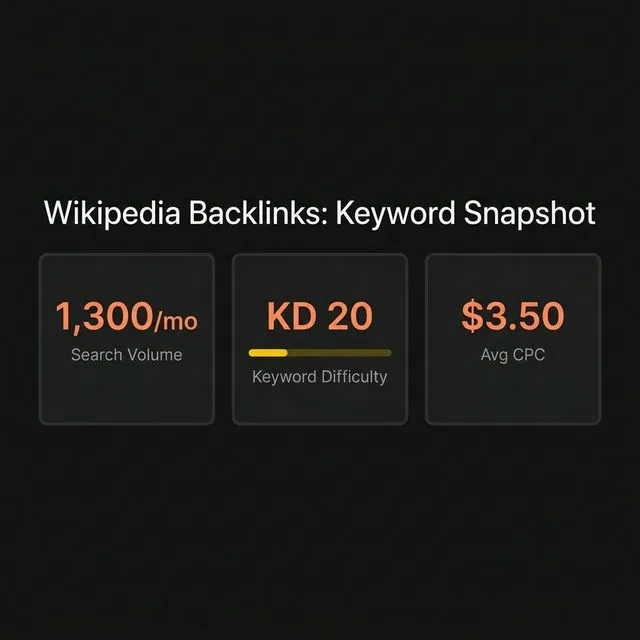
Wikipedia adds nofollow to all external links to discourage spam editors from adding links for SEO benefit. It’s a blanket policy applied since 2007 — regardless of the source’s quality or relevance.
How Wikipedia Links Provide Value Despite Nofollow
The nofollow attribute doesn’t make Wikipedia links worthless — it makes them valuable through different channels than traditional backlinks:
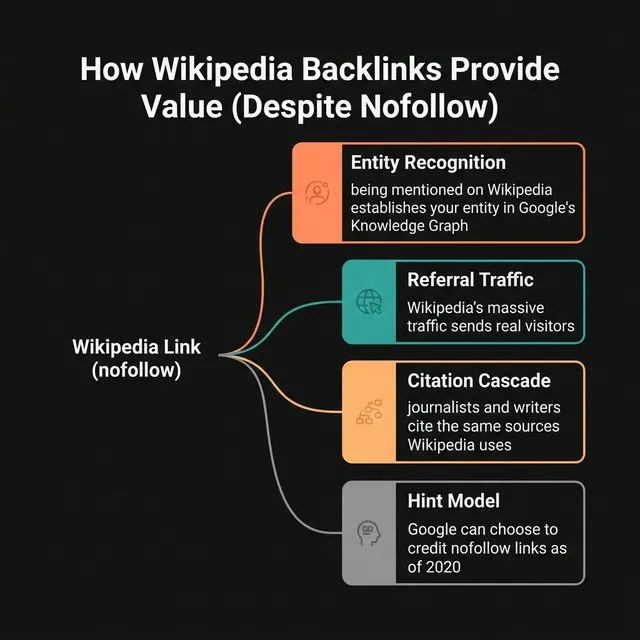
Channel 1: Entity recognition
Being cited on Wikipedia establishes your brand, author, or research as an entity in Google’s ecosystem. Google’s Knowledge Graph draws heavily from Wikipedia and Wikidata for entity information.
When your site is cited as a source on a Wikipedia article about a topic in your niche, Google’s systems create (or strengthen) an entity association between your brand and that topic. This entity recognition feeds into:
- Topical authority assessment
- Brand entity disambiguation
- Knowledge Graph entries
- GEO qualification (AI Overview source selection)
The entity value operates independently of the link’s follow/nofollow status because entities are processed from content, not just links.
Channel 2: Referral traffic
Wikipedia receives approximately 1.9 billion monthly visits globally. Articles on popular topics can receive thousands of daily visits. When your source is cited in a high-traffic Wikipedia article, the referral traffic can be significant.
This referral traffic generates engagement signals — time on site, pages per session, return visits — that feed back into your site’s quality assessment through NavBoost and similar user engagement systems. The traffic value of a Wikipedia citation on a popular article can exceed the ranking value of a dofollow link from a low-traffic site.
Channel 3: The citation cascade
This is Wikipedia’s most powerful indirect value. The citation cascade works because Wikipedia is the world’s most-used research starting point:
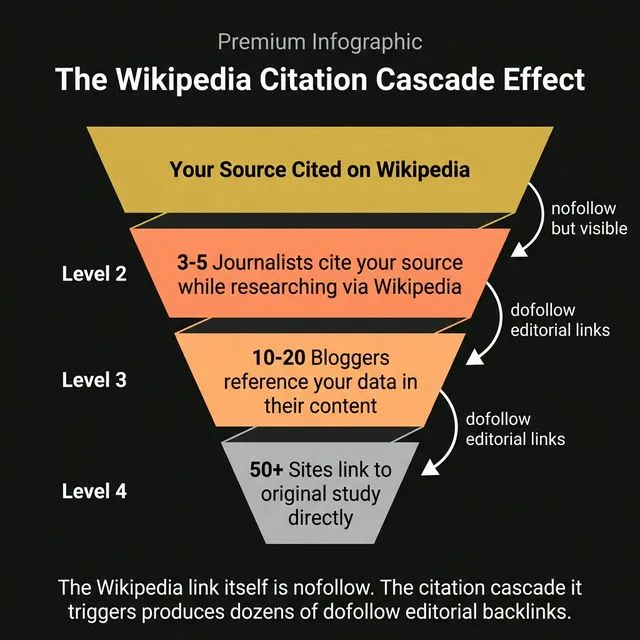
- You publish original research with unique data or findings
- Wikipedia cites your research as a reference (nofollow)
- Journalists researching the topic find your source via Wikipedia
- Journalists cite your original source in their articles (dofollow, editorial)
- Bloggers reference the journalism and trace back to your original source (dofollow)
- The cascade compounds — each new citation makes your source more discoverable
The Wikipedia link itself is nofollow. But the downstream links it triggers — from journalists, bloggers, and researchers who discover your source through Wikipedia — are typically editorial backlinks with full pagerankWeight transfer.
One well-placed Wikipedia citation can generate 10–50+ dofollow editorial backlinks over the following months through this cascade effect.
Channel 4: Google’s hint model
Since March 2020, Google treats all link annotations — including rel="nofollow" — as hints, not directives. This means Google can choose to credit a nofollow link if the editorial context warrants it.
Wikipedia is one of the highest-authority editorial contexts on the internet. While Google’s specific handling of Wikipedia nofollow links is not publicly documented, the hint model means the door is not fully closed to pagerankWeight credit from Wikipedia citations.
Based on our reading of Google’s 2019 nofollow announcement and the API leak: The hint model combined with Wikipedia’s editorial gatekeeping creates a scenario where Wikipedia citations may pass some ranking signal despite nofollow — and definitely provide entity, traffic, and citation cascade value regardless.
Wikipedia’s Editorial Gatekeeping
Understanding Wikipedia’s editorial standards is essential because they’re what makes Wikipedia citations valuable — and what makes them difficult to manipulate:
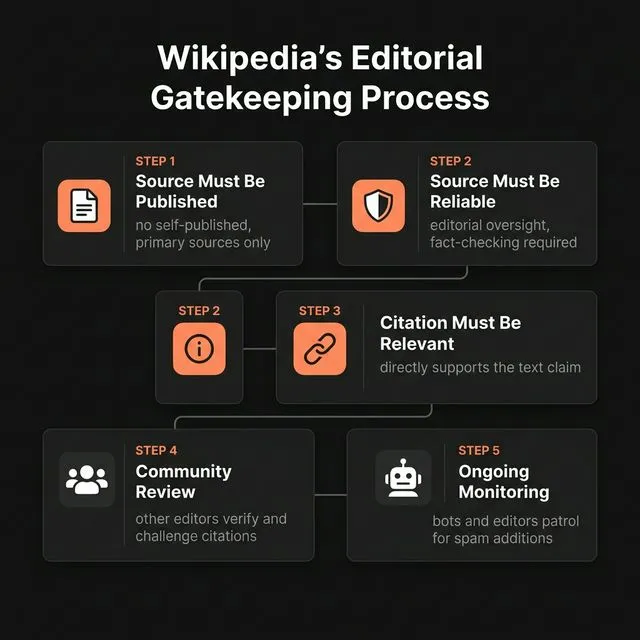
Requirement 1: Sources must be published
Wikipedia only cites published sources — not self-published blogs, social media posts, or unpublished research. The source must have been through some form of editorial process: peer review, publisher review, or newsroom editorial oversight.
Requirement 2: Sources must be reliable
Wikipedia’s Reliable Sources policy requires sources with:
- Editorial oversight (someone other than the author reviewed the content)
- Fact-checking processes (the publication has quality control)
- Established reputation (the publication is recognized in its field)
Self-published content from business blogs generally doesn’t meet this standard — even if the content is high quality.
Requirement 3: Citations must be relevant
Every Wikipedia citation must directly support a specific claim in the article text. Gratuitous citations — links that don’t clearly support the adjacent text — are flagged and removed.
Requirement 4: Community review
Other Wikipedia editors review citations and challenge unsupported ones. Popular articles have hundreds of watchers who receive notifications when changes are made. Spam additions are typically caught within hours.
Requirement 5: Automated monitoring
Wikipedia uses bots (ClueBot NG, XLinkBot) that automatically flag or revert suspicious link additions — especially from new accounts, IPs known for spam, or edits that add links without corresponding text.
How to Earn Wikipedia Backlinks Ethically
The only sustainable approach to Wikipedia backlinks is being cited for genuine editorial value:
Strategy 1: Publish citable research
Create original research with unique findings, data, or analysis that fills a gap in existing Wikipedia articles. The research must be published through a legitimate channel (industry publication, academic journal, news outlet) — not just on your company blog.
What qualifies:
- Industry surveys with unique data sets
- Longitudinal studies tracking changes over time
- Statistical analyses of publicly available data
- Expert syntheses published by recognized outlets
Strategy 2: Fix broken citations
Wikipedia articles frequently have broken citations — references that link to pages that no longer exist. If you have content that covers the same topic as a broken citation, you can propose a replacement through the article’s talk page.
Process:
- Find Wikipedia articles in your niche with
[dead link]or[citation needed]tags - Verify that your content genuinely covers the cited claim
- Propose the citation replacement on the article’s talk page (not through direct editing)
- Disclose any conflict of interest
Strategy 3: Contribute expertise honestly
If you have deep expertise in a topic, contribute to Wikipedia as an editor — not to place your own links, but to improve article quality. Over time, other editors may cite your published work as a reference.
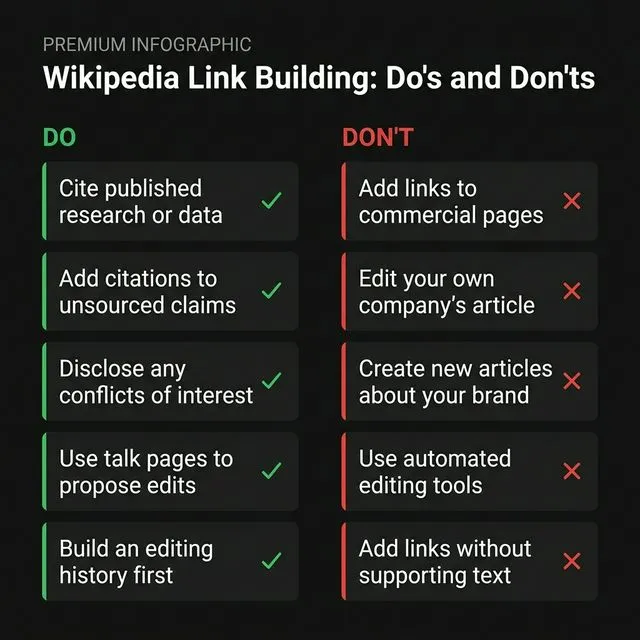
Critical rule: Wikipedia’s Conflict of Interest policy prohibits editing articles about yourself, your company, or your products. If you have a conflict of interest, use the talk page to suggest changes and let independent editors decide.
What NOT to do
- Don’t edit your own company’s Wikipedia article — this violates COI policy and will be reverted
- Don’t create new articles about your brand — these are typically flagged for deletion
- Don’t add links to commercial pages — these are spam and get caught quickly
- Don’t hire “Wikipedia editors” from Fiverr or similar platforms — these services use sock puppet accounts that get banned, taking your citations with them
Wikipedia vs. .gov Links: A Comparison
Both Wikipedia and .gov links are considered premium link types. Here’s how they compare:
| Dimension | Wikipedia links | .gov links |
|---|---|---|
rel attribute | Nofollow (always) | Usually dofollow |
Direct pagerankWeight | Minimal (hint model) | Full |
| Entity recognition | Very high (Knowledge Graph) | High (institutional trust) |
| Citation cascade | Strong (Wikipedia is a research starting point) | Moderate (journalists use gov data) |
| Referral traffic | High (1.9B monthly visits) | Low-moderate |
| Acquisition difficulty | High (editorial gatekeeping) | High (institutional gatekeeping) |
| Best approach | Publish citable research | Community resource listings |
What This Means for GEO and Source Authority
Wikipedia backlinks are exceptionally valuable for GEO — arguably more valuable for GEO than for traditional organic ranking.
The AI Overview source selection patent (US20240289407A1) evaluates sources through entity-level trust signals. Being cited on Wikipedia — the world’s largest knowledge base — creates entity associations that directly feed AI Overview source qualification:
- Entity recognition: AI systems identify your brand/research as an authoritative entity on the topic
- Citation diversity: Wikipedia citation creates a high-authority reference point that other citations build upon
- Knowledge Graph integration: Wikipedia/Wikidata entries feed directly into Google’s Knowledge Graph, which AI Overview systems consult
For GEO, the nofollow status of Wikipedia links is largely irrelevant — because GEO citation selection operates through entity trust and topical authority, not direct pagerankWeight. A Wikipedia citation may be the single most effective GEO signal available for establishing entity authority.
No link building agency can guarantee Wikipedia citations. What we can help with is creating the kind of original, citable research that makes Wikipedia citation a realistic outcome — and building the broader high quality backlinks strategy that supports overall authority.
This is the Source u{2192} Consensus u{2192} Trust cycle at the knowledge layer: Wikipedia citation establishes your content as a recognized Source in the world’s largest knowledge base, that institutional endorsement triggers a citation cascade of downstream editorial links (Consensus), and both ranking algorithms and AI overview systems treat Wikipedia-cited sources with elevated trust (Trust). It’s the most powerful version of the cycle available u{2014} and the hardest to earn.
At Get Me Links, we help clients build the research-grade content that makes Wikipedia citation realistic u{2014} and the editorial link foundation that supports overall authority. Talk to us about building institutional-grade authority u{2192}
Frequently Asked Questions
What are Wikipedia backlinks?
Wikipedia backlinks are external links from Wikipedia articles to your website, typically appearing in the references, inline citations, or external links sections. All Wikipedia external links use rel="nofollow" — but they still provide value through entity recognition, referral traffic, the citation cascade effect, and Google’s hint model.
Are Wikipedia backlinks worth pursuing?
Yes — not for direct pagerankWeight, but for entity recognition, referral traffic from Wikipedia’s 1.9 billion monthly visits, and the citation cascade (journalists discover your source through Wikipedia and link to it with dofollow editorial links). One Wikipedia citation can trigger 10-50+ downstream dofollow backlinks.
How do I get a backlink from Wikipedia?
Publish original research, data, or analysis through a legitimate channel (industry publication, journal, news outlet). Contribute to Wikipedia honestly by improving articles and let editors cite your work naturally. Never edit your own company’s article or pay for Wikipedia editing services — both violate Wikipedia’s policies and will be reverted.
Do Wikipedia links pass PageRank?
Wikipedia links use rel="nofollow" — which historically meant zero pagerankWeight. However, since 2020 Google treats nofollow as a “hint,” meaning Google can choose to credit the link. Wikipedia’s exceptionally high editorial standards make it a strong candidate for hint-based credit, though Google hasn’t confirmed this specifically.
Can I buy Wikipedia backlinks?
Never buy Wikipedia links. Services offering Wikipedia backlinks use sock puppet accounts, paid editors, or automated tools that violate Wikipedia’s policies. These citations are typically caught and removed within hours to weeks, and the accounts used to place them are permanently banned — often taking legitimate previous edits with them.
References:
- Google. (2024). Content Warehouse API Documentation (Leaked). Attributes cited:
pagerankWeight,impliedLinks, entity recognition signals. - SparkToro & Fishkin, R. (2024). An Anonymous Source Shared Thousands of Leaked Google Search API Documents with Me. SparkToro Blog.
- Google. (2019). Evolving “nofollow” — new ways to identify the nature of links. Google Search Central Blog.
- Wikipedia. (2025). Reliable sources policy. Wikipedia.
- Wikipedia. (2025). Conflict of interest policy. Wikipedia.
- Wikipedia. (2025). External links guidelines. Wikipedia.
- Google. (2024). Patent US20240289407A1: AI Overview source selection and scoring. USPTO.
- Wikimedia Foundation. (2025). Wikipedia statistics — pageview data. Wikimedia Foundation.