
- A trustworthy backlink comes from a source that passes Google’s multi-layer trust evaluation. “Trustworthy” is not a link type — it’s a quality dimension that applies to every link type. An editorial backlink from a reputable publication is trustworthy. An editorial backlink from a PBN disguised as a publication is not.
- Google evaluates trust at 5 layers: domain trust, page trust, link trust, entity trust, and network trust. A link must pass all layers to transfer maximum signal — a trusted domain with a low-quality page still produces weaker signal.
- The leaked API reveals 7 specific trust signals: domain authority consistency, editorial placement
sourceType, contextual relevance viacontext2, anchor text naturalness, link neighborhood analysis, temporal consistency (no burst patterns), and source content quality (contentEffort). - Trust and authority are different concepts. A high-authority domain (high DR) that participates in link schemes is not trustworthy. A moderate-authority domain (DR 40) with clean history and editorial standards can be highly trustworthy. Google evaluates both.
- The most trustworthy backlinks combine: editorial placement + niche relevance + natural anchor patterns + trusted link neighborhood + consistent acquisition over time. This describes high quality backlinks by another name — trust is quality’s foundation.
Every backlink article discusses “quality” and “authority.” But trust is the dimension that makes or breaks a backlink’s actual impact. Google doesn’t just measure how powerful a link source is — it measures how reliable that source is as a signal of genuine editorial endorsement.
A link from a DR 80 site that sells links to anyone who pays provides worse signal than a link from a DR 40 site that earns links through genuine editorial relationships. The difference is trust. And Google’s systems are specifically designed to evaluate it.
What Makes a Backlink Trustworthy?
A trustworthy backlink is a link from a source that Google’s systems classify as a reliable signal of editorial endorsement. “Trustworthy” is not a category of backlink — it’s a quality dimension that applies across all types of backlinks.
Any backlink type can be trustworthy or untrustworthy:
| Backlink type | Trustworthy example | Untrustworthy example |
|---|---|---|
| Editorial | Journalist citation in reputable publication | Paid placement disguised as editorial |
| Contextual | Relevant resource cited in topical article | Contextual link in PBN content |
| Forum | Helpful answer with supporting resource | Spam comment with link |
| Social | Genuine sharing by real users | Bot-generated social links |
| Curated | Expert-vetted resource page | Auto-approve directory |
Trust is the variable that determines whether a link from a given source actually contributes to your rankings or creates risk.
Google’s Trust Hierarchy for Backlinks
Google evaluates trust at 5 interconnected layers, from broad (domain-level) to specific (network-level):
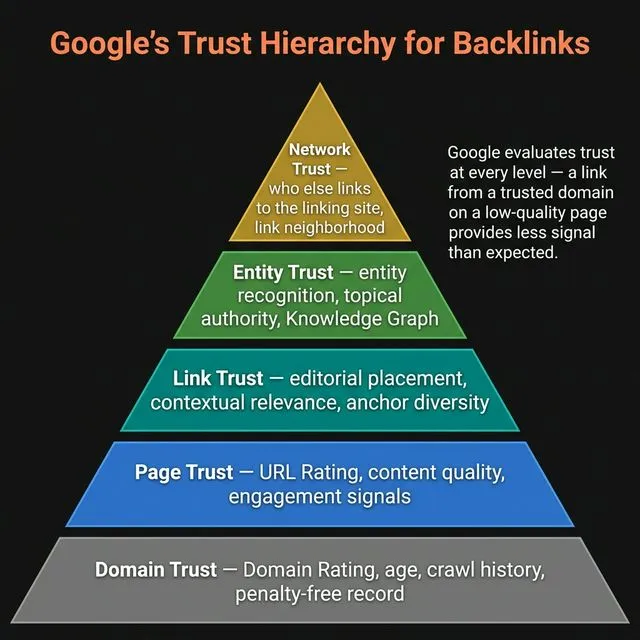
Layer 1: Domain trust
The foundation. Does the linking domain have:
- Consistent crawl history over time?
- No manual actions or algorithmic penalties?
- A pattern of producing quality content?
- Real organic traffic from legitimate users?
Domain trust is reflected in siteAuthority and the spambrain* spam-assessment fields — attributes visible in the leaked API that track domain-level reputation over time. (Per-link authority is carried separately by pagerankWeight, a per-link field, not a domain-level history.)
Layer 2: Page trust
A trusted domain can have low-trust pages. Google evaluates:
- URL Rating — the specific page’s backlink profile
- Content quality —
contentEffortscoring on the linking page - Engagement signals — does anyone actually read this page?
- Indexation status — is the page in Google’s primary index?
A sponsored post on a DR 80 news site may carry less trust than the same site’s investigative journalism page — even though they share the same domain.
Layer 3: Link trust
The specific link’s context:
- Editorial placement — was the link placed by an editor making an editorial decision, or inserted through a commercial arrangement?
- Contextual relevance — does the surrounding content relate to the link target? (
context2signal) - Anchor text — is the anchor natural, or does it show signs of manipulation?
- Link position — is the link in the main content, or in a sidebar/footer? (sitewide vs. in-content)
Layer 4: Entity trust
Does the linking entity (author, organization, publication) have established trust signals?
- Knowledge Graph presence — is the entity recognized by Google’s entity systems?
- Topical authority — does the entity consistently cover this topic?
- Entity associations — are the entity’s other properties (social, other sites) also trustworthy?
Layer 5: Network trust
The most sophisticated evaluation: who else links to the linking site?
- If the linking site receives links from other trusted domains → higher trust
- If the linking site receives links from spam networks → lower trust
- If the linking site links out to known spam sites → trust contamination
Network trust is why link neighborhoods matter. A site surrounded by trustworthy sites inherits trust signals from its neighborhood. A site surrounded by PBNs and spam inherits toxicity — even if the site itself appears legitimate. This link-neighborhood model is the practical face of graph-distance trust: a page’s trust tends to decay with its link-distance from a set of trusted seed sites, as analyzed in Seed Distance (US9953049B1).
7 Trust Signals Google Evaluates
The leaked Content Warehouse API reveals specific attributes that map to trust evaluation:
1. Domain authority consistency
Google tracks domain-level authority (siteAuthority) over time, not just at a single point. A domain that has maintained consistent authority over years is more trustworthy than one that suddenly acquired high metrics through link manipulation. (pagerankWeight, by contrast, describes the authority a single link transmits — it is a per-link field, not a domain-history metric.)
2. Editorial placement (sourceType)
The API’s sourceType classification distinguishes between genuine editorial placement and other link types. Links classified as editorial — placed by a human editor making an editorial judgment — carry the highest trust signal.
3. Contextual relevance (context2)
The context2 hash evaluates the relationship between the link and its surrounding content. A backlink surrounded by topically relevant editorial content generates a strong contextual signal. A link dropped into unrelated content generates a weak or suspicious signal.
4. Anchor text naturalness
Natural anchor text patterns use varied language — brand names, generic phrases (“click here”), URL-based anchors, and occasionally keyword-rich text. Unnatural patterns — where most anchors are exact-match keywords — are a primary trust violation signal.
5. Link neighborhood analysis
Google maps the link graph surrounding your backlink sources. If your links consistently come from sites that also link to known spam, your link profile inherits risk. If your links come from sites in clean link neighborhoods, they inherit trust.
6. Temporal consistency
Natural link acquisition happens gradually over time. Sudden bursts of links — 50 new backlinks in a day, then nothing for months — signal manipulation. Trustworthy backlinks accumulate at a rate consistent with the target site’s content publishing and promotional activity.
7. Source content quality (contentEffort)
The linking page’s own content quality matters. A link from a well-researched, expertly written article carries more trust than a link from a thin, auto-generated page — even on the same domain.
Trust vs. Authority: The Critical Distinction
These concepts are related but not identical:
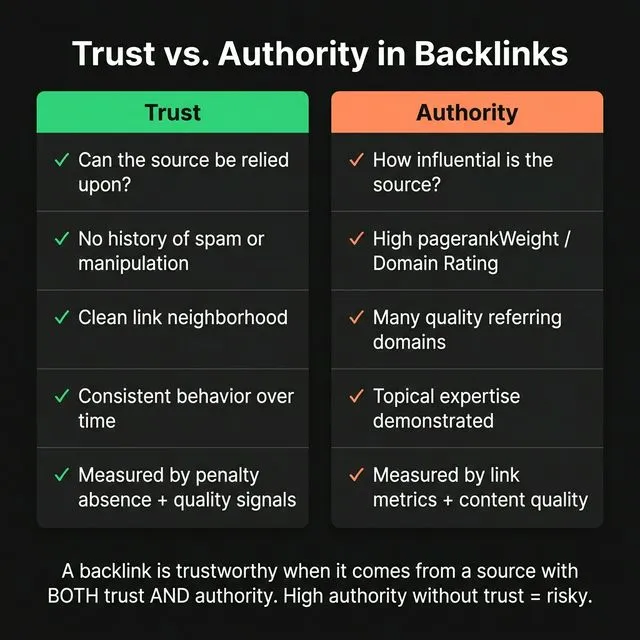
Authority answers: “How influential is this source?”
- Measured by: Domain Rating, backlink count, traffic, brand recognition
- A DR 90 website has high authority
Trust answers: “Can this source be relied upon as a genuine endorsement?”
- Measured by: clean history, editorial standards, no link selling, link neighborhood quality
- A DR 90 website that sells links is not trustworthy
The intersection matters:
| Scenario | Authority | Trust | SEO value |
|---|---|---|---|
| Major publication, editorial link | High | High | Maximum |
| Small niche blog, genuine mention | Low | High | Moderate |
| Large site, paid link placement | High | Low | Risky |
| PBN site, manipulated metrics | Fake high | None | Negative |
The rule: Always prioritize trust over authority. A trustworthy link from a moderate-authority site is safer and more effective long-term than a link from a high-authority site with compromised trust.
Identifying Trustworthy vs. Untrustworthy Backlink Sources
Practical red flags and green flags:
Trust indicators (green flags)
- Real organic traffic — the site gets visitors from Google (verifiable in Ahrefs)
- Editorial content — articles are written by real authors with editorial standards
- Natural anchor text — outbound links use varied, natural language
- Relevant niche — the site covers topics related to your industry
- Clean outbound links — other sites they link to are also trustworthy
- Consistent history — the domain has existed for years with stable metrics
- Real business — there’s a verifiable company, team, or individual behind the site
Red flags (untrustworthy indicators)
- No organic traffic — the site gets zero visitors from search
- Thin content — pages are short, auto-generated, or duplicate
- Exact-match anchors — most outbound links are keyword-stuffed
- Unrelated niche — the site’s topic has no connection to your industry
- Spam outbound links — links to casinos, pharma, payday loans alongside legitimate sites
- Metric manipulation — sudden DR spikes without corresponding content/traffic growth
- Link selling — the site openly offers link placements for money
Based on our reading of the API leak: Google’s SpamBrain system evaluates both linking and linked sites. A single toxic backlink from a spam source is typically just neutralized — its value stripped to zero, with no manual action or Search Console notice. A broader pattern of links from untrustworthy sources is what SpamBrain treats as participation in link schemes, neutralizing the borrowed authority rather than penalizing the target. The leaked spambrainLavcScore field, part of the document-level spambrain* family, reflects this kind of assessment.
Building a Trustworthy Backlink Profile
Trust operates at the profile level, not just the individual link level. Google evaluates the overall pattern of your backlink acquisition:
Profile-level trust signals
- Source diversity — links from many different trusted domains (not concentrated in a few)
- Natural velocity — links acquired at a consistent rate over time
- Anchor diversity — varied anchor text without keyword-stuffing patterns
- Niche coherence — most links come from topically relevant sources
- Type diversity — a mix of editorial, contextual, curated, and natural links
The trust formula
A trustworthy backlink profile combines:
- Majority white-hat acquisition — links earned through genuine editorial relationships
- No pattern of manipulation — no PBN networks, link exchanges, or paid schemes
- Relevant topical footprint — most linking sites relate to your industry
- Natural growth — link velocity matches content publication and business growth
- Clean link neighborhood — your linking sites are also linked to by trustworthy sources
This is fundamentally what high quality backlinks and natural backlinks describe from different angles. Trust, quality, and naturalness are three perspectives on the same underlying principle: genuine editorial endorsement from reliable sources. At Get Me Links, every placement we build is evaluated against all 7 trust signals before we pursue it — because trust isn’t a nice-to-have, it’s the foundation of durable rankings. See how we evaluate link trustworthiness →
What This Means for GEO and Source Authority
Trust is the most important backlink dimension for GEO. The AI Overview source selection patent application (US20240289407A1, pending) evaluates sources through a 3-layer model:
- Layer 1 — Query-dependent: ranking and click signals specific to the query.
- Layer 2 — Query-independent trust: the source’s standing independent of any query — author reputation, domain trust, and the link signals pointing to it. This is the layer trustworthy backlinks feed most directly.
- Layer 3 — User-dependent: personalization to the individual user’s context.
Trust enters primarily at Layer 2 — the query-independent assessment of author, domain, and links.
AI Overview systems are inherently trust-sensitive because they present information as factual statements attributed to sources. Including an untrustworthy source damages the AI system’s own credibility — so the trust bar for AI Overview citation is higher than for traditional organic rankings.
Building trustworthy backlinks from genuine editorial sources, established publications, and recognized entities is the most effective long-term strategy for both traditional SEO and GEO visibility.
This is the Source → Consensus → Trust cycle in its purest form: trustworthy backlinks are the mechanism through which your content becomes a recognized Source, editorial endorsements from trusted publications create distributed Consensus, and both ranking algorithms and AI systems respond to that pattern with elevated Trust. Every other backlink attribute — relevance, authority, context — ultimately feeds into this trust evaluation.
At Get Me Links, trust is the primary filter for every link we build. We don’t chase metrics — we build the editorial citation patterns that Google’s trust systems are designed to reward. Talk to us about building a trust-first link profile →
Frequently Asked Questions
What are trustworthy backlinks?
Trustworthy backlinks are links from sources that pass Google’s multi-layer trust evaluation: clean domain history, quality page content, editorial placement, relevant context, natural anchor text, clean link neighborhood, and consistent acquisition patterns. Trust is not a link type — it’s a quality dimension evaluated across all backlink types.
How do I know if a backlink is trustworthy?
Evaluate the linking site for: real organic traffic (verifiable in Ahrefs), editorial content standards, natural anchor text patterns in outbound links, topical relevance to your niche, and clean link neighborhood (other sites linking to the source are also reputable). Red flags include zero organic traffic, thin content, exact-match anchors, and open link selling.
What’s the difference between trustworthy and high quality backlinks?
These concepts overlap significantly. High quality backlinks are defined by relevance, authority, editorial placement, and contextual strength. Trustworthy backlinks are defined by source reliability and absence of manipulation signals. In practice, high quality backlinks are almost always trustworthy — trust is the foundation on which quality is built.
Can untrustworthy backlinks hurt my rankings?
Yes — though the mechanism is usually neutralization, not a penalty. A pattern of acquiring untrustworthy backlinks — from PBNs, link farms, and spam networks — is handled by Google’s SpamBrain system, which strips the borrowed authority from those links (silently, with no Search Console notice) rather than passing a manual penalty. The spambrainLavcScore attribute (and the broader spambrain* family) in the leaked API reflects this spam assessment. See toxic backlinks for detection and remediation.
How many trustworthy backlinks do I need to rank?
There’s no specific number. What matters is the proportion of trustworthy links in your profile and how they compare to competitors. A profile of 50 highly trustworthy, relevant backlinks will outperform 500 low-trust links. Focus on earning links from sources that pass the trust evaluation criteria rather than targeting a specific count.
References:
- Google. (2024). Content Warehouse API Documentation (Leaked). Attributes cited:
pagerankWeight,spambrainLavcScore,sourceType,context2,contentEffort,siteAuthority. - SparkToro & Fishkin, R. (2024). An Anonymous Source Shared Thousands of Leaked Google Search API Documents with Me. SparkToro Blog.
- Google. (2024). SpamBrain — Google’s AI-based spam prevention system. Google Search Central.
- Google. (2024). Link spam policies. Google Search Central.
- Google. (2024). Patent application US20240289407A1: AI Overview source selection and scoring (pending). USPTO.
- Google. (2015). Patent US9165040B1: Producing a ranking for pages using distances in a web-link graph (Seed Distance family — analysis). USPTO.
- Google. (2019). Evolving “nofollow” — new ways to identify the nature of links. Google Search Central Blog.
- Ahrefs. (2024). What is Domain Rating (DR)?. Ahrefs Blog.
- Meyerhans, A. (2026). Seed Distance PageRank — US9953049B1. alejandromeyerhans.com research.