
- A curated backlink is a link placed through an editorial selection process — someone manually reviewed and chose to include your resource on their page. Examples include resource page listings, expert roundup mentions, weekly link roundups, and “best of” lists.
- Curated links are valuable because they involve editorial judgment — a human decided your content belongs on their curated list. This distinguishes them from automated directory submissions or user-generated links with no gatekeeping.
- The leaked API’s
sourceTypeclassification likely differentiates between curated/list placements and deep editorial citations. Curated links provide moderatepagerankWeighttransfer but lesscontext2signal than editorial backlinks (which are embedded in narrative content). - Quality varies enormously. A resource page on a DR 70 university site selecting your tool is far more valuable than a submission to a mass web directory. The editorial standard of the curator determines the link’s value.
- Curated links are the most scalable white-hat link building method — you can systematically find curated pages, assess their quality, and pitch your resources. Unlike natural backlinks, they respond to outreach.
Between purely organic links (nobody asked for them) and purely paid links (someone bought them), there’s a middle ground: curated links. Someone actively decided to include your resource on their page — not because you asked, not because you paid, but because your resource met their editorial criteria.
Curated link building is a structured process: find pages that curate links on your topic, verify they apply editorial judgment, create content worth curating, and pitch your resource to the curator. It’s the most accessible form of link building for businesses that have genuine value to offer but haven’t built the brand recognition needed for purely natural backlinks.
What Are Curated Backlinks?
A curated backlink is a link placed on a page where someone has manually selected which resources to include. The defining characteristic is editorial selection — the curator reviewed multiple options and chose to include specific resources.
The key distinction from other link types:
- Unlike natural backlinks: curated links often respond to outreach (you can ask to be included)
- Unlike editorial backlinks: curated links appear in lists/collections, not embedded in narrative content
- Unlike sponsored backlinks: curated links are selected on merit, not payment
- Unlike directory submissions: curated pages have genuine editorial selection criteria
5 Types of Curated Backlinks
Curated links come in several formats, each with different value:
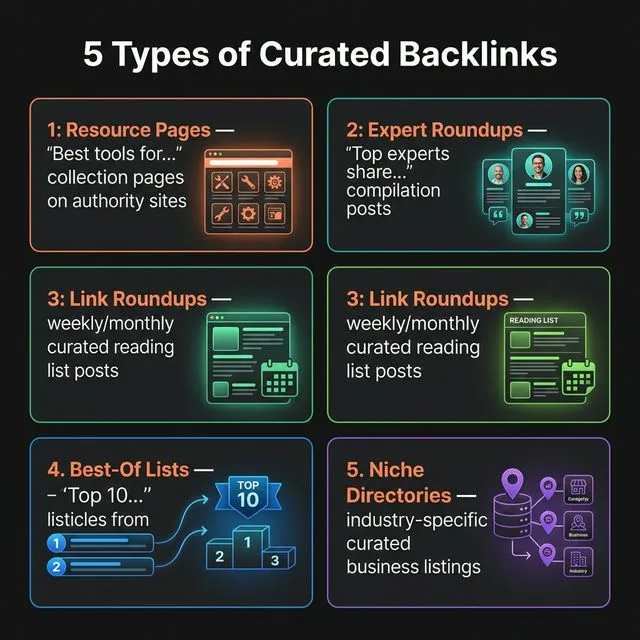
1. Resource pages
Collection pages that list the best tools, guides, or resources on a specific topic. Common formats:
- “Best [topic] tools for [year]”
- “[Topic] resource library”
- “Recommended [topic] reading”
- University or institution resource collections
Resource pages provide the most consistent curated link value because they’re typically permanent pages that get updated regularly.
2. Expert roundups
Posts where a curator gathers input from multiple experts on a question or topic. When you’re included as an expert, you typically get:
- A link to your site/profile
- Your quote or contribution published
- Association with other recognized experts
Expert roundups range from high-value (published by respected industry sites with selective curation) to low-value (mass “roundup farms” that include anyone who responds).
3. Link roundups (weekly/monthly)
Regular posts where a blogger or publication shares the best content they found in a given period. These are time-limited opportunities — you need to get your content noticed while the roundup is being compiled.
Examples: “This week in marketing: 10 articles worth reading” or “Monthly SEO roundup: March 2026.”
4. Best-of lists
Listicle-format articles ranking or recommending the best products, services, or resources. Common in B2B and SaaS: “Top 10 project management tools” or “Best link building services for 2026.”
These carry significant commercial value because readers use them for purchase decisions — generating referral traffic with high conversion intent.
5. Niche directories
Industry-specific directories with editorial review. Unlike mass web directories (which accept anything), niche directories apply selection criteria: relevance, quality, and topical fit.
Examples: DMOZ (historical), industry association directories, university resource libraries, government resource pages (see gov backlinks).
The Curated Link Quality Spectrum
Not all curated links are equal. They exist on a spectrum defined by how much editorial judgment the curator applies:
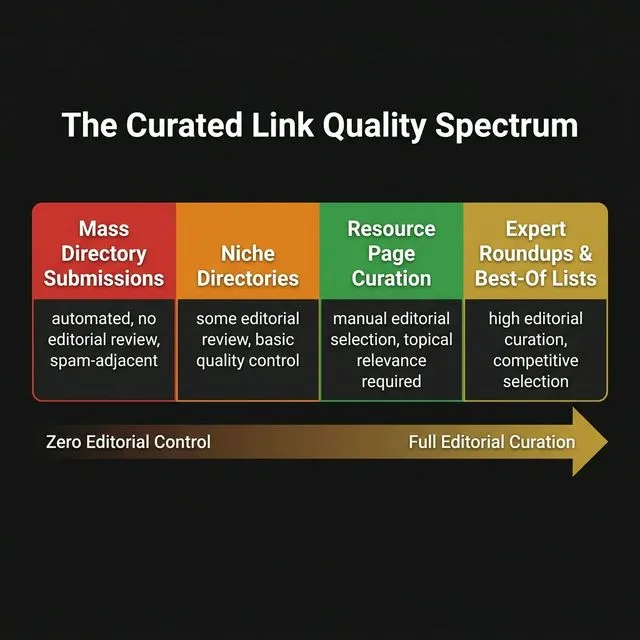
Zero editorial control (lowest value)
Mass web directories that accept any submission without review. These provide near-zero signal because the “curation” is automated — there’s no editorial judgment. Google’s systems have classified mass directory submissions as a link scheme since the Penguin update.
Basic editorial review (low-moderate value)
Niche directories that verify basic relevance and quality but don’t apply competitive editorial standards. Your submission needs to be topically relevant and not spam, but the bar is low.
Manual editorial selection (moderate-high value)
Resource pages where the curator actively searches for the best resources, evaluates multiple options, and selects specific ones. The editorial selection creates genuine sourceType signal because someone made a deliberate choice to include you.
Competitive editorial curation (highest value)
Expert roundups and best-of lists from authoritative publications that receive many more submissions/candidates than they include. Being selected from a competitive pool is a strong quality signal — both to readers and to Google’s systems.
Based on our reading of the API leak: Google’s sourceType classification likely assigns different categories to list/directory placements vs. deep editorial citations. Curated links in the “manual selection” and “competitive curation” tiers likely score higher on sourceType than automated directories — but lower than in-content editorial citations that provide rich context2 signal.
Curated Links vs. Editorial Links
Understanding this distinction prevents confusion about the relative value:
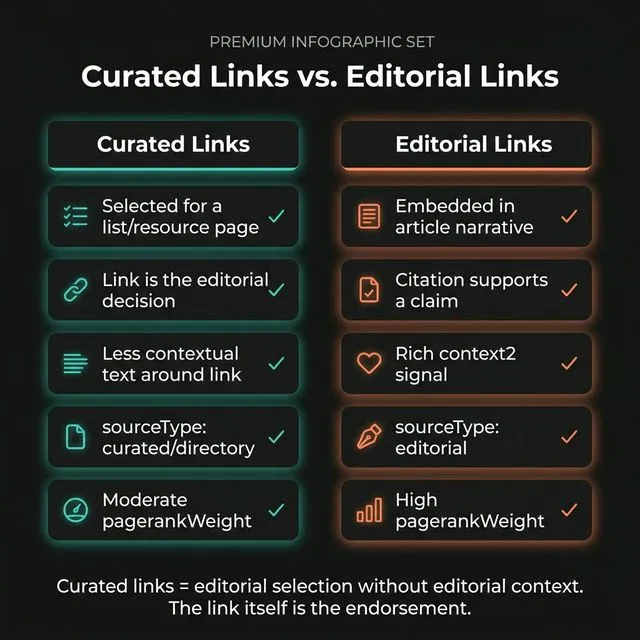
| Dimension | Curated links | Editorial links |
|---|---|---|
| Format | Listed in a collection | Embedded in article narrative |
| Editorial decision | ”This resource belongs on our list" | "This source supports our argument” |
context2 signal | Low (list format, minimal surrounding text) | High (full editorial context) |
sourceType | Curated/directory | Editorial |
pagerankWeight | Moderate | High |
| Scalability | High (outreach-responsive) | Low (earned through excellence) |
| Predictability | Moderate (pitch acceptance varies) | Low (organic earning) |
| Link persistence | High (resource pages stay up) | High (articles stay up) |
The practical takeaway: Curated links are more scalable and predictable than editorial links, but carry less per-link signal value. A balanced strategy uses curated link outreach for volume and relies on content quality + digital PR for editorial links.
How to Earn Curated Backlinks
The 4-step process for systematic curated link acquisition:
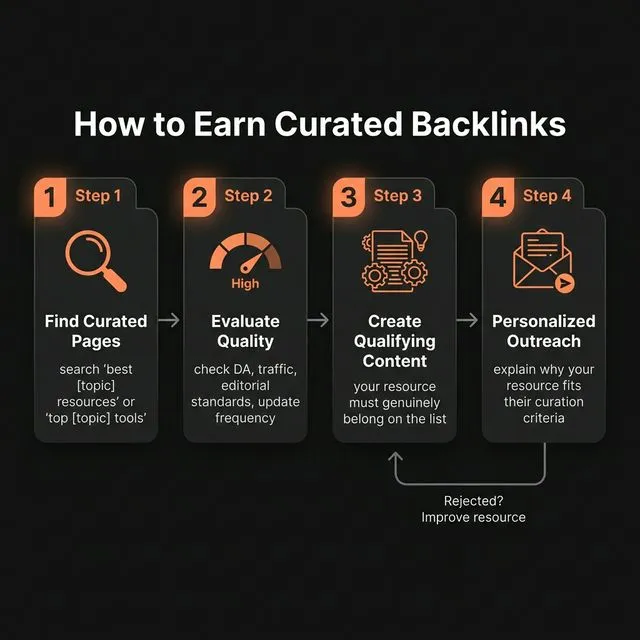
Step 1: Find curated pages
Search operators to find resource pages in your niche:
"best [topic] tools"or"top [topic] resources""[topic] resource guide" + inurl:resourcesintitle:"useful [topic] links"orintitle:"recommended [topic]""weekly roundup" + [topic]or"monthly roundup" + [topic][topic] + "add a resource"or"suggest a link"
Step 2: Evaluate quality
Not every curated page is worth pursuing. Evaluate:
- Domain authority — is the curating site itself authoritative?
- Traffic — does the resource page receive real visitors?
- Update frequency — is the page actively maintained?
- Editorial standards — are the listed resources genuinely high quality?
- Relevance — is the page topically aligned with your content?
Step 3: Create qualifying content
Your resource must genuinely deserve to be on the list. This means:
- It’s the best or most comprehensive resource on the specific topic
- It provides unique value (data, tools, methodology) not available elsewhere
- It’s well-produced, regularly updated, and functional
- It serves the page’s audience (not just your own marketing goals)
Step 4: Personalized outreach
Contact the curator with a personalized pitch that:
- References their specific resource page
- Explains why your resource fits their existing curation criteria
- Highlights what makes your resource uniquely valuable
- Suggests where on their page it would fit
Avoid mass email templates. Curators receive dozens of link requests — your pitch needs to demonstrate you’ve actually reviewed their page and have something genuinely worth adding.
What This Means for GEO and Source Authority
Curated backlinks contribute to GEO indirectly through entity validation:
The AI Overview source selection patent (US20240289407A1) evaluates sources through trust and authority layers. Being featured on curated resource pages contributes to:
- Entity validation: Multiple curated pages listing your resource validates your entity’s relevance and quality
- Topical authority: Consistent inclusion on curated pages within a specific topic reinforces topical authority signals
- Citation diversity: Curated page mentions create a diverse citation profile across different domains
This is the Source ? Consensus ? Trust cycle at the curation layer: when independent curators select your content across multiple resource pages (Source), that repeated editorial selection creates a web-wide pattern of validation (Consensus), and both ranking algorithms and AI systems recognize that endorsement pattern as genuine trust (Trust).
For direct AI Overview citation, editorial backlinks and contextual backlinks carry more weight because they provide the rich contextual signal that AI systems use for source quality assessment. Curated links build the consensus foundation that editorial links convert into rankings.
At Get Me Links, we build curated link profiles that create the consensus pattern AI systems reward. Talk to us about your curated link strategy ?
Frequently Asked Questions
What are curated backlinks?
Curated backlinks are links from pages where someone manually selected your content for inclusion — resource pages, expert roundups, best-of lists, weekly link roundups, and editorially-reviewed niche directories. The defining feature is editorial selection: a human decided your content deserves to be listed.
Are curated backlinks good for SEO?
Yes — high-quality curated backlinks provide legitimate SEO value. They transfer pagerankWeight (usually dofollow), involve editorial judgment (positive sourceType signal), and validate your content’s quality. However, they provide less per-link value than in-content editorial backlinks because they lack the rich contextual signal of narrative embedding.
How do I find curated link opportunities?
Search Google for resource pages using operators like "best [topic] tools", "[topic] resource guide", intitle:"useful [topic] links", and "weekly roundup" + [topic]. Filter results for pages with genuine editorial standards, active maintenance, and topical relevance to your content.
What’s the difference between curated links and directory links?
The difference is editorial selection. Curated links come from pages where someone manually reviews and selects resources based on quality criteria. Directory links come from automated directories that accept any submission. Google values curated links significantly higher because the editorial selection serves as a quality signal.
How many curated backlinks do I need?
Focus on quality over quantity. 10 curated links from relevant, high-authority resource pages provide more value than 100 directory submissions. The ideal curated link profile includes a mix of resource pages in your niche combined with your other link types — editorial, contextual, and natural backlinks.
References:
- Google. (2024). Content Warehouse API Documentation (Leaked). Attributes cited:
pagerankWeight,context2,sourceType. - SparkToro & Fishkin, R. (2024). An Anonymous Source Shared Thousands of Leaked Google Search API Documents with Me. SparkToro Blog.
- Google. (2024). Link spam policies. Google Search Central.
- Google. (2024). Patent US20240289407A1: AI Overview source selection and scoring. USPTO.
- Google. (2014). Patent US9165040B1: Ranking search results based on entity metrics (siteFocusScore). USPTO.
- Google. (2012). Penguin algorithm update — targeting link schemes. Google Search Central Blog.
- Moz. (2024). Resource Page Link Building Guide. Moz Learning Center.
- Wikipedia. (2025). Link building.