
- A toxic backlink is a link that either triggers a Google manual action or is automatically devalued (not penalized) by SpamBrain’s algorithmic classifiers.
- The leaked Google API reveals that Google ignores most low-quality links rather than penalizing sites for them. The
linkPenaltyInfoattribute exists — but its application is narrow, focused on deliberate link schemes rather than random spam. - “Toxic backlink” scores from SEO tools are proprietary metrics with no equivalent in Google’s systems. A link flagged as “toxic” by Semrush or Moz may be perfectly harmless — or may already be ignored by Google without any action from you.
- The only links that are genuinely toxic are those from link networks (PBNs), paid link schemes, hacked sites, and doorway pages — patterns that violate Google’s link spam policies.
- The Google Disavow Tool exists but should be used sparingly. In most cases, Google’s algorithms already ignore the links that tools flag as “toxic” — and disavowing legitimate links can hurt your rankings.
“You have toxic backlinks” is one of the most common — and most misleading — alerts in SEO tools. Third-party platforms flag thousands of links as “toxic” based on proprietary scoring algorithms that have no relationship to how Google actually classifies link quality.
The result is widespread anxiety. Site owners spend hours disavowing links that Google would have ignored anyway, or worse, disavowing legitimate links that were actually helping their rankings.
The leaked API documentation provides clarity. Google’s link quality system is more nuanced than a binary “toxic or safe” classification — and the threshold for a link to genuinely damage your rankings is far higher than most SEO tools suggest.
What Is a Toxic Backlink?
A toxic backlink is a link that actively harms (or has the potential to harm) your site’s rankings. This is a narrow definition — and intentionally so. Most low-quality links are not toxic. They’re simply low value or ignored.
The distinction matters:
| Classification | What happens | Example |
|---|---|---|
| Toxic (penalizable) | Manual action or algorithmic demotion | Links from a Private Blog Network (PBN) you built |
| Low quality (ignored) | Google discounts the link; no ranking impact | Random spam comment link, scraper site |
| Low value (minimal signal) | Small positive or neutral contribution | Directory listing, low-DR blog mention |
The vast majority of links that SEO tools flag as “toxic” fall into categories 2 or 3 — ignored or low-value. Genuinely toxic links that trigger penalties require deliberate manipulation.
How Google Classifies Link Quality: The API Evidence
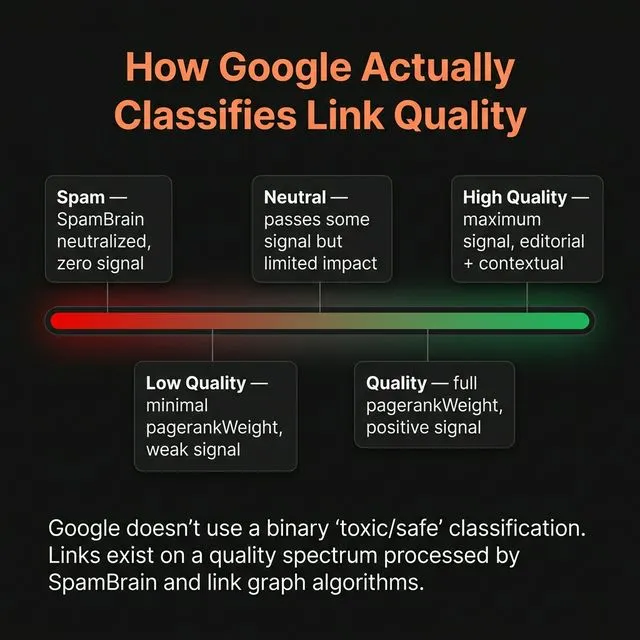
The leaked API reveals specific attributes Google uses to evaluate link quality and detect manipulation:
linkPenaltyInfo
This attribute exists in the API documentation but its scope is narrow. It’s associated with manual actions — human reviewer decisions that a link violates Google’s guidelines. Manual actions are triggered by:
- Pattern detection by SpamBrain (escalated for human review)
- Reports from other webmasters
- Google’s own quality rater audits
Important: linkPenaltyInfo is applied to the linking pattern, not individual links. Google doesn’t penalize you for receiving a single spam link. It penalizes you for participating in a link scheme — a pattern of manipulative links that shows deliberate intent.
SpamBrain: Algorithmic link quality scoring
SpamBrain is Google’s machine learning system for detecting link spam. Based on the API leak and official documentation, SpamBrain:
- Identifies link networks — clusters of sites that exist primarily to pass PageRank rather than serve users
- Detects paid link patterns — links that follow commercial exchange signatures (similar anchor text across many sites, sudden appearance on unrelated domains)
- Neutralizes, doesn’t penalize — SpamBrain’s default behavior is to ignore detected spam links, not penalize the target site
This is the critical distinction most SEO guides miss: SpamBrain’s primary function is neutralization, not punishment. When SpamBrain detects that a link is spam, it removes the link’s pagerankWeight contribution — reducing that link’s value to zero. It does not add a negative penalty to your site.
Based on our reading of the API leak and Google’s official guidance: The “toxic backlink” concept as defined by SEO tools dramatically overstates the risk. Google’s system is designed to ignore spam links rather than penalize sites for receiving them — because Google cannot assume that competitive negative SEO attacks are the target site’s fault.
sourceType and spam classification
The sourceType attribute classifies links by their origin context. Links classified as spam, UGC abuse, or network-generated receive reduced or zero pagerankWeight. But again — reduced weight is not a penalty. It’s neutralization.
When Backlinks Are Actually Toxic
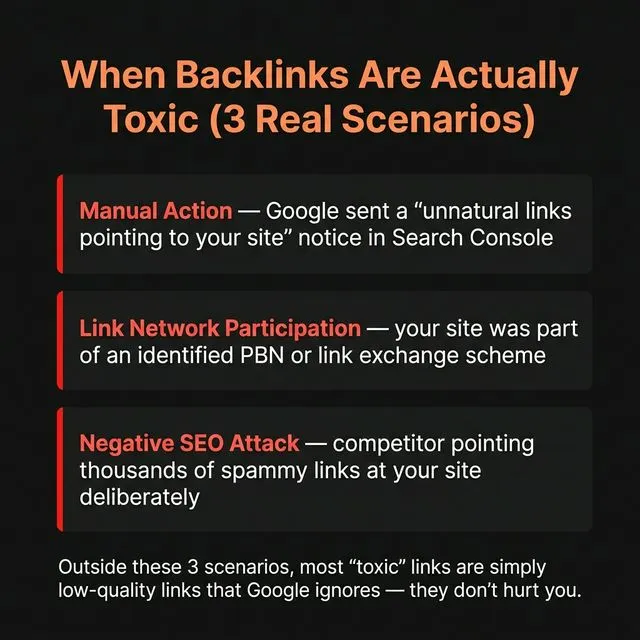
Based on Google’s link spam policies and the API leak evidence, genuinely toxic backlinks require deliberate participation in link manipulation:
Private Blog Networks (PBNs)
Sites created solely to pass PageRank to a target site, with no genuine audience or editorial purpose. PBNs are the clearest violation of Google’s link spam policies because they represent a deliberate attempt to manufacture high quality backlinks that don’t exist organically.
How Google detects them: Hosting pattern analysis, shared IP addresses, content quality signals, link pattern clustering, registrant overlap.
Paid link schemes
Buying or selling links that pass PageRank — specifically links placed solely for ranking manipulation with no editorial justification. The distinction between a legitimate sponsored placement (marked with rel="sponsored") and a paid link scheme is whether the link passes PageRank and whether the placement was disclosed.
Link exchange networks
“You link to me, I’ll link to you” at scale. Reciprocal linking isn’t inherently toxic — natural sites link to each other. But organized link exchange networks with hundreds of participants create detectable patterns.
Hacked site injections
Links injected into legitimate sites through security exploits. These are toxic because they’re placed without the publisher’s knowledge — creating a signal that appears editorial but isn’t. Google’s hacked content policies address this directly.
Automated link spam
Comment spam bots, automated directory submissions, forum signature spam at scale, blog network auto-posting. These create thousands of low-quality links with manipulative anchor text.
Why SEO Tool “Toxic Scores” Are Misleading
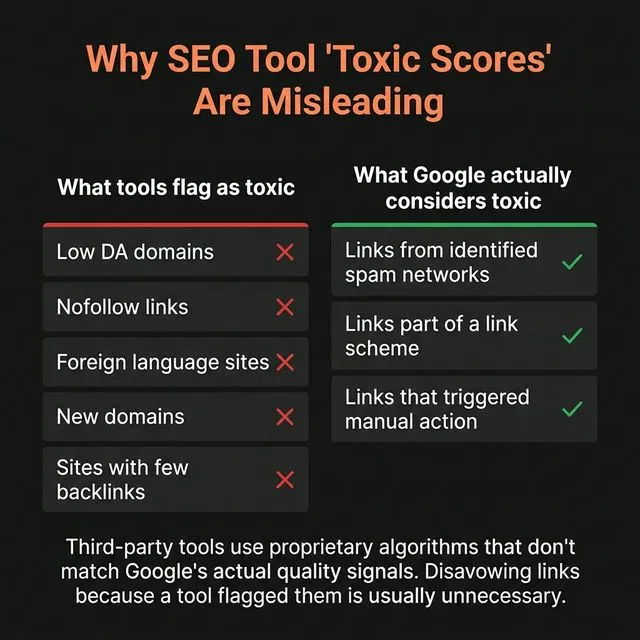
Every major SEO tool has a “toxic backlink” feature. Here’s why these scores should be interpreted with extreme caution:
No tool has access to Google’s data
Semrush’s “Toxicity Score,” Moz’s “Spam Score,” and similar metrics are proprietary calculations based on domain-level signals the tools can observe (IP address patterns, content quality, link patterns). None of these tools have access to Google’s linkPenaltyInfo, SpamBrain’s internal classifications, or the actual pagerankWeight assigned to each link.
The tools over-flag by design
SEO tools have a financial incentive to flag more links as toxic. A tool that says “your backlinks are fine” generates less engagement than one that says “WARNING: 500 toxic links detected.” The over-flagging creates urgency that drives tool subscriptions and audit services.
Low quality ≠toxic
A link from a low-DR, low-traffic site is not toxic. It’s low value. Google processes it, assigns minimal pagerankWeight, and moves on. The link doesn’t harm you — it just doesn’t help much.
A link from a spam directory that exists purely to sell links is potentially toxic — not because of its metrics, but because of its intent and pattern.
The disavow cascade risk
When tools flag legitimate links as toxic, site owners disavow them. This removes the pagerankWeight from links that were actually contributing to rankings — causing ranking drops that the site owner then attributes to “more toxic links,” leading to more disavowing. This cascade is one of the most common self-inflicted SEO injuries we see in audit work.
When to Use the Google Disavow Tool
The Google Disavow Tool should be used only in specific situations:
When to disavow
- You have a manual action for unnatural backlinks and need to demonstrate cleanup
- You previously built PBN links or participated in link schemes and want to disassociate
- A negative SEO attack is genuinely affecting your rankings (rare, but documented)
- Hundreds of links from a single spam domain that were clearly injected, not earned
When NOT to disavow
- An SEO tool flagged links as toxic — investigate the actual pattern before acting
- Low-quality sites link to you naturally — Google already ignores these
- You received spam comment links — they carry
rel="ugc"orrel="nofollow"and pass zeropagerankWeight - Your rankings dropped and you’re looking for a cause — disavowing random links won’t fix algorithmic changes
- You’re not sure if a link is harmful — when in doubt, don’t disavow
Based on our reading of Google’s official documentation and John Mueller’s public statements: Google’s own guidance is that the Disavow Tool is a “last resort” for sites that have participated in link schemes. For most sites, SpamBrain handles link quality scoring automatically — and manual disavows add no benefit.
How to Audit Your Backlink Profile for Genuine Toxicity
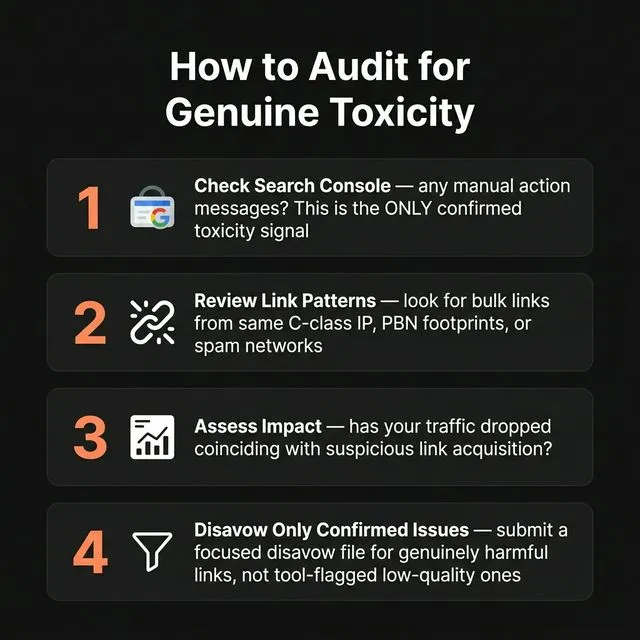
If you’re concerned about toxic backlinks, here’s the evidence-based audit approach:
Step 1: Check for manual actions first
Go to Google Search Console → Manual Actions. If nothing is listed, you don’t have a penalty-level toxic link problem. Everything else is optimization, not emergency.
Step 2: Identify pattern-level risks
Look for patterns, not individual links:
- 50+ links from the same spam domain → investigate
- Hundreds of links with the same anchor text from unrelated sites → investigate
- Links from known PBN providers you previously used → disavow
- Sudden burst of 500+ links from suspicious sources → investigate
Step 3: Evaluate the linking source
For any link you’re considering disavowing, check:
- Does the linking site have real content and real traffic?
- Was the link placed editorially or injected?
- Does the linking site link to many other sites in a suspicious pattern?
- Did you pay for this link or participate in an exchange?
If the answer to the last two questions is “no” — the link is almost certainly not toxic.
Step 4: Disavow only with evidence
Only disavow links where you have clear evidence of manipulation — either your own past schemes or clearly identifiable spam injections. Never disavow a link simply because an SEO tool flagged it.
No link building agency should recommend mass disavow operations based on tool scores alone. Evidence-based auditing protects your existing ranking signals while addressing genuine risk. At Get Me Links, we audit link profiles using the same API signals Google uses — not third-party toxicity scores. See how we approach link profile auditing ?
What This Means for GEO and Source Authority
Toxic backlinks have minimal direct impact on GEO because AI Overview source selection uses positive quality signals, not negative penalty signals.
The AI Overview source selection patent (US20240289407A1) evaluates sources through trust layers that measure authority, relevance, and citation patterns. A site’s toxic link count doesn’t directly reduce its GEO score — but a site whose high quality backlinks have been incorrectly disavowed may lose the positive trust signals needed for AI citation.
The more relevant GEO concern: false disavows. If you disavow legitimate editorial backlinks or contextual backlinks because a tool incorrectly flagged them, you reduce the positive trust signals that feed AI Overview source selection — making incorrect disavows a greater GEO risk than the toxic links themselves.
In the Source → Consensus → Trust framework, toxic link management is fundamentally about protecting the positive signals: ensuring that your genuine editorial citations (Source), diverse linking patterns (Consensus), and accumulated domain trust (Trust) remain intact. The risk isn’t bad links — it’s losing good ones through overcorrection.
At Get Me Links, we protect client link profiles through evidence-based auditing — identifying genuine manipulation while preserving the editorial citations that drive rankings. Talk to us about link profile protection →
Frequently Asked Questions
What are toxic backlinks?
Toxic backlinks are links that either trigger a Google manual action or come from identified link schemes (PBNs, paid link networks, hacked sites). They represent deliberate manipulation, not simply low-quality links. Most links flagged as “toxic” by SEO tools are actually just low-value — Google ignores them rather than penalizing your site for them.
How do I check for toxic backlinks?
Start with Google Search Console → Manual Actions to check for penalties. Then review your backlink profile in Ahrefs for pattern-level risks: clusters from the same spam domain, suspicious anchor text patterns, or links from known PBN providers. Don’t rely solely on third-party “toxicity scores” — they have no equivalent in Google’s systems.
Should I disavow toxic backlinks?
Only if you have clear evidence of manipulation — either your own past link schemes or identifiable spam injections. Google’s SpamBrain automatically neutralizes most spam links without your intervention. Disavowing legitimate links based on inaccurate tool scores can harm your rankings.
Can competitors create toxic backlinks to hurt my site?
Negative SEO through backlinks is theoretically possible but rare in practice. Google’s systems are designed to ignore suspicious links rather than penalize the target site — specifically because Google cannot assume you’re responsible for links you didn’t build. In most cases, competitor spam links are automatically neutralized by SpamBrain.
How many toxic backlinks are too many?
Individual toxic links are rarely dangerous. Google penalizes patterns, not individual links. A site with 10 PBN links is at risk. A site with 10 random spam comment links is not. The key question isn’t “how many” but “what pattern exists” — and whether that pattern shows deliberate manipulation.
References:
- Google. (2024). Content Warehouse API Documentation (Leaked). Attributes cited:
linkPenaltyInfo,pagerankWeight,sourceType,anchorMismatch. - SparkToro & Fishkin, R. (2024). An Anonymous Source Shared Thousands of Leaked Google Search API Documents with Me. SparkToro Blog.
- Google. (2024). Link spam policies. Google Search Central.
- Google. (2024). Hacked content spam policies. Google Search Central.
- Google. (2024). Disavow Tool documentation. Google Search Central.
- Google. (2024). Patent US20240289407A1: AI Overview source selection and scoring. USPTO.
- Mueller, J. (2023). Various public statements on Disavow Tool usage. Google Search Relations team.
- Wikipedia. (2025). Backlink.