
- High quality backlinks are defined by 6 measurable attributes from Google’s leaked API — not just Domain Rating or the presence of a dofollow tag.
- The 6 quality factors are:
pagerankWeight(authority transfer),siteFocusScore(topical relevance),context2(surrounding text alignment),sourceType(editorial classification), click engagement (lastLongestClicks), andanchorMismatch(absence of). - A single high-quality backlink that scores well across all 6 factors produces more ranking movement than 50 low-quality links that only have the dofollow attribute in their favor.
- The definition of “high quality” changes by context: a link that’s high quality for an SEO page may be low quality for a medical page because niche relevance shifts the quality equation.
- There is no universal quality threshold. Quality is relative — evaluated against the link profiles of the pages currently ranking for your target keyword.
“Get high quality backlinks” is the most common advice in SEO. It’s also the vaguest. Without defining what makes a backlink high quality at the algorithmic level, the advice is useless.
The leaked Google API documentation makes the definition concrete. A high quality backlink isn’t simply a dofollow link from a high-DR site. It’s a link that scores well across 6 quality dimensions that Google measures for every link in its index. Most links only satisfy one or two of these dimensions. The links that move rankings satisfy all six.
In this article, we define exactly what “high quality” means in Google’s scoring system, provide a practical evaluation framework, and explain why the industry’s over-reliance on Domain Rating produces misleading quality assessments.
What Makes a Backlink “High Quality”?
A high quality backlink satisfies multiple quality signals simultaneously. Based on the leaked API documentation and patent filings, we’ve identified 6 measurable quality attributes:
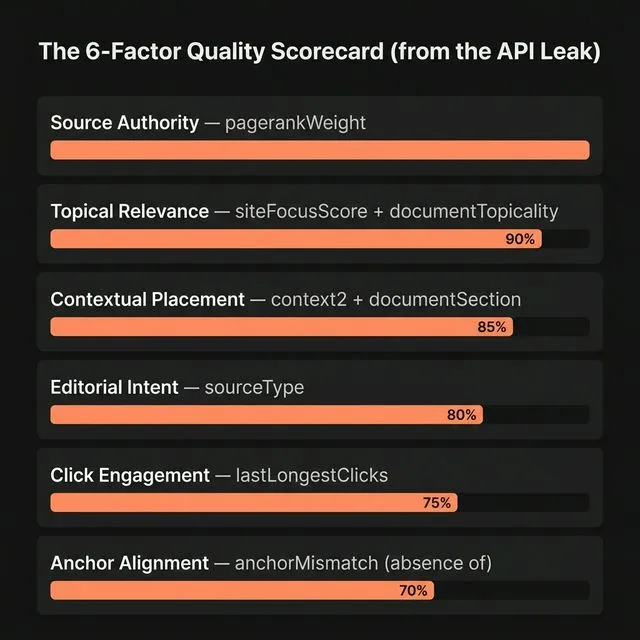
Factor 1: Source authority (pagerankWeight)
The linking page’s ability to transfer ranking signal. This is what Domain Rating approximates — but pagerankWeight is calculated per-link, not per-domain. A page with high organic traffic on a DR 50 site may carry more pagerankWeight than a page with zero traffic on a DR 80 site.
How to evaluate: Check the linking page’s URL Rating (UR), organic traffic, and referring domains — not just the domain’s DR.
Factor 2: Topical relevance (siteFocusScore + documentTopicality)
The topical relationship between the linking domain, the linking page, and your target page. The siteFocusScore patent (US9165040B1) measures domain-level topical concentration. The documentTopicality attribute measures page-level topic classification.
How to evaluate: Does the linking domain regularly publish content about your topic? Is the specific linking page about a related subject? See our niche relevant backlinks analysis for the 4-layer relevance model.
Factor 3: Contextual placement (context2 + documentSection)
Where the link sits on the page and what text surrounds it. The context2 hash fingerprints the surrounding content to verify topical alignment. The documentSection attribute classifies whether the link is in body content, sidebar, footer, or boilerplate.
How to evaluate: Is the link embedded in a body paragraph surrounded by relevant text? Or is it in a sidebar widget, footer, or author bio? See our contextual backlinks analysis for the context2 hash mechanism.
Factor 4: Editorial classification (sourceType)
How Google classifies the origin and intent of the link. Editorial backlinks — placed because the content genuinely adds value — receive the highest sourceType classification. UGC links, reciprocal links, and spam-pattern links receive progressively lower classifications.
How to evaluate: Was the link placed because the publisher genuinely found the content valuable? Or was it exchanged, purchased, or inserted without editorial judgment?
Factor 5: Click engagement (lastLongestClicks, goodClicks)
Whether real users click the link and engage with the target page. Google’s NavBoost system (Patent US9953049B1) tiers links by click behavior. Links that drive genuine referral traffic sit in a higher-quality index than links that generate zero clicks.
How to evaluate: Does the linking page get real organic traffic? Is the link positioned where readers would naturally click? Would a reader actually find value in following the link?
Factor 6: Anchor alignment (absence of anchorMismatch)
Whether the link’s anchor text is topically consistent with the target page’s content. The anchorMismatch attribute flags links where the anchor text conflicts with the target’s topic — reducing or negating the link’s value.
How to evaluate: Does the anchor text naturally describe the target page? Or is it keyword-stuffed, generic (“click here”), or topically mismatched?
High Quality vs. Low Quality: The API-Level Difference
Same HTML tag. Same dofollow attribute. Fundamentally different algorithmic treatment:
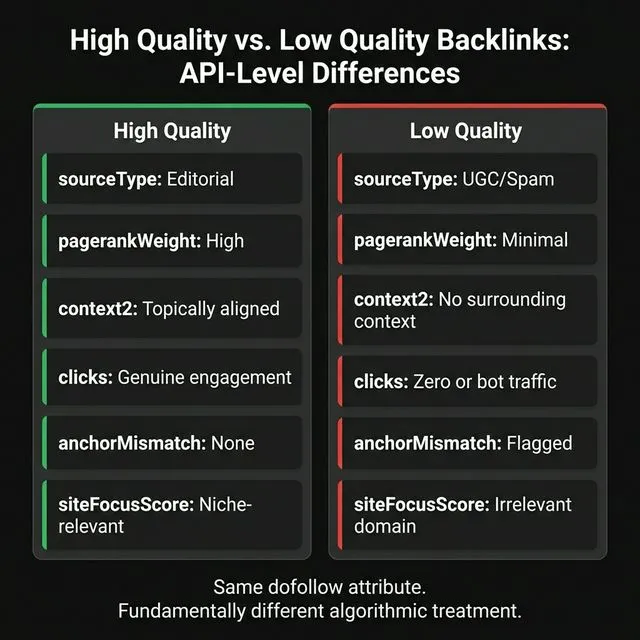
| Quality factor | High quality link | Low quality link |
|---|---|---|
pagerankWeight | High (authoritative linking page with traffic) | Minimal (dead page, no traffic) |
siteFocusScore | Niche-relevant domain | Irrelevant or topically broad domain |
context2 | Topically aligned surrounding text | No surrounding context (sidebar/footer) |
sourceType | Editorial (publisher-chosen) | UGC, spam, or transactional |
| Click engagement | Genuine referral clicks | Zero clicks (invisible placement) |
anchorMismatch | None (natural, relevant anchor) | Flagged (keyword-stuffed or mismatched) |
A link that scores well on all 6 factors is genuinely high quality. A link that scores well on only 1 factor (e.g., high DR but no relevance, no context, no clicks) is far less valuable than the industry typically assumes.
This is why buying links from high-DR sites with no topical relevance produces disappointing results. The Domain Rating represents only Factor 1. Factors 2–6 are either absent or negative — and the net ranking impact is a fraction of what the DR number suggests.
How to Evaluate Backlink Quality: The GML Framework
We use a 4-step evaluation framework to assess every link opportunity before pursuing it:
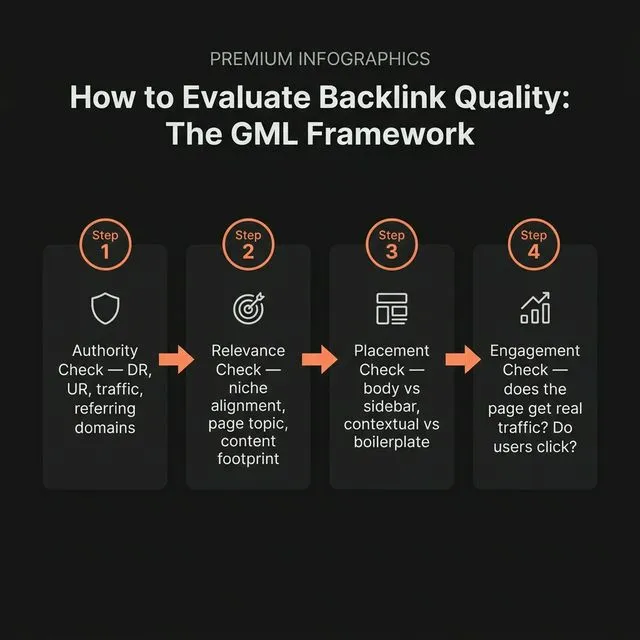
Step 1: Authority check
Metrics: DR, UR, organic traffic, referring domains
Use Ahrefs to check both the domain and the specific URL. A DR 50 domain is irrelevant if the specific linking page has UR 5, zero traffic, and no referring domains of its own. The page-level metrics are what determine pagerankWeight.
Minimum threshold: We typically look for pages with UR 15+ and at least some organic traffic. Below this threshold, the pagerankWeight transfer is minimal regardless of other quality factors.
Step 2: Relevance check
Metrics: Content topic, domain niche, keyword overlap
Check the domain’s content footprint. What percentage of their pages cover topics related to yours? Use Ahrefs Organic Keywords to compare keyword overlap between the prospect and your site. High overlap indicates high siteFocusScore alignment.
Minimum threshold: At least 30% of the domain’s recent content should be about topics in your niche. If the domain publishes about 20 different verticals and yours is a minor one, the siteFocusScore multiplier is too low.
Step 3: Placement check
Metrics: Link position, surrounding content quality, documentSection
Evaluate where the link will sit on the page. Body content placements produce context2 hash signals and carry full documentSection weight. Sidebar, footer, or author bio placements do not.
Minimum threshold: The link must be in the body content, surrounded by topically relevant text. We decline link opportunities that can only produce sidebar or footer placements.
Step 4: Engagement check
Metrics: Page traffic, user engagement, click potential
Does the linking page receive real visitors? A page with zero organic traffic produces zero click engagement — regardless of how strong the other quality factors are. The lastLongestClicks signal requires actual users clicking the link.
Minimum threshold: The linking page should have at least some organic traffic. Pages with zero traffic or traffic from bot-heavy sources provide diminished engagement signals.
This 4-step framework is how we vet every placement at Get Me Links. We reject opportunities that pass only 1–2 factors — even when the headline DR looks impressive. The result is a link profile where every placement contributes to Source authority across all three evaluation layers: algorithmic, human-rater, and AI citation. See our evaluation process in action →
The Ideal Quality Distribution
No backlink profile is 100% high quality. Healthy link profiles have a natural quality distribution:
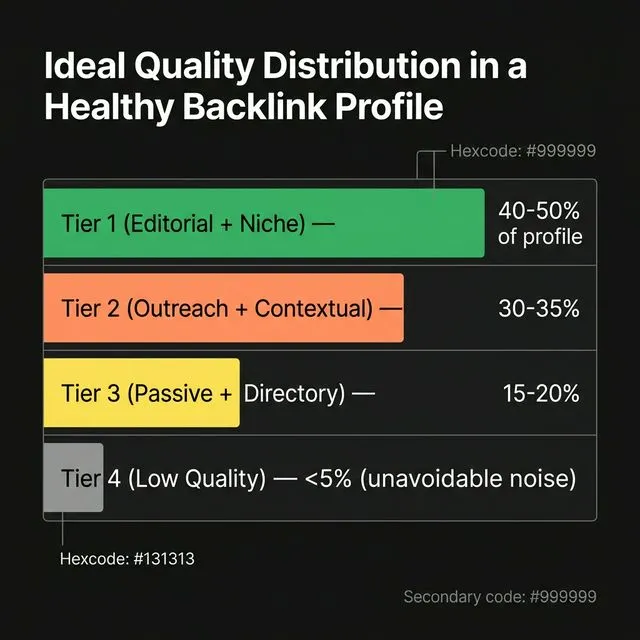
| Tier | Description | Target % | Examples |
|---|---|---|---|
| Tier 1 | Editorial + niche-relevant | 40–50% | Earned citations, digital PR, expert quotes |
| Tier 2 | Outreach + contextual | 30–35% | Guest posts, link insertions, resource pages |
| Tier 3 | Passive + directory | 15–20% | Brand mentions, directories, social profiles |
| Tier 4 | Low quality (noise) | <5% | Scraped content, automated spam (unavoidable) |
A profile skewed too heavily toward Tier 1 looks unnatural. A profile dominated by Tier 4 triggers spam classifiers. The ideal distribution shows natural growth — a mix of earned, built, and passively acquired links where the quality tiers reflect genuine industry engagement.
Quality is relative, not absolute
What constitutes “high quality” depends on your competitive landscape. For a keyword where the top 5 results average DR 40 with 20 referring domains, a DR 35 link from a relevant site is high quality relative to the competition.
For a keyword where the top 5 results average DR 80 with 500 referring domains, the same DR 35 link is relatively low quality — it doesn’t meet the competitive threshold.
Always evaluate quality against the link profiles of pages currently ranking for your target keyword. Absolute quality metrics are guidelines; relative quality determines competitive outcomes.
Why Domain Rating Alone Is Misleading
Domain Rating (DR) is useful as a proxy for pagerankWeight potential — but it tells you nothing about the other 5 quality factors. This creates systematic misvaluation:
High DR doesn’t mean high quality when:
- The domain has no topical relevance to your content (Factor 2 fails)
- The link is in a sidebar or footer (Factor 3 fails)
- The linking page is a paid advertorial (Factor 4 fails)
- The linking page gets zero traffic (Factor 5 fails)
- The anchor text is keyword-stuffed (Factor 6 fails)
Lower DR can mean higher quality when:
- The domain is laser-focused on your exact niche (Factor 2 maximized)
- The link is embedded in a substantial, topically relevant article (Factor 3 maximized)
- The publisher genuinely chose to cite your content (Factor 4 maximized)
- The linking page has engaged readers in your target audience (Factor 5 maximized)
- The anchor text naturally describes your content (Factor 6 maximized)
This is why our link building agency evaluates every placement across all 6 factors — not just the headline DR metric. A DR 40 link that satisfies all 6 factors is a better investment than a DR 80 link that only satisfies Factor 1.
What This Means for GEO and Source Authority
The AI Overview source selection patent (US20240289407A1) uses quality-weighted link signals in its source trust scoring. This means the 6-factor quality model directly affects whether your content gets cited in AI Overviews.
AI Overview systems need to cite trustworthy, authoritative sources. A page backed by high-quality backlinks — links that score well across authority, relevance, context, editorial intent, engagement, and anchor alignment — demonstrates exactly the kind of trust that the source selection algorithm rewards.
Conversely, a page with a large number of low-quality backlinks may rank organically (through sheer volume) but fail to qualify for AI citation — because the quality signals don’t meet the trust threshold.
This is the Source → Consensus → Trust progression: high-quality backlinks make you the Source that publishers cite, those citations build Consensus across the web, and that consensus establishes the Trust that both ranking algorithms and AI systems require. Low-quality links skip the middle step — and without consensus, there is no compounding trust.
Based on our reading of patent US20240289407A1: GEO source selection is quality-gated. The threshold for AI Overview citation is higher than the threshold for organic ranking — which means the 6-factor quality model becomes even more important as AI-generated search results grow.
Every campaign we build at Get Me Links is designed to satisfy all 6 quality factors simultaneously — because that’s what moves rankings today and qualifies for AI citation tomorrow. Talk to us about building a quality-first link profile →
Frequently Asked Questions
What is a high quality backlink?
A high quality backlink is a link that scores well across 6 measurable attributes: source authority (pagerankWeight), topical relevance (siteFocusScore), contextual placement (context2 hash), editorial classification (sourceType), click engagement (lastLongestClicks), and anchor alignment (absence of anchorMismatch). A link that satisfies all 6 factors produces significantly more ranking impact than one that only satisfies 1 or 2.
How many high quality backlinks do I need to rank?
It depends on the competitive landscape for your target keyword. Evaluate the link profiles of pages currently ranking in positions 1–5. Your page needs to match or exceed their quality-weighted link signals — not just their total backlink count. In most niches, 15–30 high-quality links that satisfy all 6 factors outperform hundreds of low-quality links.
Is Domain Rating the best way to measure backlink quality?
No. Domain Rating approximates only 1 of the 6 quality factors (source authority). It tells you nothing about topical relevance, contextual placement, editorial classification, click engagement, or anchor alignment. Use DR as a starting filter, then evaluate the other 5 factors before pursuing any link opportunity.
What makes a backlink low quality?
A low quality backlink fails on most or all of the 6 quality factors: low pagerankWeight (dead page, no traffic), irrelevant domain (siteFocusScore mismatch), non-contextual placement (sidebar, footer), non-editorial origin (spam, UGC), zero click engagement, and/or mismatched anchor text. Dofollow backlinks from spam sources are the most common low-quality link type.
Do high quality backlinks still matter for SEO in 2026?
Yes — they matter more than ever. Google’s shift toward quality-weighted link scoring means that low-quality links carry progressively less ranking signal while high-quality links carry more. Additionally, the types of backlinks that qualify content for AI Overview citation are exclusively high quality — making quality backlinks essential for both traditional SEO and GEO.
References:
- Google. (2024). Content Warehouse API Documentation (Leaked). Attributes cited:
pagerankWeight,siteFocusScore,documentTopicality,context2,documentSection,sourceType,lastLongestClicks,goodClicks,anchorMismatch. - SparkToro & Fishkin, R. (2024). An Anonymous Source Shared Thousands of Leaked Google Search API Documents with Me. SparkToro Blog.
- Google. (2014). Patent US9165040B1: Ranking search results based on entity metrics (siteFocusScore). USPTO.
- Google. (2017). Patent US9953049B1: NavBoost — modifying search result ranking based on implicit user feedback. USPTO.
- Google. (2024). Patent US20240289407A1: AI Overview source selection and scoring. USPTO.
- Google. (2015). Patent US8719257B1: Characterizing site quality. USPTO.
- Google. (2024). Link spam policies. Google Search Central.
- Wikipedia. (2025). Backlink.
- Wikipedia. (2025). PageRank.