
Canadian Medical Devices Provider: Two Years of Strategic Partnership, 920 Keywords in the Top 3, and 109 AI Overview Citations
An enterprise medical devices company expanded from Growth to Advisory tier over two years. Organic traffic more than doubled, 920 keywords reached the top 3, and the brand now appears in AI Overviews when people search for competitors' names.
The Partnership
This case study isn’t about links. It’s about what happens when a strategic partnership compounds over two years.
A Canadian medical devices enterprise came to us operating in one of the most scrutinized verticals online — YMYL health technology, primarily serving the Canadian market. The brand had deep product expertise and a comprehensive content library, but organic visibility wasn’t matching the quality of what they offered.
What made this engagement different from day one was the person on the other side. The client’s head of marketing and search is an enterprise-level operator who treats link building as strategic infrastructure, not a line item. From the first session, they were in the data with us — reviewing competitive landscapes, evaluating publisher quality against their internal compliance standards, and co-directing strategy based on their market position.
The engagement started at Growth tier — a measured commitment to validate the methodology against their specific constraints before increasing exposure. As results compounded and trust deepened, budget expanded every quarter:
A sophisticated enterprise team doesn’t consistently grow their investment from Growth to Advisory over two years, quarter over quarter, unless the work is producing tangible, substantial ROI. They have internal revenue data, conversion attribution, and pipeline metrics we can’t show here. They expanded because the numbers justified it — every quarter.
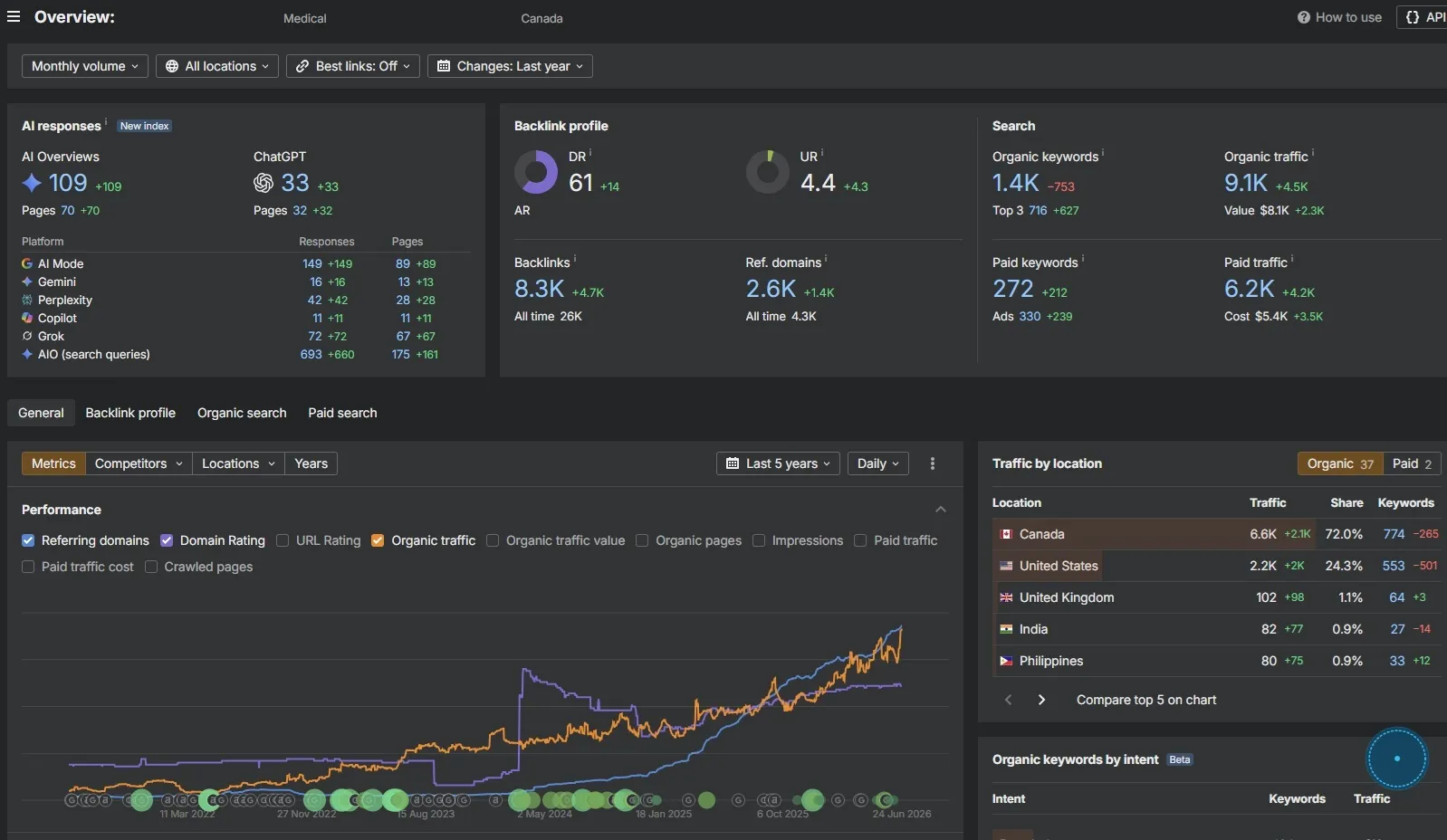
AI Visibility — The Modern Search Story
This is the 2026 reality: traditional rankings and AI citations are now two sides of the same coin. The same editorial authority that drives organic positions also determines whether AI platforms cite your brand — or your competitor’s.
Here’s what 468 strategic placements on real publisher sites produced across AI platforms:
| AI Platform | Citations | Pages Cited |
|---|---|---|
| Google AI Overviews | 109 | 70 pages |
| ChatGPT | 33 | 32 pages |
| Perplexity | 42 | 28 pages |
| Google Gemini | 16 | 13 pages |
| Microsoft Copilot | 11 | 11 pages |
| Grok | 72 | 67 pages |
| AIO Search Queries | 693 | 175 pages |
283 total AI citations. 693 search queries triggering AI citations. 6 platforms.
The mechanism isn’t mysterious. When AI models retrieve from the web, they find this brand referenced across hundreds of legitimate editorial contexts — including contexts that mention competitors by name.
That’s how a medical devices brand ends up appearing in AI Overviews when someone searches for a competitor’s name. The editorial consensus we built across the web translates directly into AI retrieval signals. This is competitive displacement at the AI layer — driven by the same editorial authority that drives traditional rankings.
This isn’t a side effect of link building. It’s the new frontier of what editorial consensus produces — and it’s where the ROI of strategic placements on real publisher sites becomes most visible.
Read more about how strategic link building drives AI search visibility.
The Challenge
The constraints that shaped every decision in this campaign:
- YMYL scrutiny. Health-technology pages face Google’s strictest quality thresholds. Content had to demonstrate genuine expertise, and the off-page profile had to match — every placement on the wrong site creates more risk than ten placements on the right ones.
- Canadian geographic focus. The target audience was primarily Canadian, compressing the available publisher pool dramatically compared to a US or global campaign.
- Decaying inherited authority. The existing link profile was built on aging legacy backlinks that were actively deteriorating. Within six months of engagement start, many of those historical links would fall off entirely.
- 500+ domain blocklist. By mid-campaign, the internal blocklist exceeded 500 domains — sites rejected for manipulated metrics, guest-post advertising, adult adjacency, or insufficient topical relevance. In a geo-constrained health niche, that’s the majority of the addressable publisher pool.
How We Work
Building the links is 1% of what happens in an Advisory engagement. This is the other 99%.
For two years, we’ve met with this team regularly. Every session is a deep dive — competitors, positioning, content gaps, placement strategy, what’s shifting in the market. We’ve gone beyond links into on-page optimization, user experience, content strategy, and competitive intelligence. The fine-tuning never stops.
| Layer | What Happens | Cadence |
|---|---|---|
| Strategy | Competitive landscape analysis, SERP position mapping, goal alignment with client’s head of search | Regular sessions — ongoing for 2 years |
| Intelligence | Competitor link profile monitoring, content gap identification, algorithm update impact analysis | Continuous |
| Architecture | Target URL selection and rotation, anchor text distribution engineering, brand mention vs. keyword anchor balance | Monthly review, quarterly recalibration |
| Narrative | Guest post angle refinement, topical alignment with client’s content strategy, publisher vertical matching | Evolved throughout campaign |
| Execution | Publisher prospecting, site-by-site vetting (traffic, topical relevance, editorial quality), placement delivery | Weekly pipeline, monthly delivery |
| Reporting | Full link report (every placement documented), anchor distribution analysis, indexed status tracking, follow/nofollow audit | Monthly deliverable |
What 2 years of fine-tuning looks like:
- Anchor strategy evolved: Started with balanced commercial anchors, progressively shifted heavier on brand mentions as authority grew — reducing over-optimization risk while building brand-level signals
- Placement site types narrowed: Began with health/wellness general publishers, narrowed over time to medical-device-adjacent editorial sites that genuinely serve the audience
- Velocity became quality-gated: Scaled from 10/month (proving phase) to 35/month (growth phase), then at Advisory, velocity became a function of quality — some months fewer placements at significantly higher individual value
- Target URL rotation: Started homepage-heavy (37.6% of links), progressively shifted to inner commercial pages as domain authority solidified — distributing equity where it drives conversions
- Guest post narratives refined: Topics evolved from generic health content to specialist narratives matching the client’s content calendar and competitive positioning
468 total placements. Average host traffic 10,011 visitors/month. Median host traffic 2,098 visitors/month. These are real publisher sites with real readership — not metrics-inflated shells.
The Evidence
Here’s what two years of strategic link building produces.
Phase 1: Building Through Decay (Months 1–10)
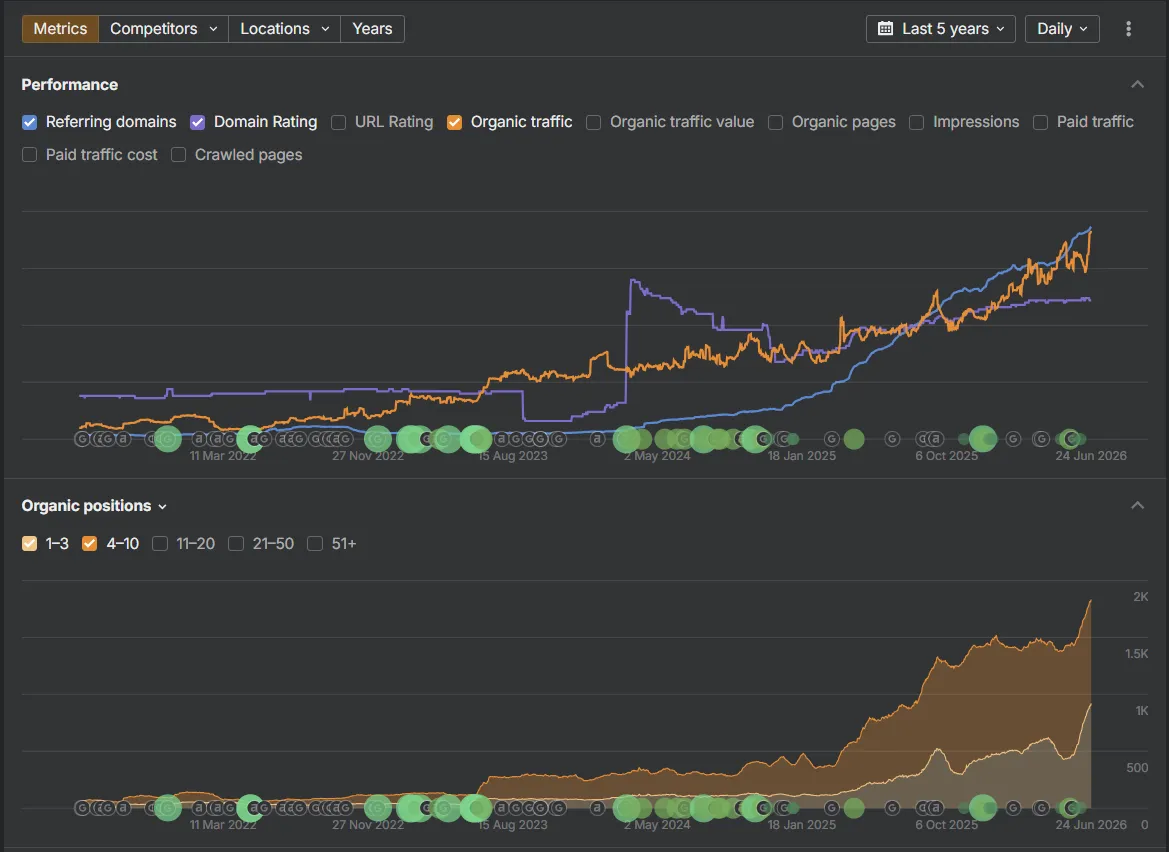
The inherited link profile had been dying for years before we started. Legacy backlinks were falling off in waves — and within 7 months, domain authority dropped from its inherited level to a fraction of where it started.
This is what happens when a domain runs on borrowed authority without active maintenance. The question was never whether the inherited links would decay — it was when.
Our campaign didn’t cause the deterioration. What it did was hold traffic steady at ~3,500/month while the legacy foundation eroded beneath it. The new links we were building were carrying weight immediately, compensating for decaying equity in real time. Traffic didn’t drop. That’s the signal.
Phase 2: Clean Foundation (Months 11–18)
With legacy links fully purged, the new campaign links became the entire foundation — and they performed:
- Traffic climbed from ~3,900 to 5,500 (+41%)
- Keywords in top 3 jumped from 59 to 335 — a 468% increase
- Month 12 was the inflection point — the compound effect activated after sustained, consistent pressure
The authority was now entirely earned, not inherited. Every referring domain, every editorial placement, every anchor — built from the ground up on vetted, topically relevant publisher sites.
Phase 3: Advisory Acceleration (Months 19–24)
The Advisory phase introduced fully bespoke curation — every placement hand-vetted by our team, then reviewed and approved by the client’s head of search before execution. Individual placements ranged from standard guest posts to premium editorial features, each selected for strategic fit.
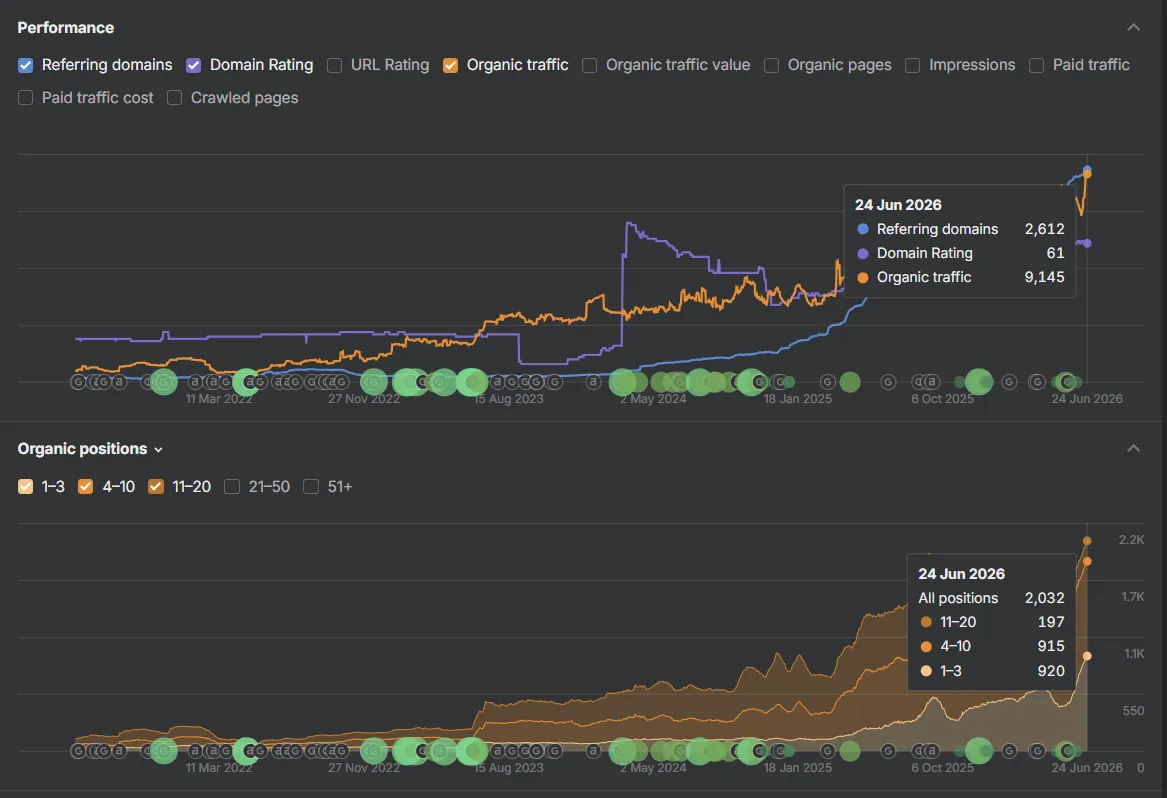
- Traffic: 5,500 → 8,271 (+50%)
- Keywords in top 3: 335 → 920 (+175%)
- Referring domains grew to 2,612
- Performance improved through every algorithm update — each update narrowed the path toward exactly what we were building
The Outcome
| Metric | Start | Current (24 months) | Change |
|---|---|---|---|
| Organic Traffic | 3,456/mo | 8,271/mo | +139% |
| Top 3 Keywords | 50 | 920 | +1,740% |
| Top 10 Keywords | 201 | 1,374 | +583% |
| AI Overview Citations | 0 | 109 | New signal |
| Total AI Citations | 0 | 283 | 6 platforms |
| AIO Search Queries | 0 | 693 | 175 pages |
| Referring Domains | 255 | 2,612 | +923% |
| Engagement Tier | Growth | Advisory | Budget expanded every quarter |
| Algorithm Updates | — | 7 | Performance improved through each |
What the numbers don’t show
- The brand now appears in AI Overviews for competitor-name queries. When someone searches for a competing manufacturer in this space, AI platforms reference our client as an alternative. That’s competitive displacement at the AI layer — driven by the same editorial authority that drives traditional rankings.
- The keyword profile consolidated. Total organic keywords shifted from high-volume, low-position rankings to concentrated top-3 visibility. The site shed page 5+ positions and focused visibility where it converts.
- Commercial keywords dominate the top positions. The brand now ranks in top positions for high-intent queries across its core product categories — the queries that drive device sales and subscription sign-ups.
What This Case Study Teaches
The budget expansion is the proof
A sophisticated enterprise team doesn’t consistently grow their investment from Growth to Advisory over two years, quarter over quarter, unless the work is producing tangible, substantial ROI. They have internal data we can’t show — revenue attribution, pipeline metrics, conversion data. They chose to expand because the numbers justified it.
Links are 1%. Strategy is 99%.
Two years of competitive deep dives, anchor architecture, narrative fine-tuning, placement site evolution, and velocity calibration. The placements are the delivery mechanism. The work is everything that determines which sites, which anchors, which pages, at what pace, and why.
Editorial authority translates to AI citation
468 placements on real publisher sites produced 283 AI citations across 6 platforms. The mechanism is editorial consensus — AI models retrieve from the same web that traditional search indexes. Strategic placements on legitimate publishers don’t just build links. They build the retrieval surface that AI systems use to determine what brands to cite.
Consistency creates compounding
Top 3 keywords went from 50 to 920 over 24 months. The curve accelerated, not flattened. Each month of sustained quality pressure widened the competitive gap — and each algorithm update narrowed the path toward exactly what we were building.