
Key Takeaways
- Outsourcing link building is a strategic operations decision, not a cost-cutting shortcut. The question isn’t whether to outsource — it’s how to structure outsourcing so quality scales with volume.
- Our data across 120+ agency partnerships shows a 100% link survival rate at 6 months and 92% at 12 months — but only because we vet publishers the way Google evaluates links: by entity relevance, editorial standards, and content permanence.
- Before outsourcing a single link, your domain needs to pass a readiness test: technical health, heading structure, crawl efficiency, and clear keyword targeting. Links amplify what’s already working — they don’t fix what’s broken.
- The real cost comparison isn’t “outsourced vs. in-house” — it’s the total cost of the link lifecycle: prospecting, negotiation, placement, monitoring, and replacement.
- Success depends on covering enough of your competitive link gap to trigger ranking movement. We call this gap coverage, and it’s the metric that matters more than raw link count.
Table of Contents
- What Outsourced Link Building Actually Means
- When to Outsource (and When Not To)
- The Real Cost Comparison: Outsourced vs. In-House
- What Makes a Link Building Partner Worth Trusting
- Publisher Vetting: How We Evaluate Every Placement
- Link Survival: What Actually Happens After Placement
- The Gap Coverage Model: How Links Create Ranking Movement
- Prerequisites: What Your Domain Needs Before Link Building Works
- Link Types That Matter for Outsourced Campaigns
- Anchor Text Strategy for Outsourced Links
- How to Evaluate an Outsourced Link Building Service
- Red Flags That Reveal Low-Quality Providers
- The Outsourced Campaign Lifecycle
- Reporting, Monitoring, and Quality Control
- Case Study Evidence: What Happens When You Follow the Process
- Related Services
What Outsourced Link Building Actually Means
Outsourced link building is the practice of hiring an external partner — an agency, a specialist team, or a white-label link building provider — to handle the entire backlink acquisition process on your behalf. Link building, in search engine optimization, is the process of acquiring hyperlinks from external websites to your own — and outsourcing it means delegating that process to specialists who do it at scale. That process includes prospecting publisher sites, negotiating placements, creating or commissioning content, securing live links, monitoring link health, and replacing links that don’t meet standards.
This is not the same as buying links from a marketplace. A marketplace gives you a catalog. Outsourcing gives you a campaign.
The distinction matters because Google’s ranking systems evaluate backlinks across multiple dimensions simultaneously. The pagerankNs signal assigns topic-specific authority based on the linking domain’s relevance. The Salient Terms system checks whether the anchor text and surrounding content match the expected term frequencies for your target query. NavBoost tracks whether users who click through from SERPs engage deeply or bounce — and links from irrelevant contexts contribute to the wrong user signals.
An outsourced partner owns all of this. They control the publisher relationship, the editorial context, the anchor distribution, and the long-term maintenance. When it works, it works because the provider has spent years building the infrastructure you’d need years to replicate.
When it doesn’t work, it’s almost always because the provider treats links as a commodity instead of a reputation signal.
When to Outsource (and When Not To)
When Outsourcing Makes Sense
You’ve hit a ranking ceiling. Your on-page optimization is solid, your content covers the topic thoroughly, and your technical SEO is clean — but you’re stuck on page 2. The gap is almost always off-page authority, and more specifically, it’s a link gap measured in quality referring domains.
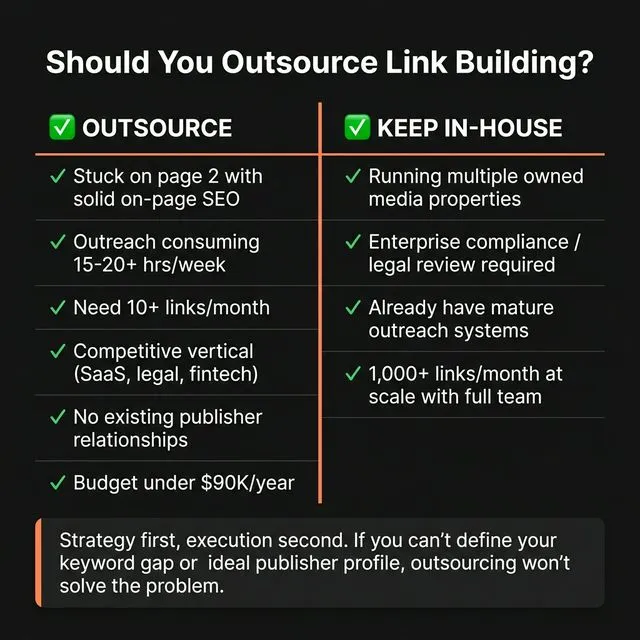
Outreach is consuming disproportionate resources. Building links in-house requires a dedicated team for prospecting, a pipeline for outreach emails, a content operation for guest post creation, and a relationship management system for publisher maintenance. If this infrastructure eats 15–20 hours per week from your team, every hour spent on outreach is an hour not spent on strategy, content, or client delivery.
You need to scale beyond 5–10 links per month. In-house teams hit capacity around this mark. Beyond it, quality degrades unless you add headcount. A specialised link building partner has the publisher relationships, negotiation systems, and editorial workflows to deliver 20–50+ placements monthly without quality degradation.
You operate in a competitive vertical. Industries like SaaS, legal, fintech, and e-commerce demand links from topically relevant, editorially curated domains. These relationships take years to build. An outsourced partner who already operates in your vertical brings pre-established publisher networks that would take 12–18 months and a Senior-tier hire ($72K–$96K/year) to develop internally.
When Outsourcing Is the Wrong Move
You don’t know what you want. If you can’t define your target keywords, your competitive link gap, or your ideal publisher profile, outsourcing won’t solve the problem. You need a strategy first, then execution.
Your domain has fundamental issues. Links amplify signals — they don’t create them. If your pages have crawl errors, thin content, broken heading hierarchy, or JavaScript-rendered content that takes three seconds to load, links will push a broken signal harder. Fix the foundations first.
You’ve chosen the cheapest option available. The lowest-cost providers typically operate with the lowest editorial standards. There is a quality floor in link building, and operating below it creates algorithmic risk that compounds over time. Google’s SpamBrain classifier specifically targets coordinated low-quality link patterns.
The Real Cost Comparison: Outsourced vs. In-House
The standard comparison — “a couple hundred bucks per link from an agency vs. hire someone full-time” — misses the operational reality on both sides. The math is more nuanced than most articles admit.
The Full In-House Cost: What It Actually Takes
The first question is who you’re hiring. Link building talent falls into four tiers, and each has a different cost profile, skill ceiling, and management requirement.
The Four Tiers of In-House Link Builders
| Tier | Profile | Typical Location | Monthly Cost | Annual Cost |
|---|---|---|---|---|
| Junior | Follows established processes, knows good from bad, handles outreach execution | Philippines, Southeast Asia | ~$900 | ~$10,800 |
| Mid-Tier | Creative thinker, experienced with tools, experiments with AI-augmented workflows, can solve problems independently | Eastern Europe | ~$2,500 | ~$30,000 |
| Senior | Extensively experienced, manages campaigns end-to-end, trains others, deep tool expertise across prospecting and analysis | Multiple regions | $6,000–$8,000 | $72,000–$96,000 |
| Artisan | Architect-level operator — the people who typically build agencies instead of working inside them. Extremely rare as hires | N/A — you’re poaching | $8,500+ | $100,000+ |
Most agencies and in-house teams hire at the Junior or Mid-Tier level and pair them with systems. The $90K “link builder” that other articles quote is closer to a Senior-tier hire — and at that price, you’re not getting a process-follower. You’re getting someone who should be designing your entire off-page strategy.
The Toolbox Cost
The link building toolbox has shifted. The legacy stack — Ahrefs, Pitchbox, Hunter.io — still works, but modern operations run leaner.
| Stack | Components | Annual Cost |
|---|---|---|
| Legacy | Ahrefs ($449/mo) + Pitchbox ( | ~$12,000 |
| Modern | Ahrefs ($449/mo) + Claude Code or equivalent AI ($200/mo) + HARO/Connectively ($0–$100/mo) | ~$8,000 |
Either way, you’re looking at roughly $8,000–$12,000 per year in tools — and these costs exist regardless of output volume.
Content Creation Costs
Content creation for guest posts is volume-dependent. Even with highly augmented AI pipelines — RAG systems, multi-skill chains, quality checks — producing genuinely good guest post content costs at minimum $2–$5 per article in raw creation. Then you need an editor.
A decent editor in an affordable location costs $12,000–$20,000 per year. At scale (hundreds of articles per year), the per-article cost stays low — maybe $3–$5 each — but the editor salary is fixed overhead regardless of output.
Ramp-Up Time: The Hidden Cost
If you’ve never built an in-house link building operation, six months is a realistic ramp-up timeline to get the team functioning effectively. Finding the right people, assembling the tools, building the outreach systems, training the team, coaching them through the first campaigns, and making sure everything works together — that doesn’t happen in a quarter.
If you’ve done this before and you’re reassembling (new company, new team, same playbook), two months is realistic — but only if you have an experienced manager running the buildout.
Management Overhead
This scales with ambition. A team of two juniors and a mid-tier builder needs 5–10 hours per week of management. But if you’re targeting 1,000 quality links per month, you need 10 people — or 5 heavily AI-augmented operators with extremely mature systems. Building those mature systems takes a year or more of iteration, after the initial 6-month ramp.
The Real In-House Math
| Configuration | People | Tools | Content/Editor | Total Annual |
|---|---|---|---|---|
| Lean (agency starting out) | 1 Junior ($10.8K) | $8K | $12K editor | ~$31,000 |
| Mid-scale (agency with 20+ clients) | 1 Mid-Tier + 1 Junior ($40.8K) | $8K | $16K editor | ~$65,000 |
| Serious (50+ client campaigns) | 1 Senior + 2 Juniors ($93.6K) | $12K | $20K editor + $5K content | ~$131,000 |
| Enterprise (1,000+ links/month) | Director + 5–10 builders ($250K+) | $15K | $20K+ editor | $285,000+ |
These numbers don’t include ramp-up opportunity cost, management overhead, or the cost of a bad hire (which in link building can mean months of wasted placements on low-quality domains).
The Outsourced Cost
| Package | Monthly Cost | Links Delivered | DR Range | Effective Cost/Link |
|---|---|---|---|---|
| Starter | ~$500 | 3–5 | DR 30–60+ | ~$100–$170 |
| Growth | $1,500–$3,000 | 8–15 | DR 40–70 | ~$170–$350 |
| Scale | $3,000–$6,000 | 15–25 | DR 50–80 | ~$200–$400 |
| Custom/enterprise | $6,000–$12,000+ | 25–50+ | Custom targets | Negotiated |
At $1,500/month outsourced, you’re getting roughly 10 quality links for $18,000/year — less than the cost of one junior link builder plus their tools. At $3,000/month, you’re at 15–25 links for $36,000/year, which is comparable output to a “Lean” in-house team at a higher quality floor, with zero ramp-up time.
You can get 20 outsourced links per month for less than the cost of the single person who would need to operate the equipment if you went in-house.
When In-House Actually Makes Sense
In-house link building makes operational sense in two scenarios:
-
You run a media company. If you operate multiple properties, the publisher relationships, outreach infrastructure, and editorial team serve all your sites. The fixed cost distributes across multiple revenue-generating properties.
-
You’re a large company that requires 100% control over every placement. Enterprise organisations with strict compliance, legal review, and reputational safety requirements sometimes need every link to pass through internal governance. Even then, most large organisations outsource the link building execution while maintaining strategic oversight internally.
For everyone else — agencies, in-house marketing teams, growth-stage companies — outsourcing is the more efficient model. The math doesn’t close for in-house unless you’re building at enterprise scale.
The Hidden Variable: Link Lifecycle Cost
No one talks about what happens after a link goes live. In-house teams rarely have systems for monitoring link health, detecting removals, or negotiating replacements. Outsourced providers — the good ones — build this into their delivery model.
Based on our data across 2,400+ link intelligence reports, approximately 8% of outsourced links require attention at the 12-month mark. The question is whether your provider has the infrastructure and publisher relationships to handle that efficiently, or whether you’re absorbing the cost yourself.
What Makes a Link Building Partner Worth Trusting
They Show the Working
A trustworthy partner can explain why they recommend specific publishers, not just that they have access to them. They should be able to articulate the relevance rationale: why this domain, for this campaign, targeting this keyword cluster.
Google’s entity topicality system evaluates links based on the normalizedTopicality of the linking page’s entity graph. If the linking page’s primary entities don’t relate to your domain’s core topic, the link passes less contextual authority — regardless of the domain’s raw Domain Rating.
A partner who understands this won’t pitch you links on high-DR sites with no topical connection. They’ll show you why the placement makes sense within your entity graph.
They’ve Been Through Cycles
Link building strategies that worked in 2020 may actively harm you in 2026. A partner who’s operated through multiple Google algorithm cycles — including the SpamBrain updates, the Helpful Content Updates, and the Link Spam Updates — has institutional knowledge about what survives and what collapses.
We’ve worked with over 120 agencies across this period. The patterns are clear: campaigns built on editorial integrity outperform those built on volume every single time.
They Have a Quality Floor
Ask any potential partner: “What is the minimum standard a link must meet before you deliver it?”
If they can’t answer with specific criteria — minimum domain rating thresholds, traffic requirements, editorial standards, topical relevance checks — they don’t have a quality floor. They have a price list.
Our quality floor includes:
- Minimum DR threshold per campaign tier
- Real organic traffic on the linking domain (not just DA/DR metrics)
- Topical relevance between the linking page and the target domain
- Editorial content standards (not thin pages stuffed with outbound links)
- Publisher legitimacy verification (real editorial teams, not link farms disguised as blogs)
They Acknowledge Trade-Offs
No link building approach is perfect. Guest posting offers editorial control but takes longer. Niche edits offer speed but less content control. Digital PR generates recognition signals but costs more per placement.
A good partner tells you where each approach works and where it fails. A bad partner promises everything with no constraints.
Publisher Vetting: How We Evaluate Every Placement
The Fast Publisher vs. the Legitimate Publisher
This is the operational reality that separates experienced link builders from beginners: detecting which publishers are legitimate editorial operations and which are opportunistic sites running a link-selling business on the side.
The legitimate publisher cares about their domain’s reputation. They have editorial guidelines, real traffic, a content calendar, and an audience. They’re selective about what they publish because their domain’s value depends on editorial standards.
The opportunistic publisher cares about the transaction. They’ll accept anything for $50–$200, publish it with minimal review, and disappear when it’s time to maintain the content. These are the links that die at the 12-month mark.
How to Tell the Difference
After negotiating with tens of thousands of publishers over the years, the signals become identifiable:
Legitimate publishers:
- Have a visible editorial team or named editors
- Publish consistently (content calendar, not sporadic bursts)
- Reject submissions that don’t meet their standards
- Respond professionally and negotiate reasonably
- Have real organic traffic (verifiable via Ahrefs/Semrush)
- Maintain their content over time (update old posts, remove dead links)
Opportunistic publishers:
- Accept every submission without revision requests
- Respond instantly — no editorial review period
- Have inflated DR relative to actual traffic
- Host content from dozens of unrelated industries on the same domain
- Price aggressively low (under $100 for DA40+ placement)
- Don’t respond to post-placement communication
The Publisher Legitimacy Matrix
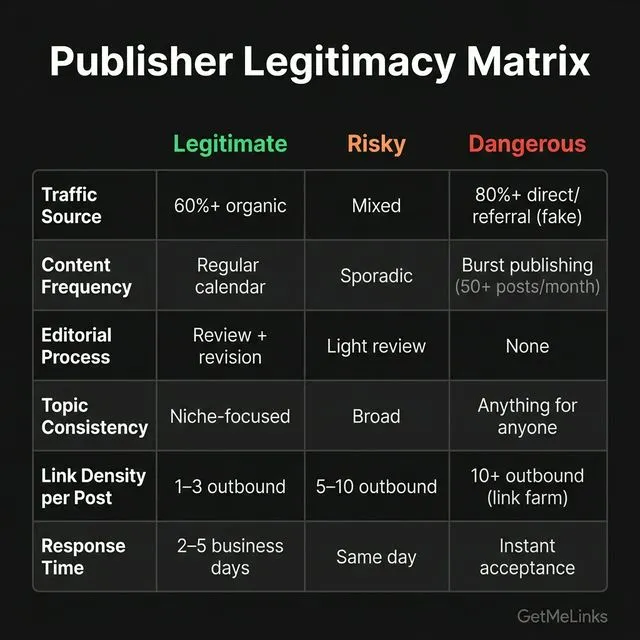
| Signal | Legitimate | Risky | Dangerous |
|---|---|---|---|
| Traffic source | 60%+ organic | Mixed | 80%+ direct/referral (fake) |
| Content frequency | Regular calendar | Sporadic | Burst publishing (50+ posts/month) |
| Editorial process | Review + revision | Light review | None |
| Topic consistency | Niche-focused | Broad | Anything for anyone |
| Link density per post | 1–3 outbound | 5–10 outbound | 10+ outbound (link farm) |
| Response time | 2–5 business days | Same day | Instant acceptance |
Link Survival: What Actually Happens After Placement
This is the data point no competitor publishes. Here’s our current link survival data:
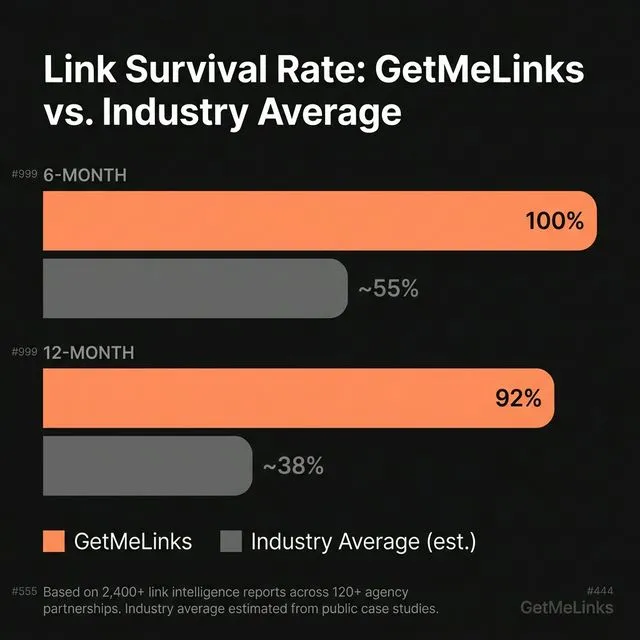
| Timeframe | Survival Rate | What Causes Drops |
|---|---|---|
| 6 months | 100% | Within negotiated guarantee period |
| 12 months | 92% | Content refreshes, publisher decisions |
| 18 months | ~85% (estimated) | Page pruning, domain changes, editorial rewrites |
Why the 8% Drops at 12 Months
After the one-year mark — which is the standard contractual guarantee in professional link building — publishers have full discretion over their content. Three things typically happen:
1. Content refresh. Diligent SEO managers on publisher sites audit all content published in the previous year. If the guest post or editorial placement hasn’t performed (low traffic, low engagement), they may choose to rewrite or consolidate it. If the content you submitted was subpar, this is where it gets cut.
2. Page removal. Some publishers decide to prune pages that don’t contribute to their domain’s topical focus. This is healthy content management on their part, but it means your link disappears.
3. Link removal. The publisher keeps the page but removes the outbound link. This happens when editorial teams tighten their linking policies or when they notice the linked content hasn’t maintained quality.
How We Handle the 8%
Our contractual structure with agency clients includes replacement commitments for links that drop during the campaign period. When a link is removed within the first 12 months, the agency manages the replacement at no additional cost — whether through renegotiation with the publisher or through a new placement of equivalent value.
This is the outsourcing commitment that matters more than any individual metric. Individual links are tactical. The system for maintaining them is strategic.
How to Increase Long-Term Survival
The best defence against link removal is quality at placement:
- Submit genuinely useful content that the publisher’s audience engages with
- Write to the publisher’s editorial standards, not just your own
- Create content that ages well — frameworks and analysis outperform news commentary
- Build the relationship beyond the transaction — publishers who know you maintain your links
The Gap Coverage Model: How Links Create Ranking Movement
Beyond Raw Link Count
The question “how many links do I need?” is the wrong question. The right question is: how much of your competitive link gap do you need to close before Google’s ranking systems respond?
We call this gap coverage.
How Gap Coverage Works
Every keyword you’re targeting has a competitive link environment. The top-ranking pages have a specific backlink profile — certain referring domains, certain domain ratings, certain topical distributions. Your page has its own profile. The delta between these profiles is your competitive link gap.
Ranking movement doesn’t happen linearly. You don’t gain 1 position for every 1 link. Instead, there’s a threshold effect:
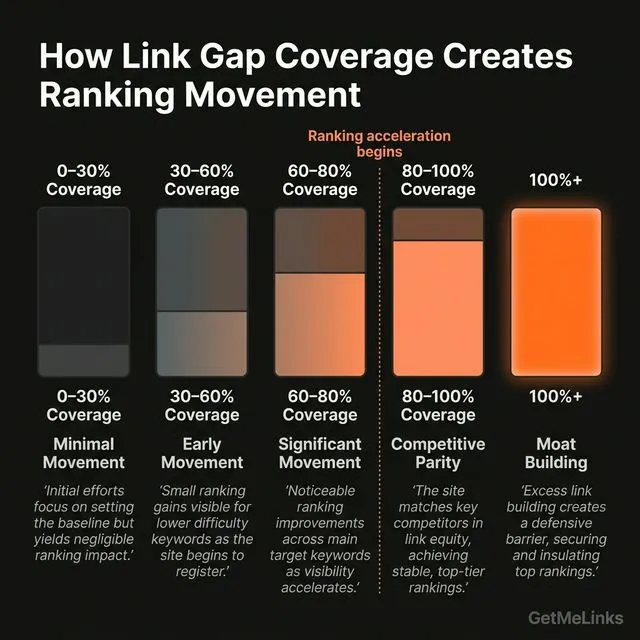
| Gap Coverage | Expected Outcome |
|---|---|
| 0–30% | Minimal ranking movement. Google doesn’t yet see enough off-page consensus to consider your page competitive. |
| 30–60% | Early movement. You may enter the top 20. Google starts weighting your off-page signals, but they’re not decisive yet. |
| 60–80% | Significant movement. Top 10 becomes realistic, especially if your on-page quality exceeds competitors. This is where quality advantages compound. |
| 80–100% | Competitive parity. Rankings are now determined by on-page quality differences, entity authority, and NavBoost signals (user behaviour). |
| 100%+ | You’re outbuilding the competition. Continued investment creates a moat that’s expensive for competitors to close. |
The Conditions for Gap Coverage to Work
Gap coverage assumes your other ranking signals are healthy. If your pages have technical problems, thin content, or poor user experience, closing the link gap won’t override those signals.
The prerequisites (covered in the next section) must be met. Think of it as arithmetic: links are one variable in a multi-variable equation. If the other variables are zero, multiplying by links still equals zero.
What We’ve Seen Across 2,400+ Reports
Our link intelligence reports map these gaps quantitatively. Across 2,400+ reports generated for 120+ agency clients, the pattern is consistent: the biggest ranking gains happen when link building targets the specific topical and authority gaps identified in the report — not when it chases raw volume.
Prerequisites: What Your Domain Needs Before Link Building Works
Links amplify existing signals. If the underlying signals are weak or broken, amplification makes things worse, not better.
Technical Foundation
Your domain must be crawlable and fast. Specifically:
- Page speed: HTML should render in under 2 seconds. Pages buried in JavaScript that require client-side rendering to display content are at a disadvantage because Google’s crawl pipeline processes them differently.
- Crawl efficiency: Clean sitemap, no orphan pages, proper canonicalization, no redirect chains.
- Mobile experience: More than 60% of searches happen on mobile. If your mobile experience is degraded, NavBoost signals from mobile users (stored separately as
mobileSignalsin Google’s systems) will work against you.
Content Quality
The page you’re building links to must be the best answer for its target query. That means:
- Complete heading structure. Your H1, H2, and H3 headings should map to the subtopics Google expects for the keyword. In Google’s ranking systems, headings are vectorised independently (per Patent US11409748B1), which means each heading creates its own semantic signal.
- Entity coherence. The page should have a tight entity graph — every major entity on the page should be semantically connected to the target topic. Entity dilution (introducing unrelated entities) fragments your
normalizedTopicalityscore. - Depth, not just length. An 8,000-word page of surface-level advice will underperform a 5,000-word page with original data, specific frameworks, and expert analysis. Google’s
contentEffortLLM judge evaluates depth of research, specificity of data, and originality of analysis.
Clear Keyword Targeting
Before you outsource link building, you should know:
- The primary keyword and its semantic cluster
- The specific pages you want links pointed to
- The anchor text distribution you’re targeting (more on this in the next section)
- The competitive picture — who ranks and what their link profiles look like
An outsourced partner can help with this analysis, but the strategic decisions should be yours.
Link Types That Matter for Outsourced Campaigns
Not all link types serve the same strategic purpose. A well-designed outsourced campaign uses a mix.
| Link Type | Best For | Typical Cost | Time to Place | Editorial Control |
|---|---|---|---|---|
| Guest posts | Full editorial control, entity building | $200–$800 | 2–6 weeks | High |
| Niche edits (link insertions) | Speed, existing page authority | $100–$500 | 1–2 weeks | Low |
| Digital PR links | Brand signals, high-authority domains | $500–$2,000+ | 4–12 weeks | Medium |
| HARO / journalist queries | Authority domains, E-E-A-T signals | Time + expertise | Variable | Low |
| Resource page links | Topical relevance at scale | $50–$300 | 1–4 weeks | Low |
Strategic Mix Recommendations
For agencies scaling client campaigns: 60% guest posts + 25% niche edits + 15% digital PR. This gives you editorial control (guest posts), speed (niche edits), and authority signals (digital PR).
For in-house teams building domain authority: 40% guest posts + 30% digital PR + 20% HARO + 10% niche edits. Heavier digital PR builds consensus — the state where enough of the internet agrees that your company is the answer.
For competitive verticals (SaaS, fintech, legal): 50% guest posts on niche-relevant sites + 30% digital PR + 20% strategic niche edits. Topical relevance matters more than raw DR in these verticals because Google’s topic-specific PageRank (pagerankNs) weights links from within your vertical more heavily.
Anchor Text Strategy for Outsourced Links
Why Anchor Text Matters More in Outsourced Campaigns
When you build links in-house, you control the anchor text on every placement. When you outsource, anchor text decisions may be shared between you and the provider. This makes explicit anchor strategy critical before the first link is placed.
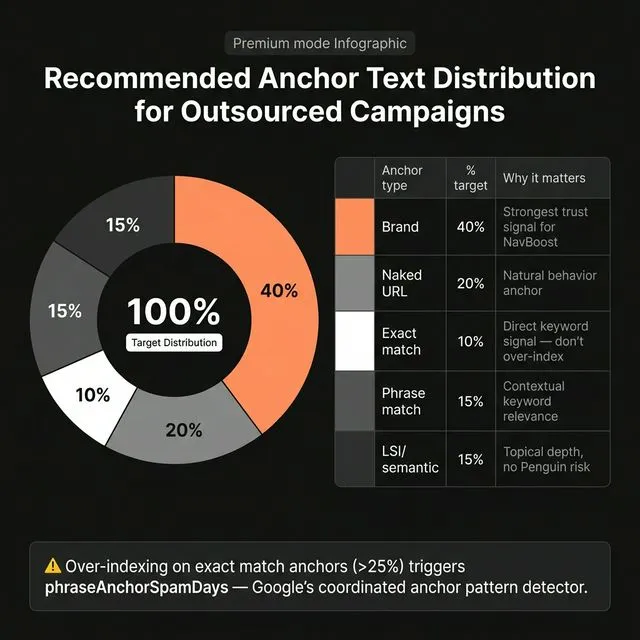
Google’s anchor analysis system evaluates anchors across multiple signals. The context2 hash captures the semantic context surrounding the anchor, not just the anchor text itself. The phraseAnchorSpamDays attribute tracks velocity — how quickly identical anchor phrases appear across new links. And AnchorPhraseSpamInfo detects commercial intent in anchor patterns.
Safe Anchor Distribution
| Anchor Type | Target % | Example |
|---|---|---|
| Branded | 30–40% | “Get Me Links,” “the Get Me Links team” |
| Partial match | 20–30% | “outsource your link building,” “link building partner” |
| URL / naked | 10–15% | “getmelinks.com,” “https://getmelinks.com” |
| Generic | 10–15% | “learn more,” “this resource,” “read the full guide” |
| Exact match | 5–10% | “outsource link building” |
The Velocity Rule
No two links with the same exact-match anchor should appear within the same 30-day window. Google’s phraseAnchorSpamDays attribute specifically tracks this velocity. A burst of identical anchors signals manipulation.
This is one of the operational reasons outsourcing to a partner matters — a professional team manages anchor distribution across the full campaign, not link by link. They see the full picture you can’t see when you’re inside a single placement.
How to Evaluate an Outsourced Link Building Service
The Five-Point Evaluation Framework
Before committing to any provider, evaluate them across these five dimensions:
1. Process Transparency
Ask to see their workflow. A legitimate provider should be able to walk you through:
- How they select publisher sites
- What editorial standards they require
- How they handle anchor text distribution
- What happens when a link is removed
- What their reporting cadence looks like
If they can’t show you the process, they don’t have one.
2. Sample Portfolio
Request 5–10 examples of live placements they’ve delivered for clients in a similar vertical. Check each placement:
- Is the hosting domain’s traffic real? (Verify in Ahrefs or Semrush)
- Is the content actually useful, or is it a thin wrapper for an outbound link?
- Are there other outbound links in the same article? How many?
- Does the domain publish content in your niche, or is it a general “blog” accepting anything?
3. Pricing Structure
Transparent pricing is a trust signal. Be cautious of providers who:
- Won’t share pricing until a sales call
- Offer guaranteed DR placements at suspiciously low prices
- Package links in “tiers” without explaining what changes between tiers
- Charge per link without explaining what’s included (content? outreach? monitoring?)
4. Communication Standards
The cadence of communication reveals the maturity of the operation:
- Weekly updates on campaign progress
- Monthly performance reports with specific metrics
- Quarterly strategic reviews to assess direction
- Clear escalation paths when something goes wrong
5. Contractual Protections
At minimum, your agreement should include:
- A defined link replacement policy (what happens when links drop)
- A minimum link quality standard (DR floor, traffic floor, relevance criteria)
- An anchor text approval process (you approve before placement)
- A clear scope of work (how many links, what type, what timeline)
Red Flags That Reveal Low-Quality Providers
They Guarantee Specific Metrics
“We guarantee DA50+ links” is a red flag. Domain Authority and Domain Rating are third-party metrics that can be inflated through PBN networks and spam. A legitimate link building provider guarantees quality standards, not metric thresholds.
They Can’t Explain How They Get Placements
If the answer to “how do you get links?” is vague — “we have a network” or “we have publisher relationships” — press deeper. Ask specifically: “Walk me through how you’d place a link for a client in the [X] industry.” If they can’t articulate the process, the “network” may be a PBN or a link farm disguised as a media network.
Their Response Time Is Suspiciously Fast
Legitimate editorial processes take time. If a provider promises placement within 24–48 hours, they’re either inserting links into content they control (not editorial) or they have pre-arranged relationships that prioritise speed over quality.
They Sell Links by the Metric
“$200 for a DA40 link, $400 for a DA60 link” is commodity pricing. It treats links as interchangeable units differentiated only by a single metric. In reality, a DA40 link from a topically relevant domain with real traffic is worth more than a DA60 link from a general blog with inflated metrics.
They Don’t Ask About Your Business
A provider who never asks about your keyword targets, competitive position, existing link profile, or content strategy is not building a campaign. They’re fulfilling an order. Campaign-level thinking requires understanding the context.
The Outsourced Campaign Lifecycle
A properly executed outsourced link building campaign runs in four phases across a minimum of six months. Each phase has distinct deliverables, and progress is measured against the gap coverage model — not by a raw link count. Campaigns that skip the foundation phase and go straight to link placement consistently underperform because they’re building without a map.
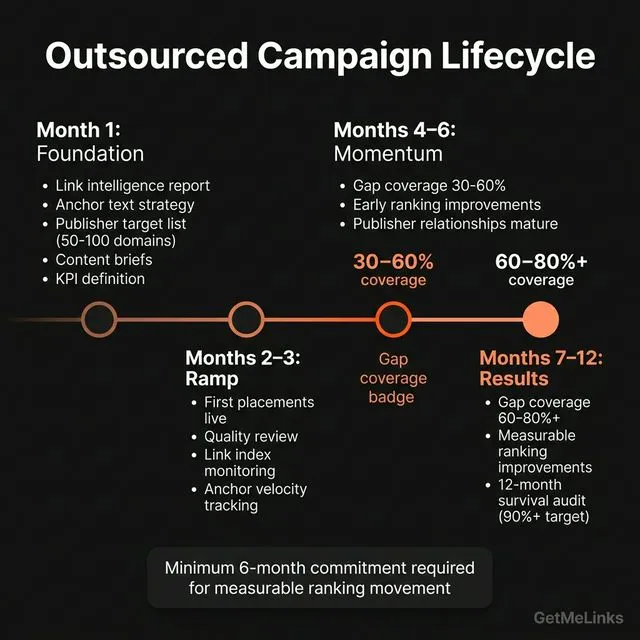
Month 1: Foundation
- Link intelligence report: Map the competitive link gap for each target page
- Anchor text strategy: Define the distribution before any links are placed
- Publisher target list: Identify 50–100 relevant domains, vetted against the legitimacy matrix
- Content briefs: Create editorial briefs for guest post content that serve the publisher’s audience, not just your SEO goals
- KPI definition: Agree on measurable success metrics (referring domains gained, ranking movement, traffic impact)
Months 2–3: Ramp
- First placements start going live
- Quality review of every delivered link (publisher check, content quality, anchor accuracy)
- Begin monitoring link index status
- Adjust publisher targets based on early results
- Track ranking signals — not expecting top 5 yet, but watching for directional movement
Months 4–6: Momentum
- Gap coverage reaches 30–60% for primary targets
- Early ranking improvements visible (page 3 → page 2, or page 2 → top of page 2)
- Publisher relationships mature — repeat placements become possible
- Content quality improves as you and the provider find editorial rhythm
- First link survival audit at the 6-month mark (should be 100%)
Months 7–12: Results
- Gap coverage at 60–80%+ for primary targets
- Measurable ranking improvements and organic traffic growth
- Strategic review: double down on what’s working, prune what isn’t
- 12-month link survival audit (target: 90%+)
- Decision point: continue, scale up, or shift to maintenance mode
Commitment Minimum
Link building campaigns need a minimum 6-month commitment to produce meaningful results. Shorter timelines don’t allow enough time for Google to crawl, index, and weight the new link signals, and they don’t include enough data to evaluate link quality or campaign effectiveness.
Reporting, Monitoring, and Quality Control
What Good Reporting Looks Like
Every report from your outsourced partner should include:
| Metric | Why It Matters |
|---|---|
| Links placed (with URLs) | Verify each placement exists and meets quality standards |
| Referring domains gained | Net new domains, not just total links |
| Anchor text distribution | Check against the agreed strategy — catch over-optimisation early |
| Domain rating/authority of placements | Quality verification at the domain level |
| Traffic of linking domains | Ensures placements are on real sites, not metric-inflated shells |
| Index status | Confirm Google has crawled and indexed the linking page |
| Ranking changes (target keywords) | Directional indicator — not the only success metric, but important |
Your Own Quality Checks
Don’t outsource quality control. Even with a trusted partner, every link should pass your own evaluation:
- Visit the page. Is the content actually useful? Would you share it with a colleague?
- Check the domain. Is there real organic traffic? Is the domain topically relevant?
- Count the outbound links. If the page has 15+ outbound links, the link value is diluted through PageRank distribution.
- Verify the anchor. Is it what was agreed? Is it natural within the content?
- Check periodically. Set a 90-day reminder to verify each link is still live.
Case Study Evidence: What Happens When You Follow the Process
Our latest two case studies demonstrate what outsourced link building looks like when the entire framework — publisher vetting, anchor strategy, gap coverage, and quality monitoring — operates together.
Both campaigns followed the same structure: link intelligence report first, then strategic anchor distribution, then phased outreach with monthly quality reviews. The results differed in timeline (different competition levels) but followed the same pattern: slow initial movement, then compounding returns once gap coverage exceeded 60%.
We’ve published these case studies with verified Google Search Console data — not estimated traffic figures from third-party tools. The full case studies are available here.
Related Services
- White Label Link Building — our full white-label program for agencies
- Link Building Services — direct campaign management
- Engagement Tiers — Foundation, Growth, Partnership, and Advisory tiers